YOUR REPORTS GET IGNORED BECAUSE THEY’RE BUILT BACKWARDS
The SAINT Reporting Framework by Trust Insights
You spend hours pulling data, building charts, and writing up findings. Your stakeholders skim past everything and ask, “So what should we do?” The problem isn’t your data — it’s the structure. Most reports bury the important parts under pages of metrics nobody asked for. By the time you get to the recommendation, your audience has already checked out.
The SAINT Reporting Framework fixes this by structuring every report around what stakeholders actually need: Summary, Analysis, Insights, Next Steps, and Timeline. Lead with the conclusion. Back it up with data. Explain why it happened. Tell people what to do. Give them a deadline. Five sections, in that order, every time.
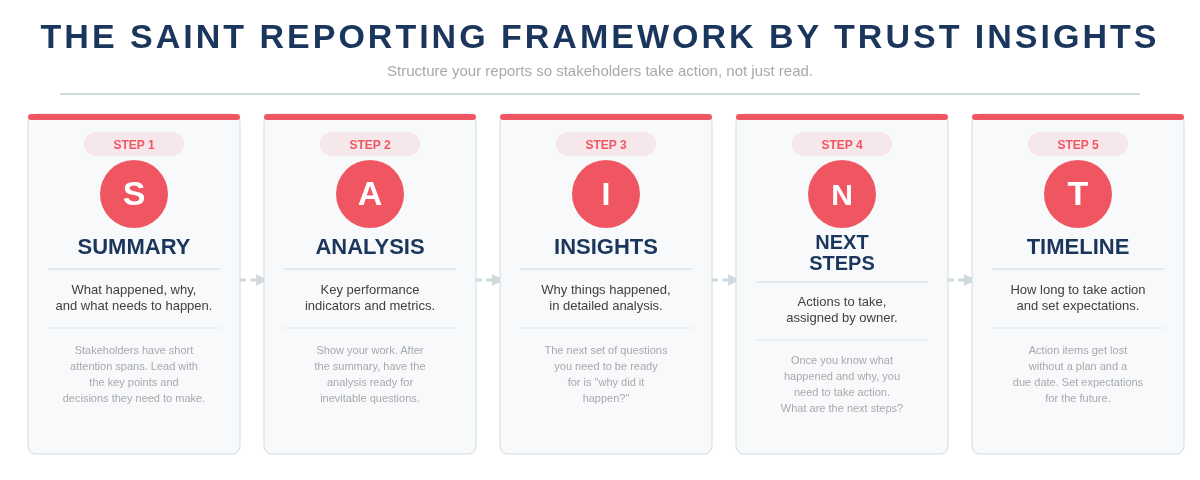
THE FIVE SECTIONS
S — SUMMARY
What happened, why, and what needs to happen. This is the most important section of your report and it goes first — not last. Your stakeholders are busy. They have a short attention span. Lead with the key points and the decisions they need to make. If they read nothing else, the summary should give them everything they need to act.
Think of it as the executive briefing: here’s what happened, here’s why it matters, here’s what we recommend. If you can’t summarize your report in a few sentences, you don’t understand it well enough yet.
Ask yourself: Could a stakeholder read just your summary and know exactly what happened and what they need to decide?
A — ANALYSIS
Key performance indicators, focused on what you and your team did. Show your work. After the summary, have the analysis ready for the inevitable questions about what happened. This is where your charts, tables, and metrics live. Focus on the KPIs that actually matter and present them with context — not just numbers in a vacuum.
A number without context is meaningless. “We had 10,000 website sessions” tells your stakeholder nothing. “Website sessions increased 23% month-over-month, driven by organic search growth from our new content strategy” tells them something they can work with.
Ask yourself: Are you showing the metrics that actually matter, or just the ones that are easy to pull?
I — INSIGHTS
Why things happened, in detailed analysis. The next set of questions you need to be ready for is “why did it happen?” Insights go beyond the data to explain causes. This is where you connect the dots between what you measured and what drove those results.
Analysis tells you what happened. Insights tell you why. This distinction is critical. Anyone can report that traffic went up 23%. It takes expertise to explain that the increase came from a specific set of long-tail keywords your new blog posts are ranking for. Insights are where you demonstrate your value.
Ask yourself: Have you answered “why” for every major result, or are you just reporting numbers without context?
N — NEXT STEPS
A list of what actions to take — by owner. So what? Once you know what happened and why it happened, you need to take action. What are the next steps? This is the section that turns a report from a document into a decision-making tool.
Every action item needs an owner. Unowned tasks don’t get done. Be specific: “Improve SEO” is not a next step. “Katie to publish three blog posts targeting [specific keywords] by end of month” is a next step. If a task doesn’t have a name next to it, it’s a wish, not a plan.
Ask yourself: Does every next step have a clear owner, and would that person know exactly what to do?
T — TIMELINE
How long do people have to take action, and set expectations for the future. Action items will get lost on an endless backlog unless there is a plan and a due date. The Timeline section is what keeps your recommendations from disappearing into the void after the meeting ends.
Make the most of your insights and actions by setting concrete deadlines and expectations for follow-up. When will you check in on progress? When should stakeholders expect to see results? A report without a timeline is just a snapshot. A report with a timeline is a plan.
Ask yourself: Does every action item have a deadline, and have you set expectations for when stakeholders will see results?
GO DEEPER
Download the complete SAINT reporting guide. Use it as a checklist every time you build a report for stakeholders.
The SAINT Reporting Framework
The complete guide to structuring stakeholder reports. All five sections explained with self-check questions and a key principle to keep your reports focused.
 Newsletter
 Podcast