YOU DON’T HAVE A STRATEGY. YOU HAVE A LIST OF TACTICS.
The STEM Marketing Strategic Framework by Trust Insights
In business, few words are so misunderstood as “strategy.” Teams call their to-do list a strategy. They call their channel mix a strategy. They call their content calendar a strategy. None of those things are a strategy. A strategy is why you’re doing what you’re doing and what you’re trying to achieve. Everything else — the channels, the content, the campaigns — are tactics in service of the strategy.
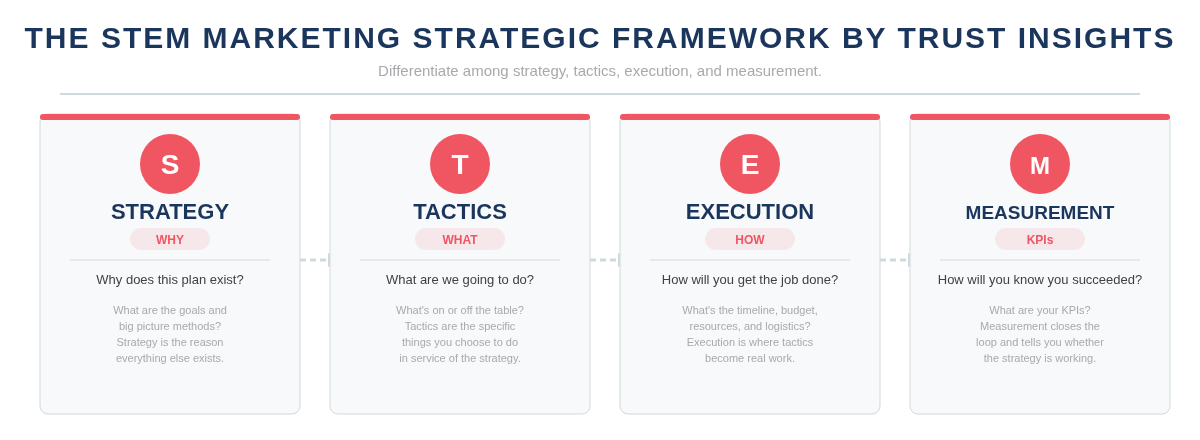
The STEM framework helps clear up the confusion and gives marketers at any level a shared vocabulary: Strategy (Why), Tactics (What), Execution (How), and Measurement (KPIs). All great marketing plans STEM from the same fundamentals. If you can’t clearly separate these four components in your own plan, your plan has a structural problem.
THE FOUR COMPONENTS
S — STRATEGY WHY
Why does this plan exist? What are the goals and big picture methods? Strategy is the reason everything else exists. It defines why you’re doing what you’re doing, what you’re trying to achieve, and the high-level approach you’ll take to get there. Without a clear strategy, tactics are random activities with no direction.
A strong strategy answers the question “why” at every level. Why this market? Why this audience? Why this approach? If your marketing plan doesn’t start with a clear articulation of the business goal it serves and the strategic approach you’ll take to reach it, everything downstream is guesswork.
Ask yourself: Can you explain in one sentence why this marketing plan exists and what business goal it serves?
T — TACTICS WHAT
What are we going to do? What’s on or off the table? Tactics are the specific things you choose to do in service of the strategy. Email marketing, SEO, paid social, events, content marketing, influencer partnerships — these are all tactics. The key word is “chosen.” Deciding what NOT to do is just as important as deciding what to do.
This is where most teams spend all their time — and where confusion with strategy begins. Tactics aren’t strategy. They’re the activities you’ve chosen because they serve the strategy. If someone asks “what’s your strategy?” and you answer with a list of channels and campaigns, you’ve just described your tactics.
Ask yourself: Can you list your tactics and explain how each one directly supports the strategy?
E — EXECUTION HOW
How will you get the job done? What’s the timeline, budget, and resources? Execution is where tactics become real work. This is the project plan: who does what, by when, with what budget, using what tools. Most marketing plans fail here — not because the strategy was wrong, but because execution was under-resourced or poorly managed.
A brilliant strategy with poor execution delivers nothing. A mediocre strategy with excellent execution at least delivers results you can learn from. If your plan doesn’t include named owners, concrete deadlines, realistic budgets, and the tools and resources each tactic needs, you don’t have an execution plan — you have a wish list.
Ask yourself: Does every tactic have a named owner, a deadline, a budget, and the resources it needs to succeed?
M — MEASUREMENT KPIs
How will you know you’ve succeeded? What are your KPIs? Measurement closes the loop. It tells you whether the strategy is working, which tactics are performing, and where execution needs adjustment. Define your KPIs before you start — not after. If you can’t measure it, you can’t manage it.
Good measurement doesn’t just track activity — it tracks outcomes. Sending 10 emails is activity. Generating 50 qualified leads from those emails is an outcome. Every KPI should ladder up to the strategic goal. If a metric doesn’t help you understand whether the strategy is working, it’s a vanity metric.
Ask yourself: Have you defined specific, measurable KPIs for each tactic, and do they ladder up to the strategic goal?
GO DEEPER
Download the complete STEM strategic framework guide. Use it as a reference every time you build or evaluate a marketing plan.
The STEM Marketing Strategic Framework
The complete guide to differentiating strategy from tactics. All four components explained with self-check questions and a key principle for building better marketing plans.
 Newsletter
 Podcast