YOUR AI ISN’T UNDERPERFORMING. YOUR PROMPTS ARE.
The RAPPEL AI Prompt Framework by Trust Insights
Most people type a single sentence into ChatGPT, Claude, or Gemini and wonder why they get generic output. The problem isn’t the model — it’s that you’re skipping steps that matter. Non-reasoning models don’t build their own chain of thought. They need you to structure the conversation, provide the right context at the right time, and guide them toward the output you actually want.
RAPPEL is a multi-turn prompting framework that gives you six steps to follow every time you prompt a non-reasoning model: Role, Action, Prime, Prompt, Evaluate, Learn. It supersedes the RACE and PARE frameworks and works with any standard AI model. The key difference? RAPPEL is a conversation, not a one-shot prompt. You prime the model first, wait for its response, and then deliver your full prompt with the context it needs.
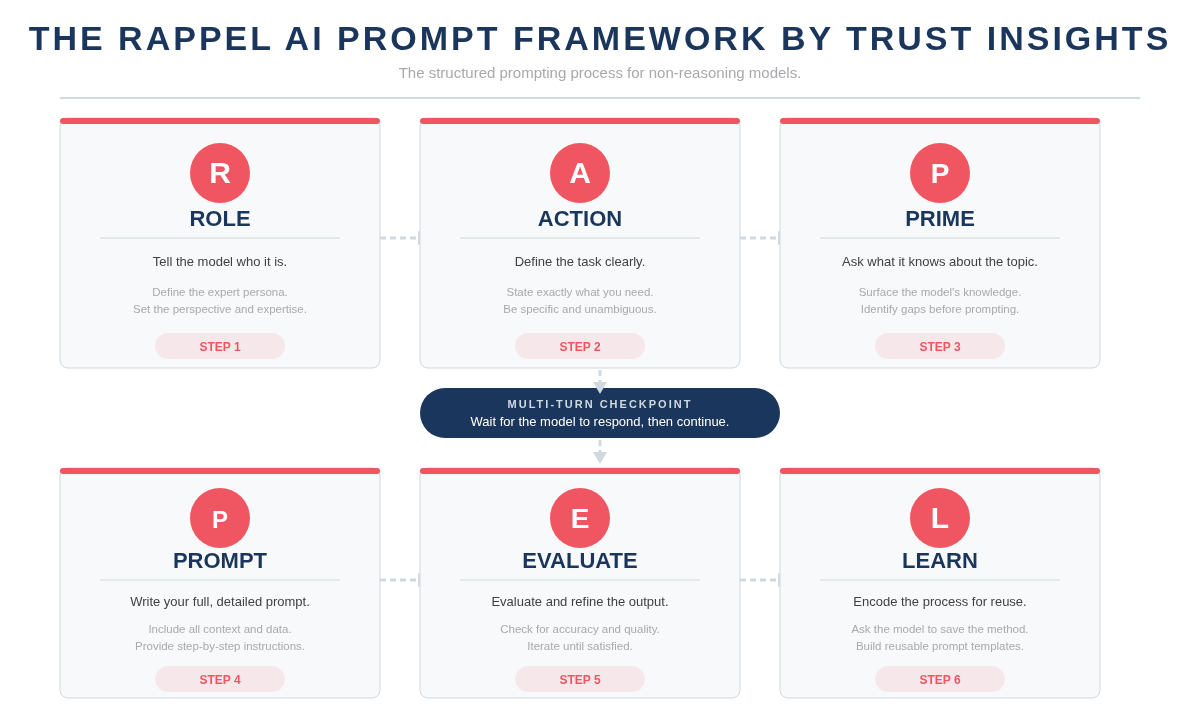
THE SIX STEPS
R — ROLE
Tell the model who it is. Before anything else, define the expert persona the model should adopt. A marketing analyst thinks differently than a financial advisor, even when looking at the same data. Setting the role up front frames the perspective, vocabulary, domain expertise, and communication style for everything that follows.
Be specific. “You are a marketing expert” is vague. “You are a B2B SaaS marketing strategist with 15 years of experience in demand generation and account-based marketing” gives the model a much sharper lens. The more precisely you define the role, the more targeted and relevant the output.
Ask yourself: Have you clearly defined who the model should be and what expertise it should bring?
A — ACTION
Define the task clearly. State exactly what you need the model to do. Be specific, unambiguous, and direct. A well-defined action prevents misinterpretation and wasted iterations. “Help me with email” is not an action. “Write three subject line variants for a product launch email targeting enterprise CTOs” is.
The Action step tells the model what task it’s performing — not how to perform it (that comes later in the Prompt step). Think of it as the assignment headline. Clear actions lead to clear outputs.
Ask yourself: Could the model complete the task from your description alone, without asking follow-up questions?
P — PRIME
Ask what it knows about the topic. This is the step most people skip, and it’s the one that makes the biggest difference. Before providing your full prompt, ask the model what it already knows about the subject. This does two things: it surfaces the model’s existing knowledge so you can see what’s accurate and what’s not, and it reveals gaps you need to fill with your own context.
After you send the Prime question, wait for the model to respond. Read what it says. Then, in your next message, provide your full prompt — correcting any mistakes, filling in gaps, and adding the specific context the model needs. This two-turn approach is what separates RAPPEL from single-shot prompting frameworks.
Ask yourself: Have you checked what the model already knows before loading it with instructions?
MULTI-TURN CHECKPOINT
Wait for the model to respond to your Prime question. Read its answer. Then continue.
P — PROMPT
Write your full, detailed prompt. Now that you’ve seen what the model knows (and doesn’t know), write the complete prompt. Include all context, data, constraints, examples, and step-by-step instructions. This is where you provide everything the model needs to produce the output you want.
Unlike reasoning models, non-reasoning models benefit from explicit instructions. Tell them how to structure the output. Tell them what tone to use. Tell them what to include and what to leave out. The more specific your prompt, the closer the output matches your expectations on the first try.
Ask yourself: Does your prompt include all the context, data, and instructions the model needs to produce the output you want?
E — EVALUATE
Evaluate and refine the output. Don’t accept the first response as final. Review the model’s output critically. Check for accuracy, completeness, tone, and quality. Ask the model to revise, expand, or correct specific parts. Iterate until you’re satisfied with the result.
The Evaluate step is where most of the real value gets created. Your first output is a draft. Good prompting is a conversation, not a transaction. Each round of feedback makes the output sharper, more accurate, and more useful.
Ask yourself: Have you reviewed the output against your original requirements and refined where needed?
L — LEARN
Encode the process for reuse. Once you have output you’re happy with, don’t just close the window. Ask the model to document the method, create a reusable prompt template, or summarize what worked well in this interaction. This turns a one-time conversation into a repeatable process you can share with your team.
The Learn step is what separates professionals from casual users. Over time, you build a library of tested, refined prompts that consistently produce quality results — instead of starting from scratch every time.
Ask yourself: Have you captured what worked so you or your team can reuse this process?
RAPPEL vs PRISM
Different models need different prompting structures.
| RAPPEL | PRISM | |
|---|---|---|
| Best for | Non-reasoning models (ChatGPT, Claude, Gemini standard, Llama, Mistral) | Reasoning models (Deepseek, Gemini Flash Thinking, OpenAI o1/o3, Claude extended thinking) |
| Approach | Spell out step-by-step instructions. Prime the model first, then provide full context. Multi-turn conversation. | Give a starting point, an ending point, and context. Let the model reason its own path. |
| Structure | 6 steps: Role, Action, Prime, Prompt, Evaluate, Learn | 3 components: Problem, Relevant Information, Success Measures |
| Key difference | You define both what to do and how to do it. The model executes your instructions. | You define what to think about. The model decides how to think about it. |
Using a reasoning model? See the PRISM Framework →
GO DEEPER
Download the complete RAPPEL prompting guide. Use it as a reference every time you work with a non-reasoning model.
The RAPPEL AI Prompt Framework
The complete guide to prompting non-reasoning models. All six steps explained with self-check questions and a cross-reference to PRISM for reasoning models.
 Newsletter
 Podcast