YOU DON’T KNOW WHO’S READING THIS
The Transmedia Content Framework by Trust Insights
Most content operations are built on an assumption about the reader that nobody has checked in years. That assumption is the expensive part. In 2026, on the Trust Insights website, crawler and AI-agent traffic outnumbers human traffic by a wide margin — only a small fraction of requests resolve to an actual person on the page. Your numbers will be different from ours. The point is that you should know them, and most teams don’t.
The idea underneath this framework hasn’t changed since we published it in 2020: one idea, told across many media, each version built for whoever is actually consuming it at that destination. Our blog and our newsletter carry the same words to opposite audiences, and they should not be written the same way. Content repurposing isn’t new either — Todd Defren called it “content atomization” in 2008. What changed is the cost of converting between formats, which used to be most of the work and now is almost none of it. That shifts the whole job from production to judgment: Review, Extract, Multiply, Index, Examine. Five stages. One loop. Not a checklist.
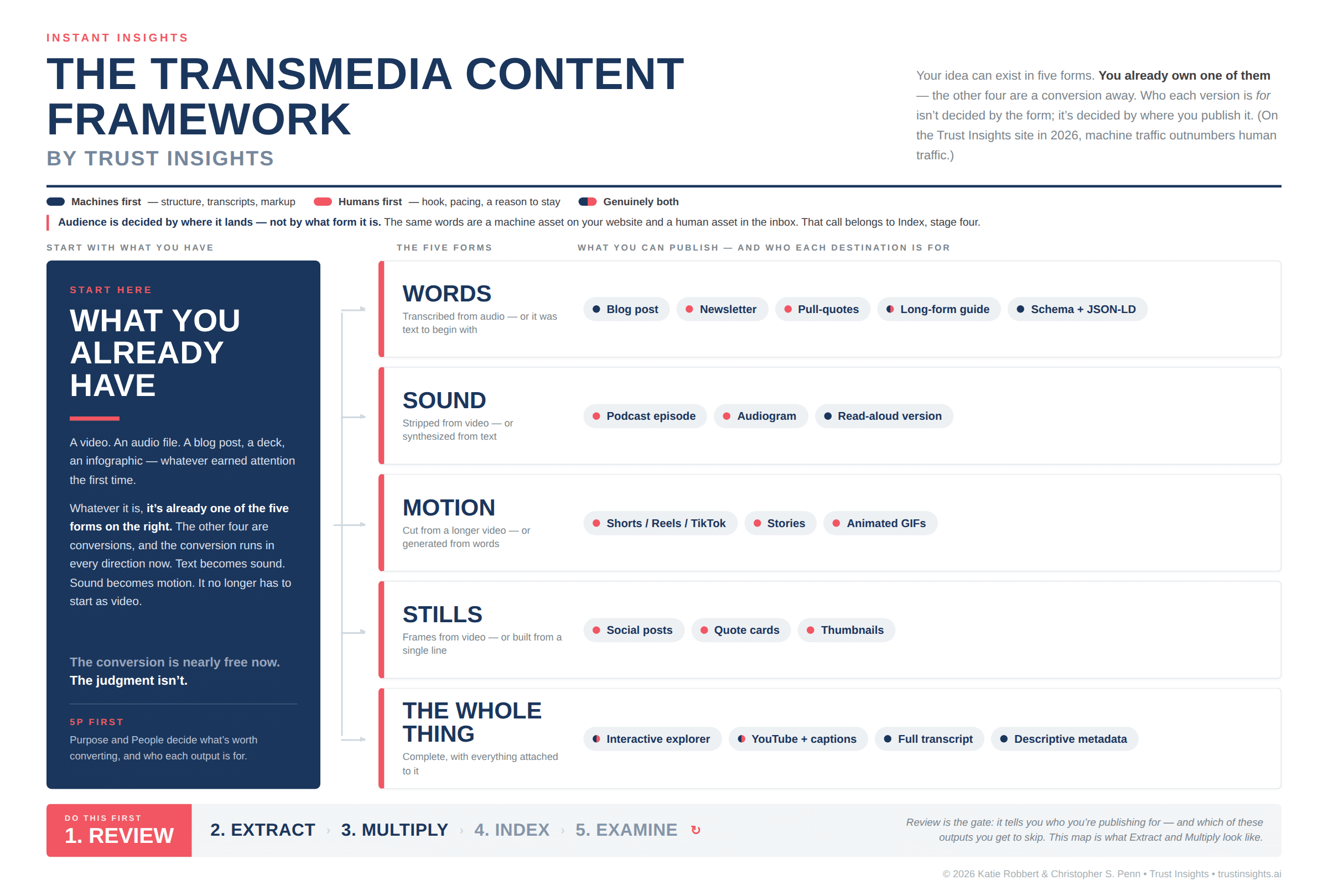
The map at full size — click to enlarge. Or explore it section by section further down the page.
WHAT CHANGED — AND WHAT DIDN’T
The foundation held. The physics underneath it didn’t.
| 2020 | 2026 | |
|---|---|---|
| The foundation | One idea, told across many media, each version built for whoever is actually consuming it. | Unchanged. This is the part that was always true. The 2020 version just didn’t say it out loud — it described the tooling of the moment and let you infer the rest. |
| Source format | Video, because video was the only format rich enough to split apart — sound, moving pictures, and words in one file. | Anything. An infographic becomes a blog post. The post reads itself aloud. The audio becomes a video. The arrow points every direction now. |
| The audience | People, distributed across channels. Optimize for attention and reach. | People and machines — but split by destination, not by channel type. In 2026 our website is read mostly by machines while our newsletter goes almost entirely to people. Measure each destination separately and write separate requirements for each. |
| The bottleneck | Production. Cutting, transcribing, editing, and reformatting each derivative by hand. | Judgment. The conversion is nearly free, so the expensive question is which conversions are worth publishing and to whom. |
| Where to start | Pick your best video and atomize it. | Pull your logs and find out who’s actually reading. Then run it through the 5P Framework by Trust Insights™ before you convert anything. |
Not sure whether your audience is a person or a process? Start with the 5P Framework →
THE FIVE STAGES
1. REVIEW — Decide Who This Is For
Start with data, not ambition. Pull your server logs and your analytics and find out what share of your traffic is human and what share is machine. Then look at the content you already own and ask which pieces earned attention the first time. You are not looking for volume. You are looking for the handful of assets that already proved they work, because those are the only ones worth multiplying.
This is a 5P problem before it’s a content problem. Purpose: humans, machines, or both — and if both, write separate requirements for each. People: which humans, and which machines? The assistants, crawlers, and answer engines that matter to your buyers don’t all want the same things, and the roster of which ones matter changes yearly. Do this honestly and you may conclude that half of what follows doesn’t apply to you. That’s a good outcome. The most expensive content operation is the one you built because everyone else was building one.
Ask yourself: Do you know what percentage of your website’s traffic is a machine, or are you assuming it’s people?
2. EXTRACT — Break the Source Into Raw Components
Your idea can exist in five forms — words, sound, motion, stills, and the whole thing intact — and you already own one of them. Extraction is the work of getting to the other four. A recorded video yields a transcript, an audio track, still frames, and clips. A blog post yields claims, examples, and a structure that a model can read aloud. Whichever form you started in, the conversion now runs in every direction. It is also mechanical work, which makes it exactly the work you should not be doing by hand.
Transcription, scene detection, and clip selection are solved problems. Here’s our 2026 version of it, as a worked example rather than a prescription: an SRT captions file goes through custom Python that finds the strongest 30-to-60-second segment, calls FFmpeg to cut it, and hands a local model the transcript to clean up — roughly forty unattended minutes on a laptop, with no cloud inference required. You set up the pipeline once. After that it’s a scheduled task, not a to-do item.
Ask yourself: How much of your team’s content time is spent on work a script could do while nobody watches?
3. MULTIPLY — Convert Any Component Into Any Format
This is the stage that changed. Text becomes audio through a text-to-speech model. Audio becomes video through an avatar or an audiogram. Video becomes vertical clips. An infographic becomes a blog post; the blog post becomes a podcast episode; the episode becomes fifteen social posts. There is no privileged source format anymore, which means the question is no longer “can we convert this?” but “which conversions are worth publishing?”
One conversion works differently from the rest. An interactive — a simple page someone clicks around in — can’t be extracted from a source, because the branching wasn’t in the source; it’s the one output you build rather than divide out. It’s also the rare format that needs no separate machine version: it’s already text and structure, so a person clicks through it and a crawler reads all of it on the first pass. And it’s the only output that tells you what people actually cared about.
If you already produce video, that’s still the highest-yield path: record once, and the recording feeds YouTube, the podcast networks, the blog post, and the social clips. It’s the route Trust Insights runs every week. The difference between 2020 and now is that four of those five steps run without a human touching them. And the tools are not the hard part — free and near-free options cover almost every conversion you need.
Ask yourself: What’s the one asset you own that deserves to exist in five formats instead of one?
4. INDEX — Make Each Output Legible to Its Audience
A converted file is not a published asset, and this is the stage where you decide who each one is for. Audience is not a property of the form — it is a property of the destination. The same paragraph is a machine asset on your website and a human asset in the inbox. Our blog is read overwhelmingly by crawlers and agents; our newsletter goes to people who chose to hear from us. Same words, opposite finishing. Machines want structure, in whatever form the current conventions take — as of 2026 that means clean schema markup, JSON-LD, full transcripts, closed captions, descriptive metadata, and inverted-pyramid writing that puts the claim before the context. The conventions will change. The requirement to meet them won’t. Humans want a hook in the first three seconds, pacing, and a reason to stay.
Which means the sorting happens by channel, not by format. Publishing the same file to every destination and hoping is the most common failure in this entire process. Schema generation, caption cleanup, alt text, and metadata are near-zero-cost now, so there’s no excuse for skipping them where they belong. The judgment call — which destination gets which treatment — is still yours, and it comes straight out of the People answer you wrote in Review.
Ask yourself: Do you write your newsletter and your blog posts the same way — even though one goes to a person who opted in and the other goes to a crawler?
5. EXAMINE — Measure the Split and Loop Back
Measure separately. Human engagement and machine consumption are different questions with different metrics, and averaging them together tells you nothing. Watch whether your content shows up in AI answers and citations. Watch whether the humans you care about are opening the email. Anomaly detection and automated reporting mean you spend your time on the decision instead of on the dashboard.
Then take what you learned and go back to Review, because the answer changes — and it changes faster than your content calendar does. This framework is a loop, not a checklist. What AI does not do is tell you which number mattered. That’s Purpose, and Purpose is yours. The tools got cheap. The judgment didn’t.
Ask yourself: If your website traffic doubled next quarter and all of the growth was machines, would you call that a win?
GO DEEPER
Download the complete framework. Bring it to your next content planning meeting and use it to decide what gets remixed, into what, and who it’s actually for.
The Transmedia Content Framework
One page. All five stages, the questions to ask at each one, and the five forms your idea can take. Current as of 2026.
Download PDFInteractive
Explore the Framework
Your idea can exist in five forms, and you already own one of them. Click any form to see what you can publish from it and who each destination is actually for. Then click a stage to see the work involved.
Audience is decided by where it lands — not by what form it is. The same words are a machine asset on your website and a human asset in the inbox.
The Five Forms
Words Transcribed from audio — or it was text to begin with 5 outputs
The most portable form, and the one most likely to be read by something that isn’t a person. Words are also where the destination split shows up most sharply: the same three paragraphs are a crawler’s meal on your blog and a subscriber’s morning read in the inbox. Write them differently.
- Blog post → your website. Read overwhelmingly by crawlers and agents. Inverted pyramid, claim before context.
- Newsletter → the inbox. A person who opted in. Voice, hook, and a reason to keep reading.
- Pull-quotes → social. One idea, no context required.
- Long-form guide → on-site or gated. Humans download it; machines index it.
- Schema + JSON-LD → the page itself. Written for machines exclusively.
Sound Stripped from video — or synthesized from text 3 outputs
Sound used to require a recording session. It doesn’t anymore — a text-to-speech model turns any post into listenable audio in about the time it takes to paste it. Which means the interesting question isn’t whether you can make audio, it’s whether anyone wants to listen to that particular thing.
- Podcast episode → the audio networks. People who chose to subscribe.
- Audiogram → social feeds. Audio made scrollable.
- Read-aloud version → a machine-facing channel. Synthetic narration published mainly to be ingested, not enjoyed.
Motion Cut from a longer video — or generated from words 3 outputs
The most human-weighted form on the list. Every destination here is an algorithmic feed serving actual people, which means the first three seconds do more work than everything after them. Motion is also the most automatable: finding the strongest sixty seconds of a recording is a solved problem.
- Shorts / Reels / TikTok → short-form platforms. Vertical, captioned, hook first.
- Stories → social. Ephemeral, low production, high frequency.
- Animated GIFs → social and email. One beat, looping.
Stills Frames from video — or built from a single line 3 outputs
The cheapest form to produce and the easiest to overproduce. A still carries one idea. If the idea isn’t good on its own, no amount of design saves it. Worth remembering that machines can’t read an image — whatever the still says, say it in the alt text too.
- Social posts → social. The image is the hook; the caption is the content.
- Quote cards → social. One line, attributed, legible at thumbnail size.
- Thumbnails → video platforms and link previews. The single highest-leverage image you make.
The Whole Thing Complete, with everything attached to it 4 outputs
The unabridged version, published with all its metadata intact. This is where the machine audience is best served, because there’s nothing to reconstruct — the transcript, the captions, and the description are all right there. It’s also where interactives live.
- Interactive explorer → your website. The one output you build rather than extract — and the rare format that needs no separate machine version, because it’s already text and structure. You’re using one right now.
- YouTube + captions → YouTube. People watch it; systems read the caption track.
- Full transcript → your website. Almost nobody reads these. That’s fine. They’re not for readers.
- Descriptive metadata → wherever it’s published. The context a machine can’t infer on its own.
The Five Stages
A loop, not a checklist. What you learn in the last stage changes what you do in the first.
1 Review Decide who this is for Start here
Start with data, not ambition. Pull your server logs and your analytics and find out what share of your traffic is human and what share is machine. Then look at what you already own and ask which pieces earned attention the first time. You’re not looking for volume. You’re looking for the few assets that already proved they work.
This is a 5P problem before it’s a content problem. Run it through the 5P Framework by Trust Insights™: Purpose — humans, machines, or both, and if both, separate requirements for each. People — which humans, and which machines? Do this honestly and you may find that half of what follows doesn’t apply to you. That’s a good outcome.
Do you know what percentage of your website’s traffic is a machine, or are you assuming it’s people?
2 Extract Get to the other four forms
You already own one of the five forms. Extraction is the work of getting to the rest. A recorded video yields a transcript, an audio track, still frames, and clips. A blog post yields claims, examples, and a structure a model can read aloud. Whichever form you started in, the conversion now runs in every direction.
It’s also mechanical work, which makes it exactly the work you should not be doing by hand. Transcription, scene detection, and clip selection are solved problems. Set the pipeline up once and it becomes a scheduled task rather than a to-do item.
How much of your team’s content time goes to work a script could do while nobody watches?
3 Multiply Convert any form into any other
Text becomes sound. Sound becomes motion. A single line becomes a still. There’s no privileged source format anymore, which means the question is no longer “can we convert this?” but “which conversions are worth publishing?”
One conversion works differently from the rest. An interactive can’t be extracted from a source, because the branching wasn’t in the source — it’s the one output you build rather than divide out. It’s also the rare format that needs no separate machine version, and the only one that tells you what people actually cared about.
What’s the one asset you own that deserves to exist in all five forms instead of one?
4 Index Decide who each output is for
A converted file is not a published asset, and this is the stage where you decide who each one is for. Audience is a property of the destination, not the form. The same paragraph is a machine asset on your website and a human asset in the inbox — same words, opposite finishing.
Machines want structure, in whatever form the current conventions take. Humans want a hook, pacing, and a reason to stay. Publishing the same file to every destination and hoping is the most common failure in this entire process.
Do you write your newsletter and your blog posts the same way, even though one goes to a person who opted in and the other goes to a crawler?
5 Examine Measure the split, then loop back ↻ back to Review
Measure separately. Human engagement and machine consumption are different questions with different metrics, and averaging them together tells you nothing. Watch whether your content shows up in AI answers. Watch whether the humans you care about are opening the email.
Then go back to Review, because the answer changes — faster than your content calendar does. What AI won’t do is tell you which number mattered. That’s Purpose, and Purpose is yours. The tools got cheap. The judgment didn’t.
If your website traffic doubled next quarter and all of the growth was machines, would you call that a win?
© 2026 Katie Robbert & Christopher S. Penn • Trust Insights • trustinsights.ai
 Newsletter
 Podcast