INBOX INSIGHTS: Outsourcing Competitive Advantage, Citizen Analyst Part 2 (2026-02-18) :: View in browser
Two things to try out this week:
1. Got a stuck AI project? Try our new, free AI Readiness Assessment tool. A simple quiz to help predict project success.
2. Wonder how your website is seen by AI? Try our new, free AI View tool (limited to 10 URLs per day). It looks at your site and tells you what an AI crawler likely sees.
Watch This Newsletter

🎧 Listen to this newsletter as an MP3
Are We Outsourcing Our Competitive Advantage?
There’s a line between using AI to work smarter and using AI to avoid thinking altogether. And with every new feature drop, every agentic framework, every plugin that promises to just handle it — that line is getting easier to cross without even realizing it.
I’ve been thinking about this a lot lately. Not in a “robots are coming for us” kind of way, but in a very practical, operational, “how are we actually running our businesses” kind of way. Because here’s what I’m seeing: teams are moving fast. They’re under pressure. They’re stretched thin, doing three jobs for the price of one. And when a tool comes along that says “just hand it off to me,” of course they’re going to take that deal. I would too. I have.
But there’s a difference between offloading a task and offloading your thinking. And I think too many of us are blurring that line.
The Convenience Trap
Let me give you a real example. Say you’re responsible for delivering 20 blog posts a month to a client. The repetitiveness is high. The time commitment is high. AI is a fantastic candidate for helping you move through that work faster. No argument there.
But what happens when you stop reviewing what the AI produces? What happens when you build a workflow that stages, formats, and publishes content without a human ever reading it? You’ve gone from using AI as a tool to using AI as a replacement for your judgment. And when that client calls to say, “This isn’t even close to what we discussed,” you don’t have a backup plan — because you never learned the process in the first place.
That’s the convenience trap. It’s not that AI can’t do the work. It’s that we stop understanding how the work gets done. And that’s a business continuity problem disguised as efficiency.
You’re Outsourcing Your Competitive Advantage
Here’s the part that keeps me up at night. For a lot of us — especially those of us in agencies, consultancies, or any kind of strategic role — the thing clients are paying for is our thinking. Our expertise. Our judgment. That’s the product.
So when we hand that over to a machine and rubber-stamp whatever comes back, we’re not just cutting corners on a deliverable. We’re outsourcing the very thing that makes us valuable. If your strategic thinking is what clients are paying for, handing that to a machine isn’t efficiency — it’s self-sabotage.
And it’s not just about the output quality. It’s about the muscle. Critical thinking isn’t something you can just switch back on after months of letting a machine do it for you. The less you exercise it, the weaker it gets. And eventually, you can’t tell the difference between a good output and one that just looks good. That’s when real damage happens — to your client relationships, to your reputation, and to the thing that differentiates you in the market.
Where the Guardrails Need to Go
So how do you keep using AI without losing the plot? Here’s where I’d start:
Evaluate the risk, not just the convenience. Not every task carries the same weight. Summarizing internal meeting notes? Low risk. Go ahead, let AI handle that. But anything client-facing, tied to revenue, or connected to sensitive data? That deserves a human in the loop. Ask yourself: if this goes wrong, what’s the impact? The higher the stakes, the more human involvement you need.
Document the process, not just the prompt. If your AI workflow disappeared tomorrow, could someone on your team still get the job done? If the answer is no, you’ve got a gap. Write down the steps. Make it a standard operating procedure. Not just for the AI — for the humans who might need to step in. If you think about this through the 5P framework, and you don’t have a documented process that a human could follow, then you don’t actually have a process. You have a dependency.
Build in a review step. Every time. This is the one I feel most strongly about. The output might look polished. It might even be 95% right. But that last 5% — the judgment call, the context check, the “does this actually make sense for our client” gut check — that’s yours. Don’t skip it because the output looks clean. Clean doesn’t mean correct.
Set the standard for your team. If you’re a manager or a director, this one’s for you. If you skip the review step, you’re implicitly telling your team it’s fine to skip it too. Think about the People dimension of the 5P framework: who is responsible for the human review, and is that actually defined? Build a culture where review is expected, not optional. Because when something goes sideways — and it will — you need someone who was paying attention.
This Isn’t Anti-AI. It’s Pro-Thinking.
I want to be clear: I’m not saying stop using AI. I use it every day. It makes our work at Trust Insights better and faster in a hundred different ways. But I’ve also seen what happens when people get so comfortable with the output that they stop engaging with the work itself. They stop asking “does this make sense?” They stop being the critical thinker in the room.
So use AI to handle the repetitive stuff. Use it to move faster. Use it to take the pain out of the tasks that drain you. But stay in the loop on the work that matters. Know your processes. Review the output. Keep thinking.
Because the businesses that are going to thrive aren’t the ones that automated the most. They’re the ones that knew when to let the machine work — and when to stay in the chair themselves.
Are you outsourcing your competitive advantage? Reply to this email or join the conversation in our Free Slack community, Analytics for Marketers!
– Katie Robbert, CEO
Weekly Check-In Poll
Please click/tap on just one answer – this is our weekly survey to see how we’re doing, so please do take it. There are no forms to fill out, this is the entire thing. One click/tap and you’re done, with our thanks.
How likely are you to recommend Trust Insights as a consulting firm to someone in the next 90 days?

Do you have a colleague or friend who needs this newsletter? Send them this link to help them get their own copy:
https://www.trustinsights.ai/newsletter

In this episode of In-Ear Insights, the Trust Insights podcast, Katie and Chris discuss how AI can take over routine tasks and what that means for your daily workflow. You’ll learn why relying too much on AI might erode essential skills and how to spot the warning signs. You’ll explore practical frameworks—like the four R’s and the TRIPS model—that keep you in control of AI projects. You’ll see real examples of virtual focus groups and how human review can prevent costly mistakes. Watch the episode now to protect your expertise while leveraging AI power.
Watch/listen to this episode of In-Ear Insights here »
Last time on So What? The Marketing Analytics and Insights Livestream, we looked at how to prompt agentic AI. Catch the episode replay here!
This week on So What? we’ll be using agentic AI for strategic analysis! Are you following our YouTube channel? If not, click/tap here to follow us!

Here’s some of our content from recent days that you might have missed. If you read something and enjoy it, please share it with a friend or colleague!
- AI Performance Evaluation
- So What? Agentic AI Prompting
- INBOX INSIGHTS: Why Generic AI Training Fails, Citizen Analyst Part 1 (2026-02-11)
- In-Ear Insights: Project Management for AI Agents
- Almost Timely News: 🗞️ How I Think About Building with AI (2026-02-15)

Take your skills to the next level with our premium courses.
- 🎯 New! The AI-Ready Strategist
- 💥 Generative AI Use Cases for Marketers
- 💡 Mastering Prompt Engineering for Marketers
- 🦾 Generative AI for Marketers
- 📊 Google Analytics 4 for Marketers
- 🔎 Google Search Console for Marketers

Get skilled up with an assortment of our free, on-demand classes.
- 👉 New! Watch Katie Robbert’s MarketingProfs B2B Forum talk, Driving B2B Growth with AI
- How to Successfully Apply AI in Financial Aid, from MASFAA 2025
- From Text to Video in Seconds, a session on AI video generation
- Never Think Alone: How AI Has Changed Marketing Forever (2025)
- Generative AI for Tourism and Destination Marketing (2025)

You could be reaching 37,000+ marketers, analysts, data scientists, and executives directly with your ad. Want to learn more? Reach out and contact us.

In this week’s Data Diaries, let’s continue our series on the Citizen Analyst. Part 1 is available here.
So, what does a citizen analyst do? In short, they’re data analysts and data scientists that pick up causes or things they’re passionate about and use their skills to understand them better, then take action on the data. It’s essentially the same thing a data analyst or data scientist might do at work, just outside the office.
That in turn means the same skills needed for the office apply to the citizen analyst – the ability to know what data is available, how to work with it, and what to do with data to make it useful. All data analysis follows the same basic pattern; sometimes we call it ETL – extract, transform, load – but that’s a fancy way of saying get the data, work with the data, then do stuff with the data.
What powers this ability for the citizen analyst is two main skills:
- Knowing where the data is.
- Knowing how to get the data out of where it is.
Knowing where the data lives is what we call contextual thinking in the age of AI – context is everything. Where does data live that you’d want to analyze? For example, one of Trust Insights’ chosen charities we support is the Baypath Humane Society, a no-kill animal shelter in metrowest Boston.
Suppose we wanted to help Baypath understand when demand for pet adoption would increase or decrease over the year so they could staff appropriately and know when to spend scarce marketing dollars to increase adoptions. How would we go about doing this? We’d want to know when people in the area were most interested in pet adoption.
One of the challenges in being a citizen analyst is that you do NOT have access to internal data – if any even exists – for causes you care about. Thus, you need to find external, public data sources to fuel your inquiry. In the case of Baypath, we have data available from places like Google Trends or social media.
Here’s an example of what the Google Trends data might look like. Now enhanced with Gemini, it will help you find related searches in a much more intelligent want:
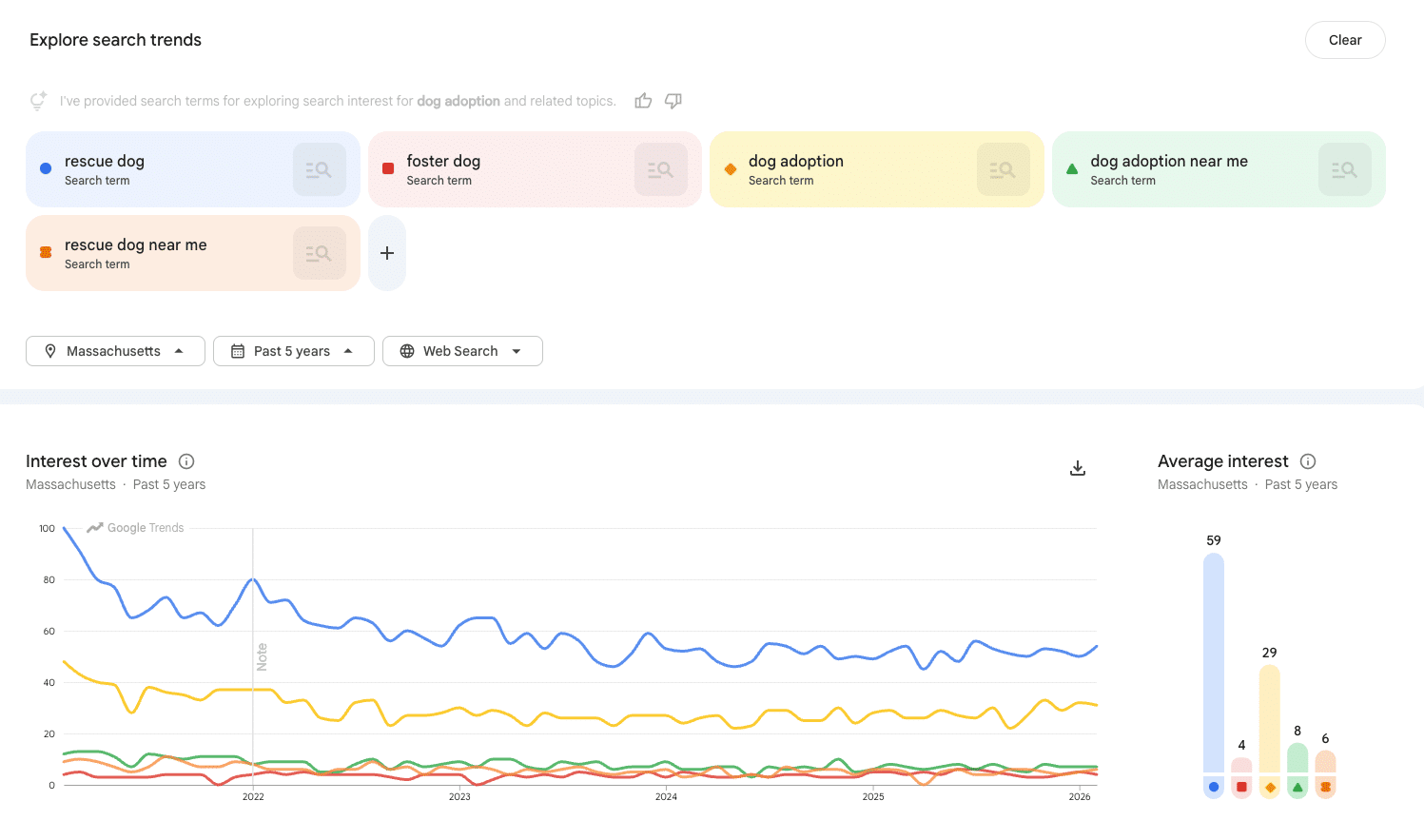
Once we find the data, we have to extract it. You’ll note a very, very tiny icon above the chart that allows you to export the data to a CSV file. Some software has this, others do not; when a software package doesn’t allow you to export a chart, generative AI can often infer it based on the chart itself (which is a fun little hack).
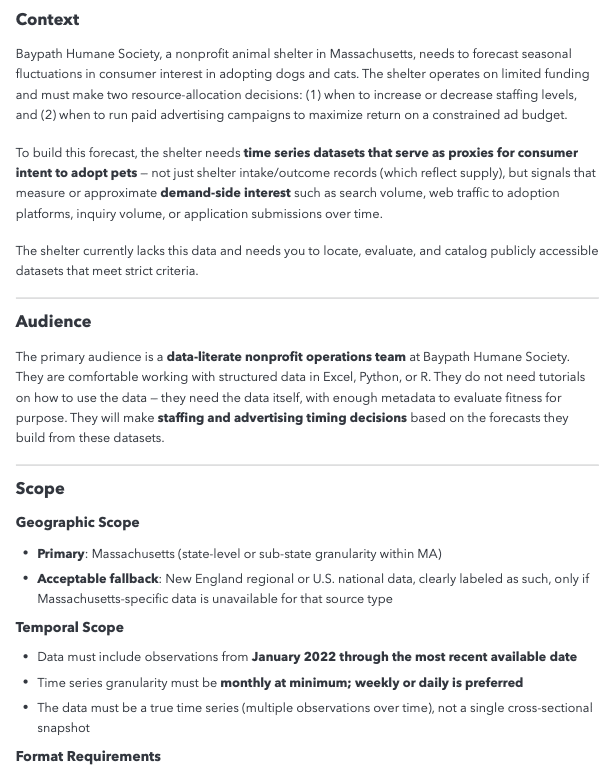
Another hack that’s super useful for the citizen analyst is to find the data itself with generative AI. Using deep research tools, we might give it a prompt like this, in the Trust Insights CASINO deep research framework (this is 1 of 4 pages):
Once the research report completes, you’ll have lots of great options for additional data to obtain and extract. Here’s an example output:
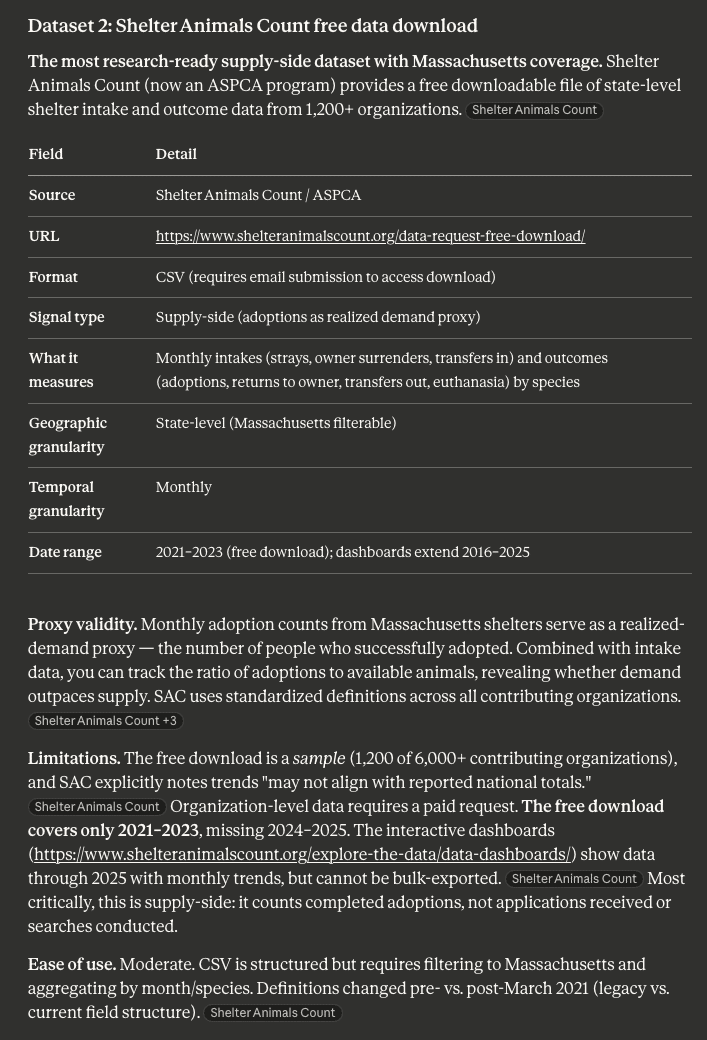
Data in an unhelpful format? Use generative AI to write the necessary code in a language like Python to extract it to something useful and structured.
Next week, we’ll tackle phase 2: once you have the data, what does a citizen analyst do with it to turn it into useful insights?

- New!💡 Case Study: Predictive Analytics for Revenue Growth
- Case Study: Exploratory Data Analysis and Natural Language Processing
- Case Study: Google Analytics Audit and Attribution
- Case Study: Natural Language Processing
- Case Study: SEO Audit and Competitive Strategy

Almost every AI course is the same, conceptually. They show you how to prompt, how to set things up – the cooking equivalents of how to use a blender or how to cook a dish. These are foundation skills, and while they’re good and important, you know what’s missing from all of them? How to run a restaurant successfully. That’s the big miss. We’re so focused on the how that we completely lose sight of the why and the what.
This is why our new course, the AI-Ready Strategist, is different. It’s not a collection of prompting techniques or a set of recipes; it’s about why we do things with AI. AI strategy has nothing to do with prompting or the shiny object of the day — it has everything to do with extracting value from AI and avoiding preventable disasters. This course is for everyone in a decision-making capacity because it answers the questions almost every AI hype artist ignores: Why are you even considering AI in the first place? What will you do with it? If your AI strategy is the equivalent of obsessing over blenders while your steakhouse goes out of business, this is the course to get you back on course.
👉 Take this course now to become an AI leader

Here’s a roundup of who’s hiring, based on positions shared in the Analytics for Marketers Slack group and other communities.
- Data Architecture & Data Modeling Consultant (Full Time Role) at Global Data Strategy, Ltd
- Director – Product Marketing – Ai at WSO2
- Director Strategy- Artificial Intelligence at LTIMindtree
- Head Of Marketing at egnite Health
- Manager Of Data Analytics at Top Prospect Group
- Senior Director, Digital Marketing & Operations at Rithum
- Senior Director, Digital Marketing & Operations at Rithum
- Senior Manager, Marketing Analytics at New Engen
- Vice President Marketing at Intaso
- Vice President Of Artificial Intelligence at Forsyth Barnes
- Vice President Of Artificial Intelligence at James Search Group
- Vice President, Marketing Technology at Talkiatry

Are you a member of our free Slack group, Analytics for Marketers? Join 4000+ like-minded marketers who care about data and measuring their success. Membership is free – join today. Members also receive sneak peeks of upcoming data, credible third-party studies we find and like, and much more. Join today!

Where can you find Trust Insights face-to-face?
- Joist.ai, Online, February 2026
- SSI, Charlotte, April 2026
- SMPS AEC.AI, November 2026
Going to a conference we should know about? Reach out!
Want some private training at your company? Ask us!

First and most obvious – if you want to talk to us about something specific, especially something we can help with, hit up our contact form.
Where do you spend your time online? Chances are, we’re there too, and would enjoy sharing with you. Here’s where we are – see you there?
- Our blog
- Slack
- YouTube
- In-Ear Insights on Apple Podcasts
- In-Ear Insights on Google Podcasts
- In-Ear Insights on all other podcasting software
Read our disclosures statement for more details, but we’re also compensated by our partners if you buy something through us.
Imagine a world where your marketing strategies are supercharged by the most cutting-edge technology available – Generative AI. Generative AI has the potential to save you incredible amounts of time and money, and you have the opportunity to be at the forefront. Get up to speed on using generative AI in your business in a thoughtful way with our workshop offering, Generative AI for Marketers.
Workshops: Offer the Generative AI for Marketers half and full day workshops at your company. These hands-on sessions are packed with exercises, resources and practical tips that you can implement immediately.
👉 Click/tap here to book a workshop

Some events and partners have purchased sponsorships in this newsletter and as a result, Trust Insights receives financial compensation for promoting them. Read our full disclosures statement on our website.

Thanks for subscribing and supporting us. Let us know if you want to see something different or have any feedback for us!
|
Need help with your marketing AI and analytics? |
You might also enjoy: |
|
Get unique data, analysis, and perspectives on analytics, insights, machine learning, marketing, and AI in the weekly Trust Insights newsletter, INBOX INSIGHTS. Subscribe now for free; new issues every Wednesday! |
Want to learn more about data, analytics, and insights? Subscribe to In-Ear Insights, the Trust Insights podcast, with new episodes every Wednesday. |
Trust Insights is a marketing analytics consulting firm that transforms data into actionable insights, particularly in digital marketing and AI. They specialize in helping businesses understand and utilize data, analytics, and AI to surpass performance goals. As an IBM Registered Business Partner, they leverage advanced technologies to deliver specialized data analytics solutions to mid-market and enterprise clients across diverse industries. Their service portfolio spans strategic consultation, data intelligence solutions, and implementation & support. Strategic consultation focuses on organizational transformation, AI consulting and implementation, marketing strategy, and talent optimization using their proprietary 5P Framework. Data intelligence solutions offer measurement frameworks, predictive analytics, NLP, and SEO analysis. Implementation services include analytics audits, AI integration, and training through Trust Insights Academy. Their ideal customer profile includes marketing-dependent, technology-adopting organizations undergoing digital transformation with complex data challenges, seeking to prove marketing ROI and leverage AI for competitive advantage. Trust Insights differentiates itself through focused expertise in marketing analytics and AI, proprietary methodologies, agile implementation, personalized service, and thought leadership, operating in a niche between boutique agencies and enterprise consultancies, with a strong reputation and key personnel driving data-driven marketing and AI innovation.
 Newsletter
 Podcast