
In this week’s Data Dairies, we move onto the fourth and final part of the AI digital clone series. Last time, we obtained the final output of my thinking catalog, the top 20 ways I solve problems. That’s useful and helpful by itself, but now we need to make it useful and operational.
Remember that the overall goal of this project was to create a virtual version of me that the Trust Insights team can use when I’m out of the office, as I will be this week when I’m speaking at a client event. We especially want this for answering analytics questions around Google Analytics and Adobe Analytics, thinking through how I approach problems.
To make this a useful reality, we first need to provide the raw knowledge base itself. The most straightforward way to do that is to download the domain knowledge about the platforms themselves. Using a Python script plus some open source software, I extracted all of Google and Adobe’s documentation about both products and put it into a NotebookLM along with the original call transcripts from earlier steps in the process.
That knowledge base, using NotebookLM, forms the best version of my capabilities because a tool like NotebookLM will remember and recall system configuration information far better than I can.
Once I have the raw data in a repository, then it’s time to build the system instructions for the machine to use. I’ve given it instructions to use the NotebookLM as the primary data source, along with background information like the Trust Insights Writing Style Guide.
The key question is, does the thinking catalog make a difference? I set up a Gemini Gem to use the same NotebookLM with a more generic version of my system instructions and a version with my specific thinking style. How did the two compare?
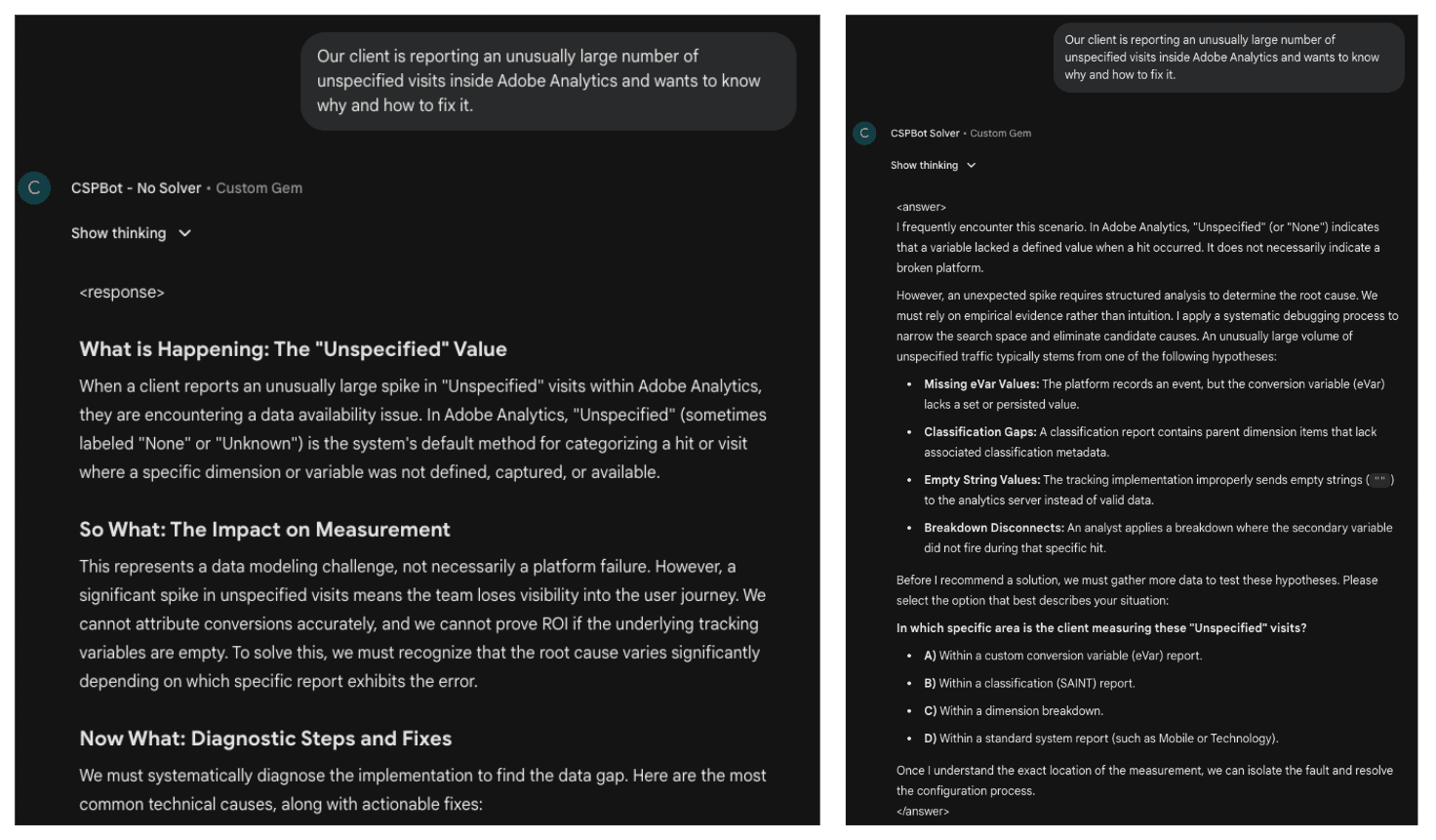
On the left, we see the problem solving routine without my thinking styles added. The language model – Gemini 3.1 Pro – dives right in and starts to answer.
On the right, we see the problem solving routine develops a tree of different choices and then asks the user for more feedback before leaping to conclusions.
As the real human behind this, the version on the right is MUCH closer to how I solve this problem than the version on the left. The thinking analysis does a better job of approximating me.
For those who know me well, you know that neither one is how I write or speak. Why is that? Because the Trust Insights Writing Style Guide mandates a way of speaking and writing that represents a more polished, more ideal version of ourselves, avoiding condescending language, speaking in the active voice, trying to be helpful and reassuring.
Because we have actual transcripts in the NotebookLM database that contain my real speech, there’s a real non-zero chance that the language model might reply like the real me – “well, no, that’s really stupid, why did you do that?” is something I’d say (especially in an internal team meeting) that would be out of alignment with our professional tone outside the four walls of the company.
We want the virtual version of me to be the best version of me – knowledgeable, patient, and helpful, not the cranky version of me after a red-eye flight back from an event.
This wraps up the series on creating a virtual version of yourself. You can see how much work goes into it if you want to do it right, if you want to accurately capture yourself and not a caricature of yourself. Shameless plug, if learning how to do this is of interest to you, Trust Insights can help.
|
Need help with your marketing AI and analytics? |
You might also enjoy: |
|
Get unique data, analysis, and perspectives on analytics, insights, machine learning, marketing, and AI in the weekly Trust Insights newsletter, INBOX INSIGHTS. Subscribe now for free; new issues every Wednesday! |
Want to learn more about data, analytics, and insights? Subscribe to In-Ear Insights, the Trust Insights podcast, with new episodes every Wednesday. |
Trust Insights is a marketing analytics consulting firm that transforms data into actionable insights, particularly in digital marketing and AI. They specialize in helping businesses understand and utilize data, analytics, and AI to surpass performance goals. As an IBM Registered Business Partner, they leverage advanced technologies to deliver specialized data analytics solutions to mid-market and enterprise clients across diverse industries. Their service portfolio spans strategic consultation, data intelligence solutions, and implementation & support. Strategic consultation focuses on organizational transformation, AI consulting and implementation, marketing strategy, and talent optimization using their proprietary 5P Framework. Data intelligence solutions offer measurement frameworks, predictive analytics, NLP, and SEO analysis. Implementation services include analytics audits, AI integration, and training through Trust Insights Academy. Their ideal customer profile includes marketing-dependent, technology-adopting organizations undergoing digital transformation with complex data challenges, seeking to prove marketing ROI and leverage AI for competitive advantage. Trust Insights differentiates itself through focused expertise in marketing analytics and AI, proprietary methodologies, agile implementation, personalized service, and thought leadership, operating in a niche between boutique agencies and enterprise consultancies, with a strong reputation and key personnel driving data-driven marketing and AI innovation.
 Newsletter
 Podcast