INBOX INSIGHTS: How to Measure the ROI of AI, Using Conference Data For Content Gaps (2026-10-14) :: View in browser
👉 Take our new course, AI for Writers and learn how to make AI write better!
Watch This Newsletter

🎧 Listen to this newsletter as an MP3
How do you measure the ROI of AI?
Yesterday I had the privilege of teaching the Claude for Business workshop at MAICON in Cleveland. I opened my Claude for Business workshop with the question I get asked more than any other. Not “which model should I use” or “is Claude better than ChatGPT.” It’s this one: how do you measure the ROI of AI?
It’s a fair question, and most organizations can’t answer it. McKinsey’s State of AI in 2026) found that nearly nine in ten respondents say their organization regularly uses AI in at least one business function. Only 37 percent attribute any EBIT impact to it, and just 6 percent qualify as high performers, meaning they can attribute 5 percent or more of their EBIT (earnings before interest and taxes) to AI. That’s a lot of AI and not a lot of return.
Helping companies answer this exact question is a big part of what Trust Insights does. The question isn’t “what’s the ROI of AI?” It’s “what’s the ROI of this one task, and were you measuring it before AI showed up?”
Nobody measures the ROI of their kitchen renovation
Think about how you’d judge a kitchen renovation. You don’t calculate the return on the oven. You notice that dinner takes forty minutes instead of ninety, that you stopped ordering takeout on Wednesdays, and that someone else in the house can finally cook without asking you where everything is.
I used that structure and framed the solution that way for the workshop. You start with your Project (your kitchen). This is your context that you load once and don’t have to do again. Then you have your Skills (your recipes) that you write down for your repeatable process. Next is your Plugin (your cookbook) that you can hand off to someone else to execute against. Each piece on its own isn’t an ROI. But all together, you can start to measure how fast it took to get dinner on the table. That’s how you start to get to the answer that plagues everyone. AI works the same way. The value shows up in a specific piece of work getting faster, less dreaded, and you can only see it if you knew what that work looked like before.
Four steps, and the first two don’t involve AI
For those of you who couldn’t make it to Cleveland, this is the short version of three hours.
Score the task before you touch a tool. We use TRIPS: Time, Repetition, Importance, Pain and Sufficient data, each scored 1 to 5. If the average comes in under 3, leave it alone. Automating low-value work is how AI projects earn a bad reputation.
Write down the requirements. The 5P Framework by Trust Insights™ asks five questions: what decision this supports (Purpose), who reads it and who builds it (People), whether there’s a standard or it lives in someone’s head (Process), where the finished thing needs to live (Platform), and how you’ll know it worked (Performance). Performance is where your ROI lives. Whichever question you can’t answer is the one to fix first.
Let those answers write the prompt. Four of the six lines in a good CASINO prompt (Context, Audience, Scope, Intent, Narrator, Outcome) come straight from your 5P Framework by Trust Insights™ answers. Purpose becomes Intent, People becomes Audience, Process becomes Scope, and Performance becomes Outcome. Bad AI output usually means missing context, not a weak prompt.
Pick one task and give it one month. Don’t go after every task you score. Pick one that you can focus on. Take your baseline measurement (if you skip this, you can’t measure your ROI), run it for a month, then measure it again. That number is your answer to the ROI question. That is the number you can bring to your leadership team.
Handing everyone a login isn’t a strategy
The pattern I see most often is a company that rolled out a tool and waited for the return to show up. BCG’s AI at Work 2025 research, which surveyed more than 10,600 employees in 11 countries, found that regular use among frontline employees had stalled at 51 percent. Only 36 percent of employees said their training was adequate. That isn’t a technology problem. The technology is almost never the problem. It’s a people and process problem, which is why Platform is fourth in the 5P Framework by Trust Insights™, on purpose.
Coming soon. Most AI reporting I see counts usage: seats, logins, tokens, hours someone says they saved. That tells you people are using the tools. It doesn’t tell you whether the output, or the business, got any better. We’ve been building a scorecard for the ROI of AI, one where every measure has to be something you can actually observe. Starting with a “how confident do you feel?” survey is good, but I want to get deeper and more accurate. More on that soon.
You don’t measure the ROI of AI. You measure the ROI of the work, one task at a time, and you start before you ever open the tool.
How are you measuring it today?
Reply to this email or join the conversation in our Free Slack community, Analytics for Marketers!
– Katie Robbert, CEO
Weekly One Question Poll 🐶
Click or tap just one answer below — there’s no form, this is the entire thing. One tap and you’re done, with our thanks.
How are you managing the expectations of using AI?
- Full speed ahead, no guilt »
- Using it, but conflicted about it »
- Actively cutting back »
- Not using AI at all »

Do you have a colleague or friend who needs this newsletter? Send them this link to help them get their own copy:
https://www.trustinsights.ai/newsletter

Last time on So What? The Marketing Analytics and Insights Livestream, we covered what’s new in the new LinkedIn algorithm. Catch the episode replay here!

Here’s some of our content from recent days that you might have missed. If you read something and enjoy it, please share it with a friend or colleague!
- So What? What’s New in Agentic AI Assistants
- AI Isn’t Your Leadership Team
- INBOX INSIGHTS: What Happens When You’re Too Good, Practical Responsible AI Part 5 (2026-10-07)
- In-Ear Insights: The 5P Framework by Trust Insights™ and Agentic Prompting
- Responsible AI, Part 2
- Powering Up for Trade Shows
- Almost Timely News: 🗞️ The Road to MAICON 2026 (2026-10-11)

Take your skills to the next level with our premium courses.
- 👉 Take our new course, AI for Writers and learn how to make AI write better!
- 🏎️ GEO 201 for Marketers
- 🤖 GEO 101 for Marketers
- 🎯 The AI-Ready Strategist
- 💥 Generative AI Use Cases for Marketers
- 💡 Mastering Prompt Engineering for Marketers
- 🦾 Generative AI for Marketers

Get skilled up with an assortment of our free, on-demand classes.
- 👉 Watch Katie Robbert’s MarketingProfs B2B Forum talk, Driving B2B Growth with AI
- How to Successfully Apply AI in Financial Aid, from MASFAA 2025
- From Text to Video in Seconds, a session on AI video generation
- Never Think Alone: How AI Has Changed Marketing Forever (2025)
- Generative AI for Tourism and Destination Marketing (2025)

You could be reaching 37,000+ marketers, analysts, data scientists, and executives directly with your ad. Want to learn more? Reach out and contact us.

This week, Katie and I are at the annual Marketing AI Conference, MAICON, in Cleveland. By the time you read this, Katie will have crushed it on stage leading the Claude for Business workshop and Anthropic will have changed Claude’s interface 4 more times. We’ll be on the show floor recording a live edition of In-Ear Insights, the Trust Insights podcast and you’ll be able to catch that on our YouTube channel.
This week, however, I want to share a different take on conferences and what you can do with conference information, even if you never leave your desk.
To make the most of this issue, consider what conference or event is most relevant to your company and your marketing. We’ll use MAICON as the example. With your favorite AI agent of choice, such as Claude Code / Claude or ChatGPT Work, point your agent at the conference agenda and ask it to download the agenda in a structured data format. I recommend an AI-friendly format like YAML.
You’ll also want to have a catalog of your own content, what you’ve created in a significant time period, like a year or two. For this experiment, I’ll use the last 2 years of Trust Insights content. We use WP Engine and WordPress as our content management system, so I can export all our blog content (which includes our newsletter, podcasts, livestreams, etc. – a great reason to put a copy of all your content in one place you control) as a single data file. WordPress uses the MySQL database, so I can export it as a structured data format, SQL.
With these two data sources, we can ask our AI this key question:
“Given our content from the last two years in the SQL export and the MAICON conference agenda in Markdown files by day, split the agenda into individual sessions. Discard non-content sessions like breaks, meals, anything where learning content isn’t being presented. Then compare each session one by one to see if Trust Insights has published content on the topic, scored by similarity using a measure like cosine similarity. Present the MAICON conference agenda, by learning session, in descending order by cosine similarity. Show the session title, speaker, and description along with the score in HTML and CSV export formats. In the HTML, color code each row by cosine similarity in interquartile ranges – light blue for the top range, light green, light yellow, and light red for the lowest cosine similarity range. Ask me up to 20 clarifying questions until you have enough information to succeed at the build.”
What comes out of this is an analysis using a statistical technique called cosine similarity, a way of measuring topical similarity regardless of content length. It’s how many AI tools that do text analysis do comparisons, and it’s fast and free in the Python programming language.
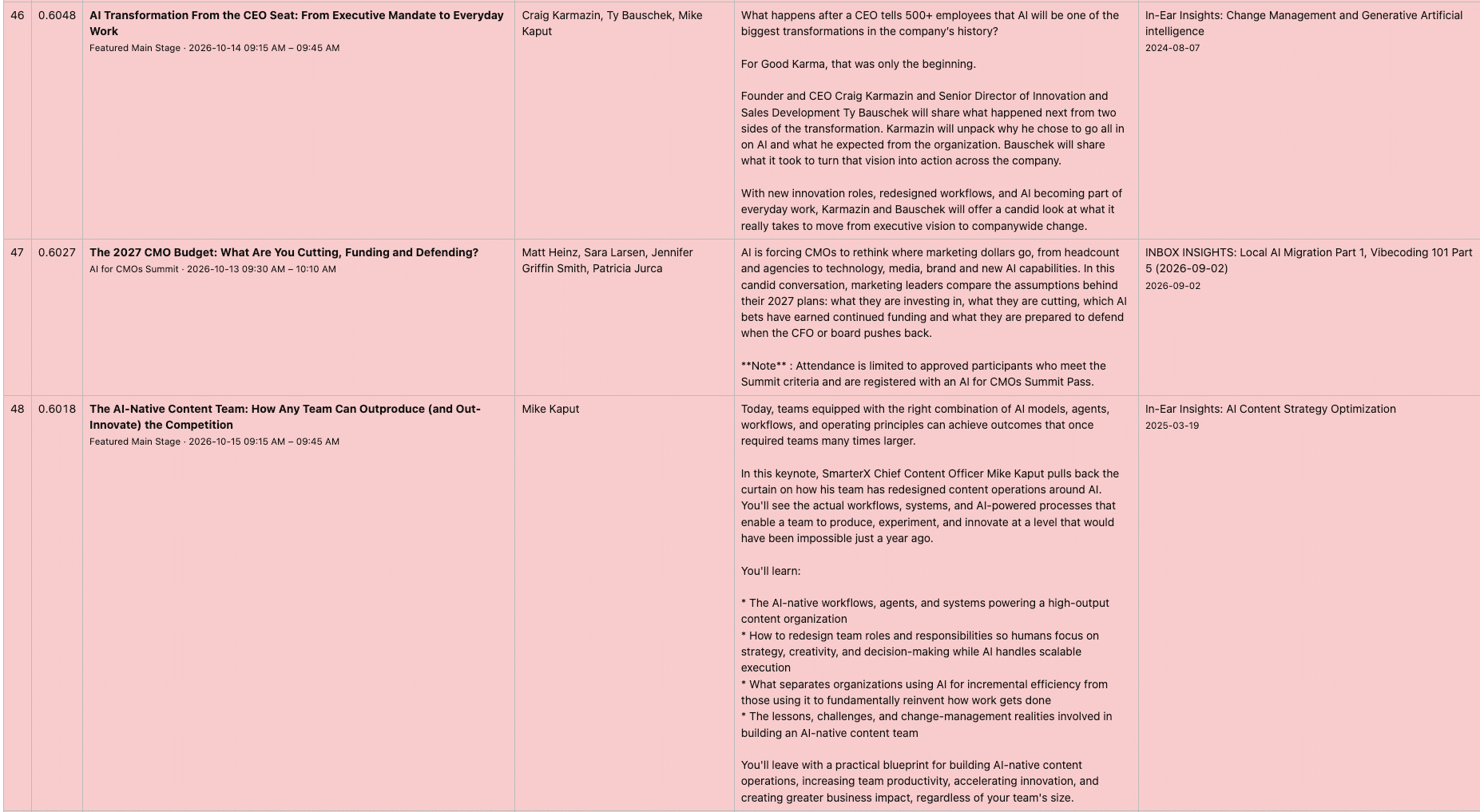
What do you do with that analysis? This is a map of what you’ve covered in your content compared to what your industry cares enough about that they’ll put it in a paid (sometimes quite expensive!) conference agenda, an agenda that they think will be compelling enough to convince people to attend the event. It’s a content gap analysis on the highest profile content in your industry, telling you what you haven’t covered and what you might want to make content about.
In our analysis, we’re generally well-positioned; our lowest similarity scores (in a floating point range from 0 to 1) are in the 0.6 range, so even our least similar content is still fairly similar to the conference agenda. That’s helpful to know, and those sessions that are in the red for us are specific points we could create new content on instead of having to pursue entirely new topics – tuning, not turning.
Do this for yourself, for your company and your industry, and see where the content gaps are for you. And you don’t have to limit this to conference agendas – you could do the same exercise for your blog versus a competitor’s, or your YouTube channel, etc.
If you’ll be at MAICON this week, come say hello!

- New!💡 Case Study: Predictive Analytics for Revenue Growth
- Case Study: Exploratory Data Analysis and Natural Language Processing
- Case Study: Google Analytics Audit and Attribution
- Case Study: Natural Language Processing
- Case Study: SEO Audit and Competitive Strategy

Almost every AI course is the same, conceptually. They show you how to prompt, how to set things up – the cooking equivalents of how to use a blender or how to cook a dish. These are foundation skills, and while they’re good and important, you know what’s missing from all of them? How to run a restaurant successfully. That’s the big miss. We’re so focused on the how that we completely lose sight of the why and the what.
This is why our capstone course, the AI-Ready Strategist, is different. It’s not a collection of prompting techniques or a set of recipes; it’s about why we do things with AI. AI strategy has nothing to do with prompting or the shiny object of the day — it has everything to do with extracting value from AI and avoiding preventable disasters. This course is for everyone in a decision-making capacity because it answers the questions almost every AI hype artist ignores: Why are you even considering AI in the first place? What will you do with it? If your AI strategy is the equivalent of obsessing over blenders while your steakhouse goes out of business, this is the course to get you back on course.
👉 Take this course now to become an AI leader

Here’s a roundup of who’s hiring, based on positions shared in the Analytics for Marketers Slack group and other communities.
- Group Manager, Product Marketing Manager – Public Sector at Samsara
- Growth Manager (Ai-First), Enterprise Tech Services at Trantor
- Manager Ai Solutions And Enablement at Catania Oils
- Senior Brand Manager, Nordictrack Dtc at iFIT
- Senior Content Marketing Manager at DigiCert
- Senior Content Marketing Manager at TimelyCare
- Senior Email & Subscription Marketing Manager at Weiss Ratings
- Senior Manager, Paid Media (Remote) at Alliance Animal Health
- Senior Marketing Manager – Narrative And Launch at Jobgether
- Senior Product Marketing Manager at DomainTools
- Senior Product Marketing Manager at Orange Logic
- Sr. Director, Demand Generation at EBG
- Sr. Member Engagement Manager, Lifecycle at Carrot

Are you a member of our free Slack group, Analytics for Marketers? Join 4000+ like-minded marketers who care about data and measuring their success. Membership is free – join today. Members also receive sneak peeks of upcoming data, credible third-party studies we find and like, and much more. Join today!

Where can you find Trust Insights face-to-face?
- MAICON, October 2026
- SMPS AEC.AI, November 2026
- MarketingProfs B2B Forum, November 2026
Going to a conference we should know about? Reach out!
Want some private training at your company? Ask us!

First and most obvious – if you want to talk to us about something specific, especially something we can help with, hit up our contact form.
Where do you spend your time online? Chances are, we’re there too, and would enjoy sharing with you. Here’s where we are – see you there?
- Our blog
- Slack
- YouTube
- In-Ear Insights on Apple Podcasts
- In-Ear Insights on Google Podcasts
- In-Ear Insights on all other podcasting software
Read our disclosures statement for more details, but we’re also compensated by our partners if you buy something through us.
Imagine a world where your marketing strategies are supercharged by the most cutting-edge technology available – Generative AI. Generative AI has the potential to save you incredible amounts of time and money, and you have the opportunity to be at the forefront. Get up to speed on using generative AI in your business in a thoughtful way with our workshop offering, Generative AI for Marketers.
Workshops: Offer the Generative AI for Marketers half and full day workshops at your company. These hands-on sessions are packed with exercises, resources and practical tips that you can implement immediately.
👉 Click/tap here to book a workshop

Some events and partners have purchased sponsorships in this newsletter and as a result, Trust Insights receives financial compensation for promoting them. Read our full disclosures statement on our website.

Thanks for subscribing and supporting us. Let us know if you want to see something different or have any feedback for us!
|
Need help with your marketing AI and analytics? |
You might also enjoy: |
|
Get unique data, analysis, and perspectives on analytics, insights, machine learning, marketing, and AI in the weekly Trust Insights newsletter, INBOX INSIGHTS. Subscribe now for free; new issues every Wednesday! |
Want to learn more about data, analytics, and insights? Subscribe to In-Ear Insights, the Trust Insights podcast, with new episodes every Wednesday. |
Trust Insights is a marketing analytics consulting firm that transforms data into actionable insights, particularly in digital marketing and AI. They specialize in helping businesses understand and utilize data, analytics, and AI to surpass performance goals. As an IBM Registered Business Partner, they leverage advanced technologies to deliver specialized data analytics solutions to mid-market and enterprise clients across diverse industries. Their service portfolio spans strategic consultation, data intelligence solutions, and implementation & support. Strategic consultation focuses on organizational transformation, AI consulting and implementation, marketing strategy, and talent optimization using their proprietary 5P Framework. Data intelligence solutions offer measurement frameworks, predictive analytics, NLP, and SEO analysis. Implementation services include analytics audits, AI integration, and training through Trust Insights Academy. Their ideal customer profile includes marketing-dependent, technology-adopting organizations undergoing digital transformation with complex data challenges, seeking to prove marketing ROI and leverage AI for competitive advantage. Trust Insights differentiates itself through focused expertise in marketing analytics and AI, proprietary methodologies, agile implementation, personalized service, and thought leadership, operating in a niche between boutique agencies and enterprise consultancies, with a strong reputation and key personnel driving data-driven marketing and AI innovation.
 Newsletter
 Podcast