This post was originally featured in the 2/4/2026 newsletter found here: INBOX INSIGHTS: Who Owns AI, Marketing Jobs Report
Who Owns AI When Everyone Owns AI?
Who owns AI when everyone owns AI? Hint: It’s nobody. Let’s dig in.
I’ve had a front-row seat to a lot of ‘AI transformations’ lately, and I’ve noticed a recurring, awkward silence. It usually happens right after a big leadership meeting where everyone agrees that ‘AI is the future.’ The meeting ends, everyone heads back to their desks, and then… nothing happens.
The problem isn’t the technology; it’s the lack of a designated driver. Right now, CEOs are telling their teams to ‘leverage AI’ as if it’s a single checkbox on a to-do list. But without a clear owner, your marketing team is looking at IT, IT is looking at Operations, and everyone is wondering if they’re even allowed to press the ‘go’ button. When everyone ‘owns’ the transformation in theory, the result isn’t innovation—it’s paralysis.
In the rush to stay competitive, we’re forgetting that AI isn’t a self-driving car; it’s an assistant that needs a manager. When everyone is responsible for ‘innovating,’ most people just keep doing what they’ve always done because it’s safe.
I wish I could say this was unusual. It’s not.
The Ownership Vacuum
Here’s the uncomfortable truth about AI in most organizations right now: when AI is “everyone’s job,” it becomes nobody’s job.
You’ve probably seen this play out. Leadership announces an AI initiative. There’s initial excitement. People experiment with ChatGPT on their lunch breaks. Maybe someone builds a cool prototype. And then… nothing. The prototype sits unused. The experiments don’t scale. The momentum dies.
Why? Because nobody was clearly responsible for making it stick.
This isn’t a technology problem. It’s an ownership problem. And I get it—you’re not alone in facing this. Every organization I talk to is wrestling with the same question: who exactly is supposed to own AI when it touches every department but belongs to none of them?
The Hiring Fantasy (And Why It Won’t Save You)
If you’ve been reading industry publications, you might think the answer is to hire your way out of this. Create an AI Product Manager role! Build a Center of Excellence! Establish an AI governance team!
That advice sounds great if you’re a Fortune 500 company with budget to spare. But let’s be honest about reality for the rest of us.
Your headcount is probably frozen. Mine is too. Even if you could hire, you’re competing for a tiny talent pool where qualified candidates command salaries that would blow your budget. And “Centers of Excellence”? That phrase alone makes most small and mid-sized organizations roll their eyes—it sounds like something designed for companies with 5,000 employees and dedicated innovation labs.
So what do the rest of us do? We work with what we have.
The In-Housing Problem
Before we talk solutions, let’s name the real issue I opened with: the in-housing problem.
When you rely on external consultants or vendors for AI capability, knowledge walks out the door when they do. You’re not building internal muscle; you’re renting someone else’s. And every time you rent, you start from scratch when the engagement ends.
I’ve seen this happen with agencies, consultants, and even vendors who implement tools and then disappear. The company is left with technology they don’t fully understand and processes nobody internally can maintain.
The solution isn’t to never use external help—sometimes you need it. The solution is to be intentional about what stays when they leave. And that means assigning clear internal ownership from day one.
A Framework That Works Without New Headcount
At Trust Insights, we use the 5P Framework—Purpose, People, Process, Platform, Performance—for almost everything. It works particularly well for sorting out AI ownership because it forces you to think beyond just “who does the work” to “who’s responsible for what kind of decision.”
- Purpose Ownership: Who decides why you’re using AI in the first place? This person ensures AI initiatives align with business goals, not just technical possibility. In most organizations, this should sit with a senior leader who understands strategy.
- People Ownership: Who’s responsible for making sure your team can actually use AI effectively? This includes training, skill development, and addressing the human side of adoption. Often this falls naturally to HR or a team lead.
- Process Ownership: Who ensures AI fits into how work actually gets done? This person maps workflows, identifies where AI adds value, and documents how humans and machines work together.
- Platform Ownership: Who manages the actual tools—selection, security, integration, and maintenance? This is usually IT, but with a critical caveat: they need a seat at the strategy table, not just implementation orders.
- Performance Ownership: Who measures whether any of this is working? They track adoption, outcomes, and ROI.
Your Practical Responsibility Matrix
Here’s where this gets actionable. Take this matrix and adapt it to your reality:
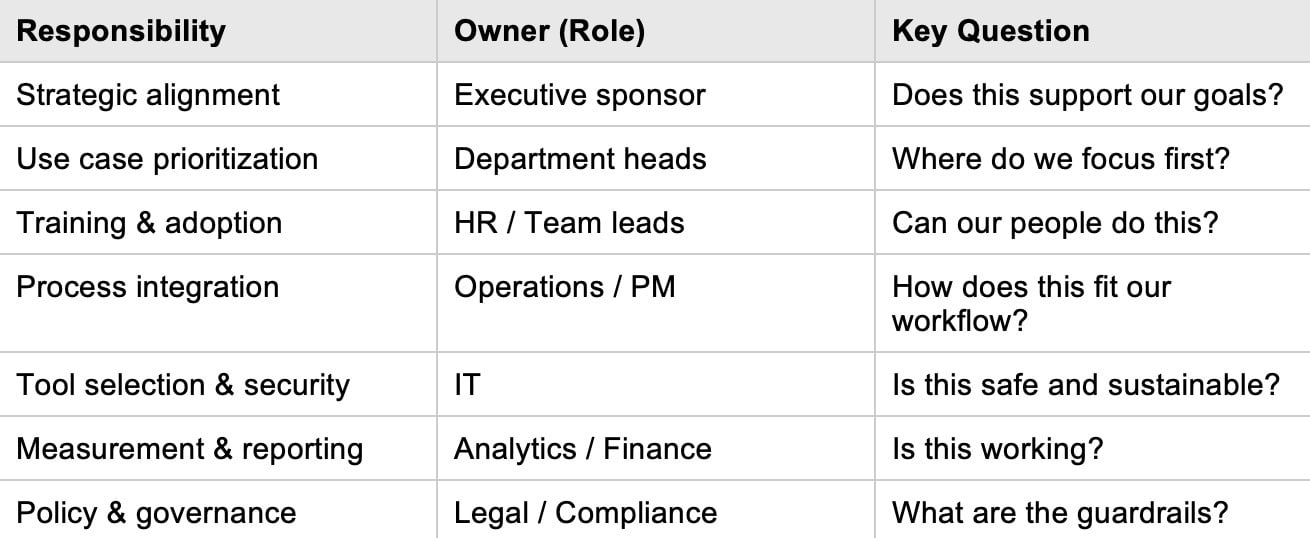
Notice something important: none of these require a new hire. They require assigning ownership to people who already exist in your organization.
The Bottom Line
I know this isn’t the sexy answer. There’s no shiny new job title, no dedicated team, no innovation lab. But here’s what I’ve learned after years of helping organizations actually get things done: clarity beats resources almost every time.
A clear owner with limited time will outperform a vague “everyone’s responsible” approach with unlimited budget. Every single time.
So here’s what I want you to do this week: print out that matrix. Fill in actual names from your organization. Have a conversation with each person about what ownership means. Make it explicit.
Stop waiting for the perfect AI hire. Start assigning ownership to the people you already have. That’s how capability stays in-house when everyone else walks out the door.
Next week we’ll explore why AI training fails and what to do about it.
How are you assigning ownership for AI? Reply to this email or join the conversation in our Free Slack community, Analytics for Marketers!
– Katie Robbert, CEO
|
Need help with your marketing AI and analytics? |
You might also enjoy: |
|
Get unique data, analysis, and perspectives on analytics, insights, machine learning, marketing, and AI in the weekly Trust Insights newsletter, INBOX INSIGHTS. Subscribe now for free; new issues every Wednesday! |
Want to learn more about data, analytics, and insights? Subscribe to In-Ear Insights, the Trust Insights podcast, with new episodes every Wednesday. |
Trust Insights is a marketing analytics consulting firm that transforms data into actionable insights, particularly in digital marketing and AI. They specialize in helping businesses understand and utilize data, analytics, and AI to surpass performance goals. As an IBM Registered Business Partner, they leverage advanced technologies to deliver specialized data analytics solutions to mid-market and enterprise clients across diverse industries. Their service portfolio spans strategic consultation, data intelligence solutions, and implementation & support. Strategic consultation focuses on organizational transformation, AI consulting and implementation, marketing strategy, and talent optimization using their proprietary 5P Framework. Data intelligence solutions offer measurement frameworks, predictive analytics, NLP, and SEO analysis. Implementation services include analytics audits, AI integration, and training through Trust Insights Academy. Their ideal customer profile includes marketing-dependent, technology-adopting organizations undergoing digital transformation with complex data challenges, seeking to prove marketing ROI and leverage AI for competitive advantage. Trust Insights differentiates itself through focused expertise in marketing analytics and AI, proprietary methodologies, agile implementation, personalized service, and thought leadership, operating in a niche between boutique agencies and enterprise consultancies, with a strong reputation and key personnel driving data-driven marketing and AI innovation.
 Newsletter
 Podcast