This post was originally featured in the March 4th, 2026 newsletter found here: INBOX INSIGHTS: 7D AI Product Launch Framework, Citizen Analyst Part 4
Why We Rebuilt the 7D Product Marketing Launch Framework for the AI Era
Everyone’s using generative AI to launch products faster. But faster doesn’t mean better — unless you have a system.
There’s a pattern playing out right now that should worry you.
Teams are spinning up new apps, new features, new products — sometimes in days instead of months — because generative AI has compressed the build cycle dramatically. What used to take a quarter now takes a sprint. The barrier to creating something has never been lower.
And yet, most of these launches still fail.
Not because the product was bad. Not because the team wasn’t talented. They fail because speed without structure is just organized chaos. You shipped faster, congratulations. But did you validate demand first? Did you define requirements from actual customer data? Did you have a measurement plan before you hit “publish”?
That’s why we rebuilt the 7D Product Marketing Launch Framework for 2026. Not because the original framework was broken — it’s guided hundreds of successful launches since we first published it. We rebuilt it because the world around it changed, and frameworks that don’t evolve become artifacts.
The Problem with “Just Ship It”
Here’s what we’re seeing in the market right now: teams using ChatGPT to write launch copy, using AI to generate landing pages, using Midjourney for product visuals — and then wondering why conversions are flat and churn is high.
The tooling got better. The thinking didn’t.
Generative AI gave everyone a faster engine, but most teams are still driving without a map. They’re optimizing individual steps — write this email faster, generate this ad creative faster — without asking whether those steps are even the right ones, in the right order, aimed at the right audience.
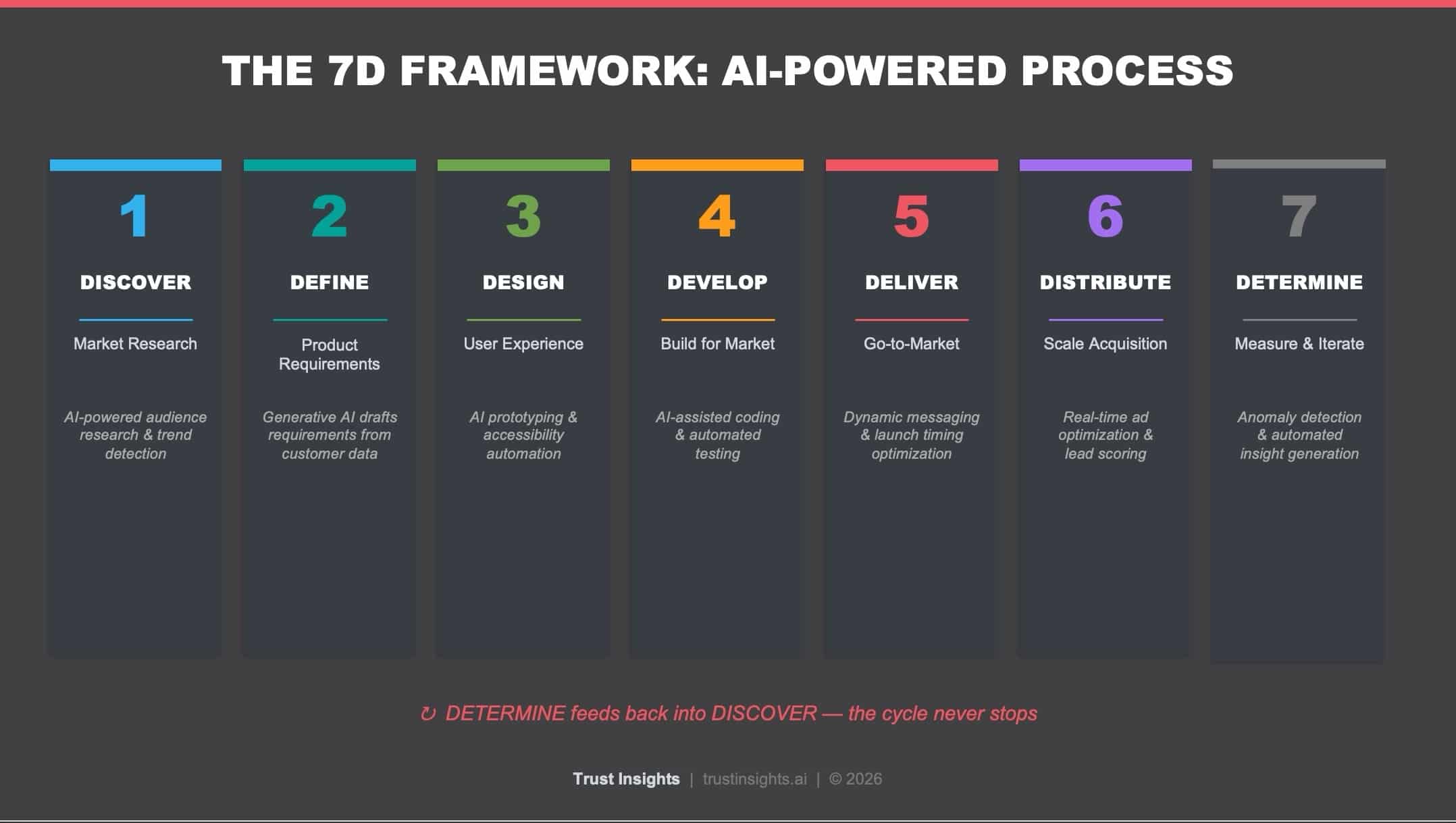
This is the gap the 7D Framework was always designed to fill. It’s not a checklist. It’s an operating system for product launches that forces you to think sequentially: Discover, Define, Design, Develop, Deliver, Distribute, Determine. Each step builds on the one before it. Skip one, and the whole thing wobbles.
The 7Ds: What the Framework Actually Is
Before we get into what changed, let’s ground this. The 7D Framework is a sequential operating system for product launches. Each step feeds the next. Here’s what each D does and how AI transforms it in 2026:
- DISCOVER — Validate Market Demand. Before you build anything, you need to know the market actually wants it. This means audience research, competitive analysis, trend detection. In 2026, AI can analyze thousands of online conversations, Reddit threads, review sites, and social posts to surface demand signals you’d never find manually. That’s not faster research. That’s different research. Are you reading the market, or guessing at it?
- DEFINE — Translate Needs into Requirements. Once you know what the market wants, you translate that into product specs. What features matter? What’s the positioning? Generative AI can now draft requirements directly from your research data — not from a PM’s gut feeling. Predictive modeling shows which features will actually drive adoption before you write a single line of code. Do your product requirements come from data, or from the loudest voice in the room?
- DESIGN — Remove Friction from the Experience. This is where you map the user journey — wireframes, user flows, microcopy, accessibility. AI assists with prototyping and accessibility checks, compressing iteration cycles from weeks to days. The goal isn’t a prettier interface. It’s a frictionless path from “I’m interested” to “I’m a customer.” How many clicks does it take to get from your landing page to a conversion?
- DEVELOP — Build for Market, Not for Ego. Ship quality while moving fast. AI-assisted coding handles boilerplate. Automated testing catches bugs. Predictive analytics forecast delays before they blow up your timeline. The 2026 upgrade here is speed without sacrifice — you move faster and catch problems earlier. Is your development timeline based on reality or optimism?
- DELIVER — Convince the Market You Exist. This is go-to-market execution: content, campaigns, messaging, channels. AI powers content creation across all channels simultaneously. Dynamic personalization shows each customer segment different messaging based on their behavior and intent. You’re not blasting one message to everyone anymore. When was the last time you tested whether your launch messaging actually resonated?
- DISTRIBUTE — Scale Acquisition. Getting attention is one thing. Converting it at scale is another. Real-time AI ad optimization adjusts spend and targeting on the fly. Predictive lead scoring tells your sales team who’s actually ready to buy instead of who just downloaded a whitepaper. Content auto-repurposes across formats so one piece of work becomes ten. Are you scaling what works, or just spending more?
- DETERMINE — Measure and Iterate. This is the step most teams skip, and it’s the one that matters most. Measure everything. AI dashboards surface insights automatically. Anomaly detection flags problems in real time — you don’t wait for a quarterly review to find out your launch underperformed. Churn prediction identifies at-risk customers before they leave. If you’re not measuring from day one, you’re not marketing — you’re guessing. What’s your plan for knowing whether this worked?
The sequence matters. Each D builds on the one before it. Skip DISCOVER and your DEFINE is based on assumptions. Skip DETERMINE and you’ll never know what actually worked. The framework forces the discipline that most teams abandon when they’re moving fast.
Why Now? Because AI Changed the Equation — Twice
The first wave of AI in product marketing was about automation. Speed up what you’re already doing. That wave hit in 2023-2024, and it was useful but limited.
The second wave — the one we’re in now — is about augmentation. AI doesn’t just do the work faster. It does work you couldn’t do before. You just saw it in every step above: AI doesn’t replace the thinking in each D, it amplifies it. You still need the framework to know what to think about. AI helps you think about it faster, deeper, and with better data.
This is what we mean when we say we “rebuilt” the framework. The seven steps didn’t change. The sequence didn’t change. What changed is what’s possible inside each step when you layer AI into the process intentionally.
Generative AI Supports the Framework. It Doesn’t Replace It.
This is the point we keep coming back to, because it’s the most misunderstood idea in marketing right now.
Generative AI is not a strategy. It’s a capability. And capabilities without a framework are just expensive experiments.
You can use AI to generate a hundred variations of launch messaging in an afternoon. Great. But which messaging is right? That depends on whether you did the DISCOVER work to understand your audience. It depends on whether you did the DEFINE work to clarify your positioning. It depends on whether you have a DETERMINE plan to measure what’s actually working.
AI accelerates every step. But you still have to take every step.
Think of it this way: a power drill is faster than a screwdriver. But a power drill doesn’t tell you where the screws go. The framework is the blueprint. AI is the power tool. You need both.
When teams use generative AI within a structured framework like the 7D, the results compound. They launch faster and smarter. They catch misalignment earlier. They measure outcomes from day one instead of retrofitting analytics after the fact.
When teams use generative AI without a framework, they just produce more stuff. More content. More variants. More noise. And they burn through budget faster while doing it.
What’s Actually New in the 2026 Version
We didn’t just add the word “AI” to each step and call it a refresh. Here’s what’s substantively different:
- AI is integrated into every phase, not bolted on. Each of the 7Ds now includes specific guidance on how generative AI, predictive analytics, and machine learning tools change what’s possible in that step. This isn’t theory — it’s based on how we use these tools with clients every day.
- The measurement framework got a complete overhaul. DETERMINE was always the most neglected step. In the 2026 version, we built out a full measurement plan with GA4 event tracking, anomaly detection guidance, and real-time dashboard recommendations. If you’re not measuring, you’re not marketing — you’re guessing.
- The downloadable one-sheet is designed for actual use. The new PDF isn’t a brochure. It’s a reference sheet you can print, pin to your wall, or share with your team as a forcing function. One page, all seven steps, with the AI integration points highlighted.
The Bottom Line
Every team is going to use AI to launch products in 2026. That’s not a competitive advantage anymore. The advantage goes to teams that use AI within a system — one that ensures you’re building the right thing, for the right people, with the right messaging, and measuring the right outcomes.
The 7D Framework is that system. It’s been validated across hundreds of launches. And now it’s been modernized for a world where AI isn’t optional — it’s the baseline.
The question isn’t whether you should use AI in your product launches. You should. The question is whether you have a framework that tells AI what to do.
Product launches don’t fail because of execution. They fail because of misalignment. Generative AI makes you faster, but only a system makes you right. The 7D Framework is the system that makes alignment possible — now powered by the very AI tools it helps you deploy.
Speed without structure is just expensive chaos.
Go here to get your copy of the 7D Product Launch Framework for free
How are you launching products in 2026? Reply to this email or join the conversation in our Free Slack community, Analytics for Marketers!
– Katie Robbert, CEO
|
Need help with your marketing AI and analytics? |
You might also enjoy:
|
|
Get unique data, analysis, and perspectives on analytics, insights, machine learning, marketing, and AI in the weekly Trust Insights newsletter, INBOX INSIGHTS. Subscribe now for free; new issues every Wednesday! |
Want to learn more about data, analytics, and insights? Subscribe to In-Ear Insights, the Trust Insights podcast, with new episodes every Wednesday. |
Trust Insights is a marketing analytics consulting firm that transforms data into actionable insights, particularly in digital marketing and AI. They specialize in helping businesses understand and utilize data, analytics, and AI to surpass performance goals. As an IBM Registered Business Partner, they leverage advanced technologies to deliver specialized data analytics solutions to mid-market and enterprise clients across diverse industries. Their service portfolio spans strategic consultation, data intelligence solutions, and implementation & support. Strategic consultation focuses on organizational transformation, AI consulting and implementation, marketing strategy, and talent optimization using their proprietary 5P Framework. Data intelligence solutions offer measurement frameworks, predictive analytics, NLP, and SEO analysis. Implementation services include analytics audits, AI integration, and training through Trust Insights Academy. Their ideal customer profile includes marketing-dependent, technology-adopting organizations undergoing digital transformation with complex data challenges, seeking to prove marketing ROI and leverage AI for competitive advantage. Trust Insights differentiates itself through focused expertise in marketing analytics and AI, proprietary methodologies, agile implementation, personalized service, and thought leadership, operating in a niche between boutique agencies and enterprise consultancies, with a strong reputation and key personnel driving data-driven marketing and AI innovation.
 Newsletter
 Podcast