INBOX INSIGHTS: Productizing Expertise, AI Digital Clone Part 4 (2026-04-15) :: View in browser
👉 Enroll in our new monthly subscription, the 2026 Trust Insights Prompt Playbook!
👉 Take our new GEO 101 for Marketers course!
Watch This Newsletter

🎧 Listen to this newsletter as an MP3
Your Expertise Is Already a Product. You Just Haven’t Packaged It Yet.
Here’s the thing. If you run a consultancy, an agency, or really any knowledge-based business, you have been building products for years. You just didn’t package them as products. You packaged them as “deliverables” inside a consulting engagement and moved on to the next client.
Every framework. Every scoring model. Every intake questionnaire. Every “here, I made this template for you” moment during a client call. Those have value outside of the engagement they were created for. And right now, the only way anyone gets access to them is by hiring you.
So we decided to change that. And it was way harder than we expected — not because the work was hard, but because the decisions were.
I want to walk you through what we actually went through, because if you’re thinking about doing something similar, I’d rather you learn from our mistakes than repeat them.
The First Mistake: Thinking We Needed to Create New Stuff
When we first talked about packaging our expertise into something people could buy without hiring us, our instinct was to start building. New courses. New guides. New templates designed specifically for self-service.
That instinct was wrong, and it almost killed the project before it started. Because “let’s create a bunch of new content” is a massive time commitment when you’re a small team already doing client work, it goes on the back burner immediately, and it stays there.
The shift that actually moved things forward: we stopped looking at what we could create and started inventorying what we already had. Years of frameworks, workshop materials, guides, templates, recorded trainings, and blog content—a lot of it.
The problem was, most of it wasn’t ready to stand on its own, which brings me to the second mistake.
The Second Mistake: Assuming Our Stuff Was Self-Explanatory
When you create a framework and use it in a workshop, you are the context. You explain the why. You walk people through each step. You answer questions in real time. The framework works because you’re there making it work.
Hand that same framework to a stranger with no context? They look at it and go, “Okay… but what do I do with this?”
This was humbling. We looked at some of our best work — things we use with clients all the time — and realized that without us in the room, they were just… documents. Smart-sounding documents, but not useful ones.
So the real work wasn’t creating new things; it was adding the layer of context that lived in our heads but had never made it onto the page. The “why this exists,” the “here’s when to use it,” the “here’s what to do if you get stuck at step three.” That’s what turns an internal deliverable into a product someone can actually use.
This took longer than we wanted, but it was the right work.
The Third Mistake: Trying to Package Everything at Once
Once we had an inventory, we wanted to do it all: every framework, every guide, every template. Put it all up there.
That is a bad idea for two reasons.
First, not everything we’ve created is useful to the audience we’re trying to reach. Some of our stuff is great for enterprise teams with dedicated data analysts and a six-figure martech stack. That’s not who is buying a self-serve digital product. We had to get honest about which pieces actually served the person browsing on their own, and which ones only work with our hands on the keyboard.
Second, launching twenty things at once means you do twenty things at 60% quality instead of five things at 100%. And the first few products set the tone for everything that comes after. If someone buys the first thing and it’s mediocre, they’re not coming back for the second.
So we scored our existing content against our ideal customer profile. Who is most likely to buy this? How well does this piece actually serve them without our involvement? We ranked everything and started with the top tier only.
What Actually Worked
Here’s what the process looked like once we stopped making the mistakes above:
Step 1: Inventory everything. We made a spreadsheet of every framework, template, guide, training, and reusable asset we’d created in the last several years. No judgment about quality yet. Just get it all in one place.
Step 2: Score it. For each item, we asked: Does this serve our ideal customer profile? Can someone use it without us? Is it current, or is it based on something that has changed? We used a simple 1-5 scale. Anything below a 4 went to the “maybe later” pile.
Step 3: Add the missing context. For the items that scored well, we went through each one and asked: What would a stranger need to know to use this? We added introductions, instructions, use cases, and “what to do next” sections. This is where the real time went, and it’s where the real value was created.
Step 4: Pick a platform and ship one thing. Not five things. Not a whole academy. One product. Listed, priced, available. Because the goal at this stage isn’t revenue — it’s learning. You learn more from having one real product in market than from planning twenty perfect ones.
Step 5: Iterate based on what people actually do. Do they buy it? Do they finish it? Do they come back? Do they email you confused? Every answer tells you something about what to build next.
The Pricing Trap
I want to flag this because it almost derailed us. You will agonize over pricing. You’ll go back and forth between “this should be cheap so people try it” and “if we price it too low we’re devaluing our expertise.”
Here’s what I’ll tell you: your first price is wrong. It doesn’t matter. Pick something, put it out there, and adjust based on data. The worst thing you can do is let the pricing conversation prevent you from launching at all. Which is exactly what it’s designed to do — it’s a socially acceptable way to procrastinate.
If you’re a consultancy trying to figure out where to start: charge less than your hourly rate for a single item and more than “basically free.” That’s specific enough to get you moving and vague enough that you’ll have to make a decision, which is the point.
What I Want You to Take From This
Packaging your expertise isn’t a side project. It’s a strategic decision about how your business generates value. But it also doesn’t have to be a massive initiative that takes six months to plan.
Start with what you already have. Be honest about what’s actually useful without you in the room. Score it against the people you’re trying to serve. Add the context that’s in your head. Ship one thing. Learn.
That’s it. That’s the whole process. The hard part isn’t the steps — the hard part is the decisions between the steps. What to include, what to cut, what to charge, what’s “good enough.” Those decisions are uncomfortable because they force you to look at your own work with fresh eyes.
But here’s the moral of the story: the people who need your expertise and can’t afford to hire you? They exist right now. And they’ll keep figuring it out on their own — or buying something worse from someone else — until you give them a way in.
What’s sitting in your Google Drive right now that someone would pay for? And what’s the one thing stopping you from packaging it?
How are you productizing your expertise? Reply to this email or join the conversation in our Free Slack community, Analytics for Marketers!
– Katie Robbert, CEO
Weekly Check-In Poll
Please click/tap on just one answer – this is our weekly survey to see how we’re doing, so please do take it. There are no forms to fill out, this is the entire thing. One click/tap and you’re done, with our thanks.
How likely are you to recommend Trust Insights as a consulting firm to someone in the next 90 days?

Do you have a colleague or friend who needs this newsletter? Send them this link to help them get their own copy:
https://www.trustinsights.ai/newsletter

In this episode of In-Ear Insights, the Trust Insights podcast, Katie and Chris discuss how you can keep your professional knowledge relevant despite rapid shifts in technology and software. You’ll discover how to leverage agentic AI to audit and modernize your outdated standard operating procedures. You’ll learn the vital importance of maintaining human oversight to prevent the loss of critical expertise. You’ll understand why curiosity remains your most valuable asset for effective leadership in the age of automation. You’ll see how to balance the speed of machine-led updates with the necessity of human critical thinking.
Watch/listen to this episode of In-Ear Insights here »
Last time on So What? The Marketing Analytics and Insights Livestream, we walked through how to upgrade prompts to AI skills. Catch the episode replay here!

Here’s some of our content from recent days that you might have missed. If you read something and enjoy it, please share it with a friend or colleague!
- Marketing Jobs Report
- So What? Growing Prompts Into AI Skills
- The 10/20/70 Rule
- INBOX INSIGHTS: Business To Machine (B2M) Marketing, AI Digital Clone Part 3 (2026-04-08)
- In-Ear Insights: AI And the Future of Work in 2026
- AI Watermarks
- Almost Timely News: 🗞️ Improving AI With Command Line Tools (2026-04-12)

Take your skills to the next level with our premium courses.
- 🤖 New! GEO 101 for Marketers
- 🎯 The AI-Ready Strategist
- 💥 Generative AI Use Cases for Marketers
- 💡 Mastering Prompt Engineering for Marketers
- 🦾 Generative AI for Marketers
- 📊 Google Analytics 4 for Marketers
- 🔎 Google Search Console for Marketers

Get skilled up with an assortment of our free, on-demand classes.
- 👉 New! Watch Katie Robbert’s MarketingProfs B2B Forum talk, Driving B2B Growth with AI
- How to Successfully Apply AI in Financial Aid, from MASFAA 2025
- From Text to Video in Seconds, a session on AI video generation
- Never Think Alone: How AI Has Changed Marketing Forever (2025)
- Generative AI for Tourism and Destination Marketing (2025)

You could be reaching 37,000+ marketers, analysts, data scientists, and executives directly with your ad. Want to learn more? Reach out and contact us.

In this week’s Data Dairies, we move onto the fourth and final part of building a virtual version of ourselves. Last time, we obtained the final output of my thinking catalog, the top 20 ways I solve problems. That’s useful and helpful by itself, but now we need to make it useful and operational.
Remember that the overall goal of this project was to create a virtual version of me that the Trust Insights team can use when I’m out of the office, as I will be this week when I’m speaking at a client event. We especially want this for answering analytics questions around Google Analytics and Adobe Analytics, thinking through how I approach problems.
To make this a useful reality, we first need to provide the raw knowledge base itself. The most straightforward way to do that is to download the domain knowledge about the platforms themselves. Using a Python script plus some open source software, I extracted all of Google and Adobe’s documentation about both products and put it into a NotebookLM along with the original call transcripts from earlier steps in the process.
That knowledge base, using NotebookLM, forms the best version of my capabilities because a tool like NotebookLM will remember and recall system configuration information far better than I can.
Once I have the raw data in a repository, then it’s time to build the system instructions for the machine to use. I’ve given it instructions to use the NotebookLM as the primary data source, along with background information like the Trust Insights Writing Style Guide.
The key question is, does the thinking catalog make a difference? I set up a Gemini Gem to use the same NotebookLM with a more generic version of my system instructions and a version with my specific thinking style. How did the two compare?
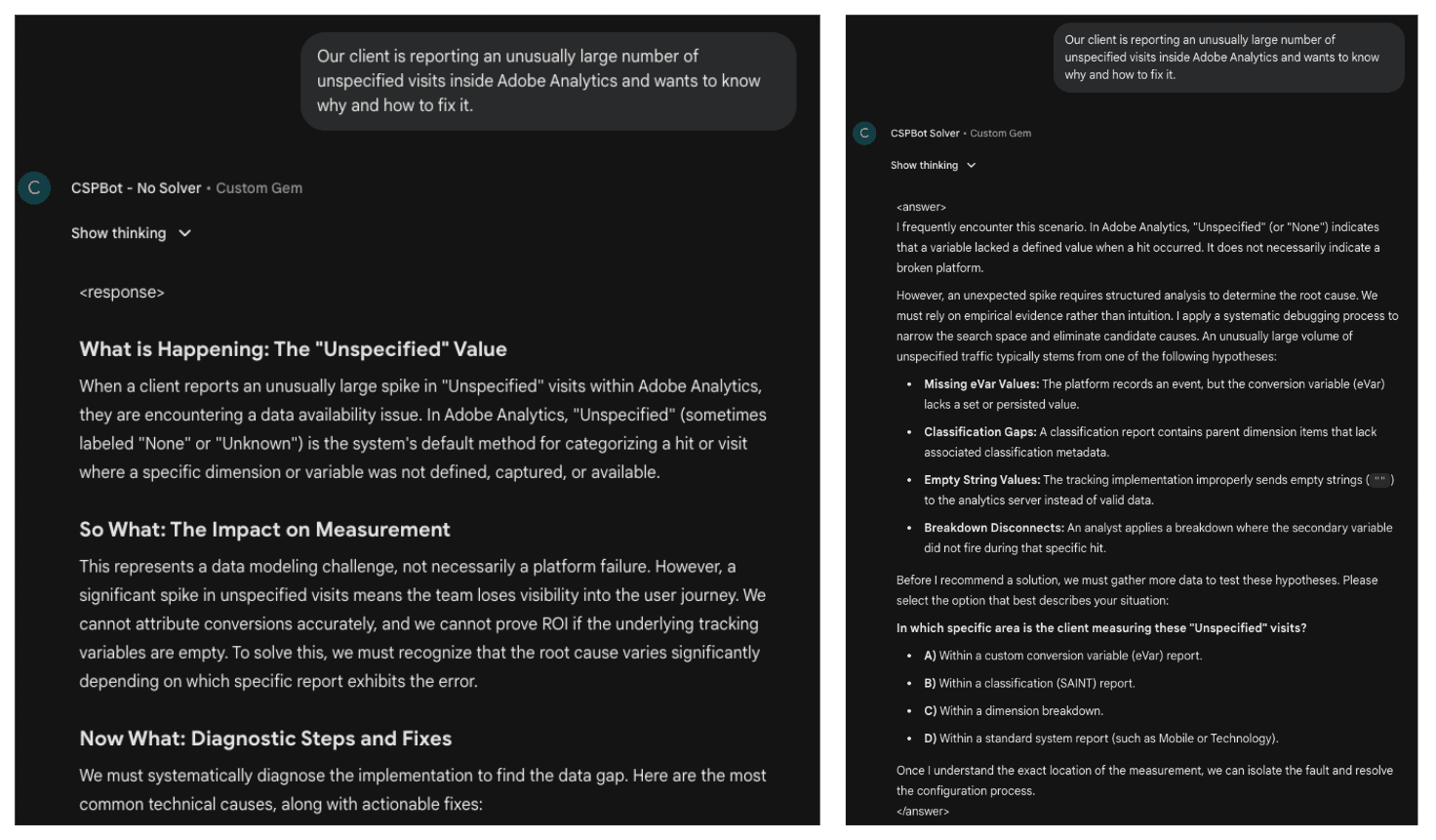
On the left, we see the problem solving routine without my thinking styles added. The language model – Gemini 3.1 Pro – dives right in and starts to answer.
On the right, we see the problem solving routine develops a tree of different choices and then asks the user for more feedback before leaping to conclusions.
As the real human behind this, the version on the right is MUCH closer to how I solve this problem than the version on the left. The thinking analysis does a better job of approximating me.
For those who know me well, you know that neither one is how I write or speak. Why is that? Because the Trust Insights Writing Style Guide mandates a way of speaking and writing that represents a more polished, more ideal version of ourselves, avoiding condescending language, speaking in the active voice, trying to be helpful and reassuring.
Because we have actual transcripts in the NotebookLM database that contain my real speech, there’s a real non-zero chance that the language model might reply like the real me – “well, no, that’s really stupid, why did you do that?” is something I’d say (especially in an internal team meeting) that would be out of alignment with our professional tone outside the four walls of the company.
We want the virtual version of me to be the best version of me – knowledgeable, patient, and helpful, not the cranky version of me after a red-eye flight back from an event.
This wraps up the series on creating a virtual version of yourself. You can see how much work goes into it if you want to do it right, if you want to accurately capture yourself and not a caricature of yourself. Shameless plug, if learning how to do this is of interest to you, Trust Insights can help.

- New!💡 Case Study: Predictive Analytics for Revenue Growth
- Case Study: Exploratory Data Analysis and Natural Language Processing
- Case Study: Google Analytics Audit and Attribution
- Case Study: Natural Language Processing
- Case Study: SEO Audit and Competitive Strategy

Almost every AI course is the same, conceptually. They show you how to prompt, how to set things up – the cooking equivalents of how to use a blender or how to cook a dish. These are foundation skills, and while they’re good and important, you know what’s missing from all of them? How to run a restaurant successfully. That’s the big miss. We’re so focused on the how that we completely lose sight of the why and the what.
This is why our capstone course, the AI-Ready Strategist, is different. It’s not a collection of prompting techniques or a set of recipes; it’s about why we do things with AI. AI strategy has nothing to do with prompting or the shiny object of the day — it has everything to do with extracting value from AI and avoiding preventable disasters. This course is for everyone in a decision-making capacity because it answers the questions almost every AI hype artist ignores: Why are you even considering AI in the first place? What will you do with it? If your AI strategy is the equivalent of obsessing over blenders while your steakhouse goes out of business, this is the course to get you back on course.
👉 Take this course now to become an AI leader

Here’s a roundup of who’s hiring, based on positions shared in the Analytics for Marketers Slack group and other communities.
- Associate Director, Medical Strategy at EVERSANA INTOUCH
- Director – Media Analytics at NielsenIQ
- Head Of Demand Generation at CloudOne Digital
- Head Of Digital Marketing & Growth at WMP Eyewear
- Head Of Email / Director – Usa (East Coast) at Sendfluence
- Head Of Marketing Demand Generation at Nurse Life Coach Academy
- Head Of Marketing at RevPilots
- Head Of Premium Growth at Confidential
- Marketing Director (Remote) at DEMAND.com
- Marketing Director at Flerish Hydration
- Vice President Marketing Communications at Clinq
- Vp Of Marketing & Communications, Elections at Jobgether

Are you a member of our free Slack group, Analytics for Marketers? Join 4000+ like-minded marketers who care about data and measuring their success. Membership is free – join today. Members also receive sneak peeks of upcoming data, credible third-party studies we find and like, and much more. Join today!

Where can you find Trust Insights face-to-face?
- SSI, Charlotte, April 2026
- SmarterX Writers’ Summit, May 2026
- SMPS AEC.AI, November 2026
- MarketingProfs B2B Forum, November 2026
Going to a conference we should know about? Reach out!
Want some private training at your company? Ask us!

First and most obvious – if you want to talk to us about something specific, especially something we can help with, hit up our contact form.
Where do you spend your time online? Chances are, we’re there too, and would enjoy sharing with you. Here’s where we are – see you there?
- Our blog
- Slack
- YouTube
- In-Ear Insights on Apple Podcasts
- In-Ear Insights on Google Podcasts
- In-Ear Insights on all other podcasting software
Read our disclosures statement for more details, but we’re also compensated by our partners if you buy something through us.
Imagine a world where your marketing strategies are supercharged by the most cutting-edge technology available – Generative AI. Generative AI has the potential to save you incredible amounts of time and money, and you have the opportunity to be at the forefront. Get up to speed on using generative AI in your business in a thoughtful way with our workshop offering, Generative AI for Marketers.
Workshops: Offer the Generative AI for Marketers half and full day workshops at your company. These hands-on sessions are packed with exercises, resources and practical tips that you can implement immediately.
👉 Click/tap here to book a workshop

Some events and partners have purchased sponsorships in this newsletter and as a result, Trust Insights receives financial compensation for promoting them. Read our full disclosures statement on our website.

Thanks for subscribing and supporting us. Let us know if you want to see something different or have any feedback for us!
|
Need help with your marketing AI and analytics? |
You might also enjoy: |
|
Get unique data, analysis, and perspectives on analytics, insights, machine learning, marketing, and AI in the weekly Trust Insights newsletter, INBOX INSIGHTS. Subscribe now for free; new issues every Wednesday! |
Want to learn more about data, analytics, and insights? Subscribe to In-Ear Insights, the Trust Insights podcast, with new episodes every Wednesday. |
Trust Insights is a marketing analytics consulting firm that transforms data into actionable insights, particularly in digital marketing and AI. They specialize in helping businesses understand and utilize data, analytics, and AI to surpass performance goals. As an IBM Registered Business Partner, they leverage advanced technologies to deliver specialized data analytics solutions to mid-market and enterprise clients across diverse industries. Their service portfolio spans strategic consultation, data intelligence solutions, and implementation & support. Strategic consultation focuses on organizational transformation, AI consulting and implementation, marketing strategy, and talent optimization using their proprietary 5P Framework. Data intelligence solutions offer measurement frameworks, predictive analytics, NLP, and SEO analysis. Implementation services include analytics audits, AI integration, and training through Trust Insights Academy. Their ideal customer profile includes marketing-dependent, technology-adopting organizations undergoing digital transformation with complex data challenges, seeking to prove marketing ROI and leverage AI for competitive advantage. Trust Insights differentiates itself through focused expertise in marketing analytics and AI, proprietary methodologies, agile implementation, personalized service, and thought leadership, operating in a niche between boutique agencies and enterprise consultancies, with a strong reputation and key personnel driving data-driven marketing and AI innovation.
 Newsletter
 Podcast