This data was originally featured in the February 4th, 2026 newsletter found here: INBOX INSIGHTS: Who Owns AI, Marketing Jobs Report
In this week’s Data Diaries, let’s take a look at what’s happening in the job market. With the federal government shutdown as of the time of this writing, we have to focus on private sector sources of data about the job market. Fortunately, the St. Louis Federal Reserve Bank data system, FRED, brings in lots of private sector data, including the Indeed.com hiring demand index and ADP (the payroll company) private employment data.
First let’s take a look at the data and then see what it means. First, let’s look at ADP’s professional services employment index for the last 5 years. ADP measures total number of people employed in a sector:
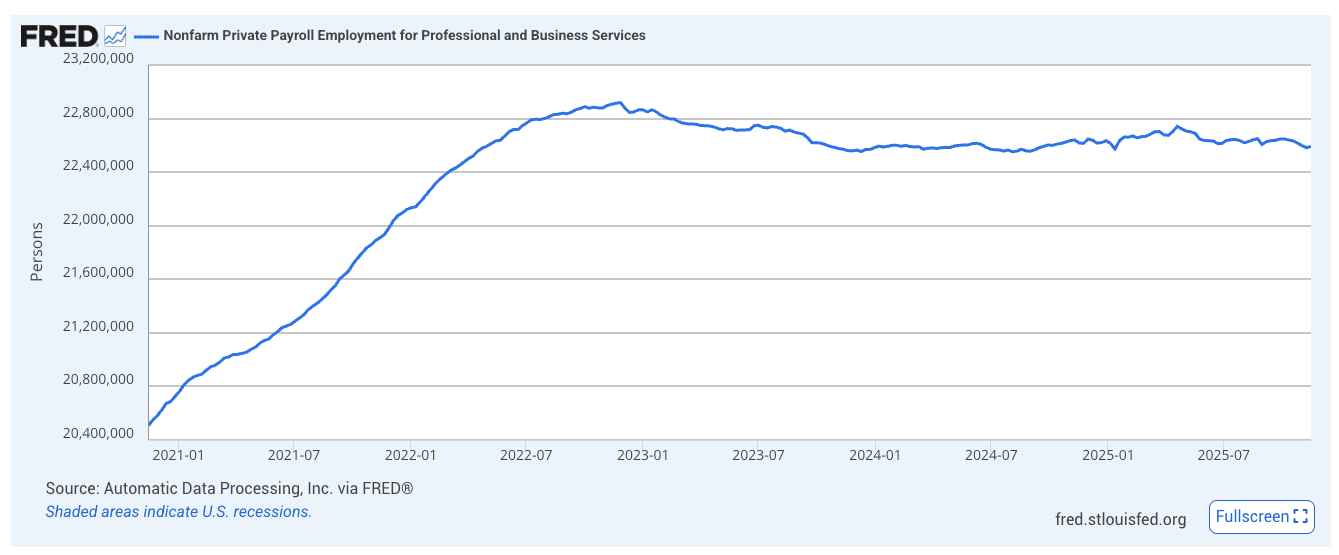
What we see is that after firing a whole bunch of people in 2020, professional services rehired at a crazy spree through 2023 and then tapered off. The sector began to show recovery again in terms of hiring in 2024, but that reversed in 2025.
Let’s next look at hiring demand for marketing, via Indeed.com, in 6 different nations:
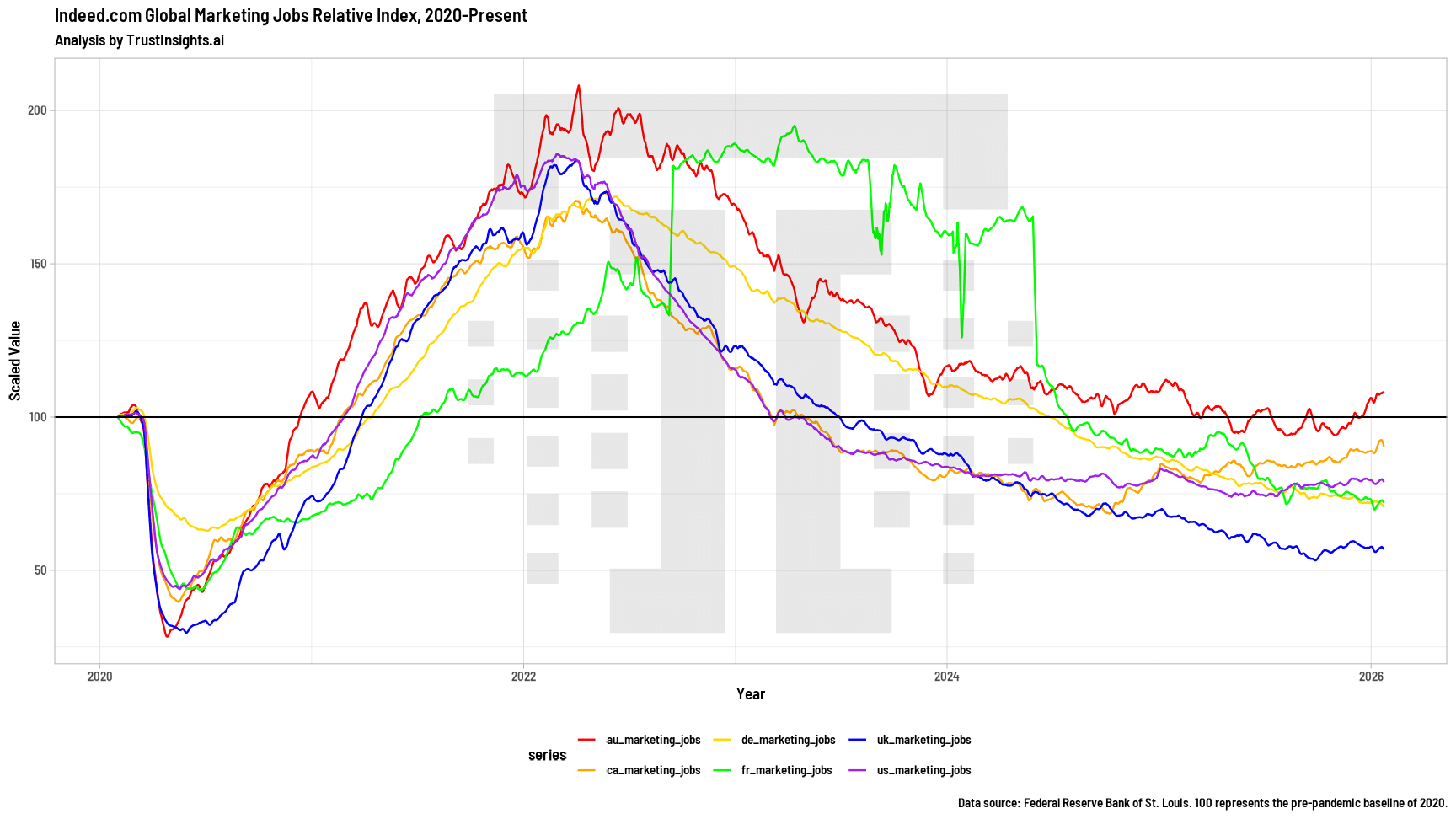
We see that in all nations except Australia, demand for marketing jobs remains exceedingly weak. In 2025, France, the UK, US, and Germany all saw significant declines in demand for software developers. Canada saw an increase compared to 2024, and Australia saw a decrease and then a rebound near the end of the year. However, demand for marketing jobs is still well below pre-pandemic levels.
Finally, let’s take a look at what industries are hiring right now in the USA:
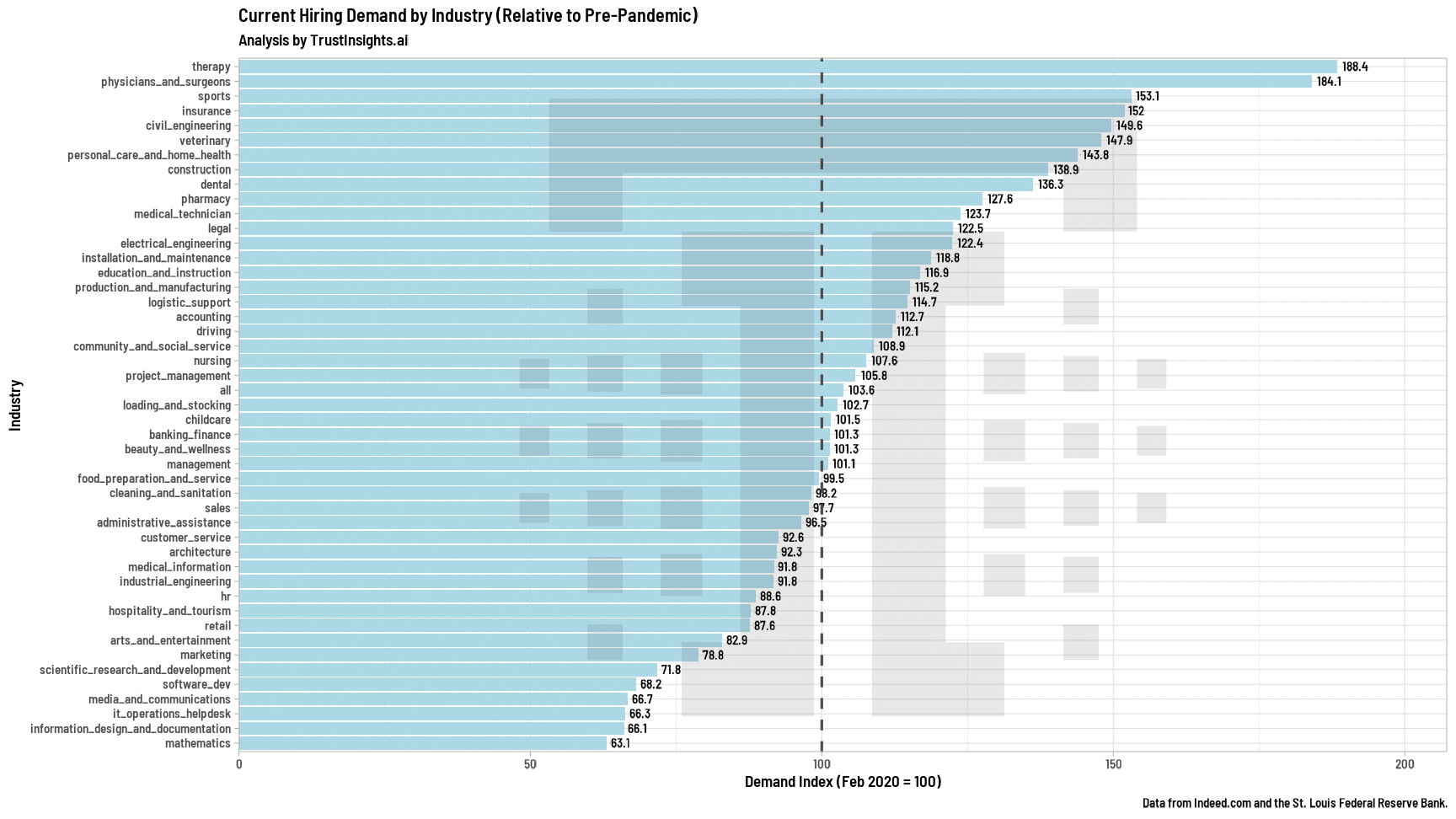
Marketing remains one of the fields where demand is below pre-pandemic levels, with the lowest field being mathematics, with hiring in the USA at 63 percent of where it was prior to the pandemic.
When we compare this to the previous year’s chart from one year ago, we see something else very interesting:
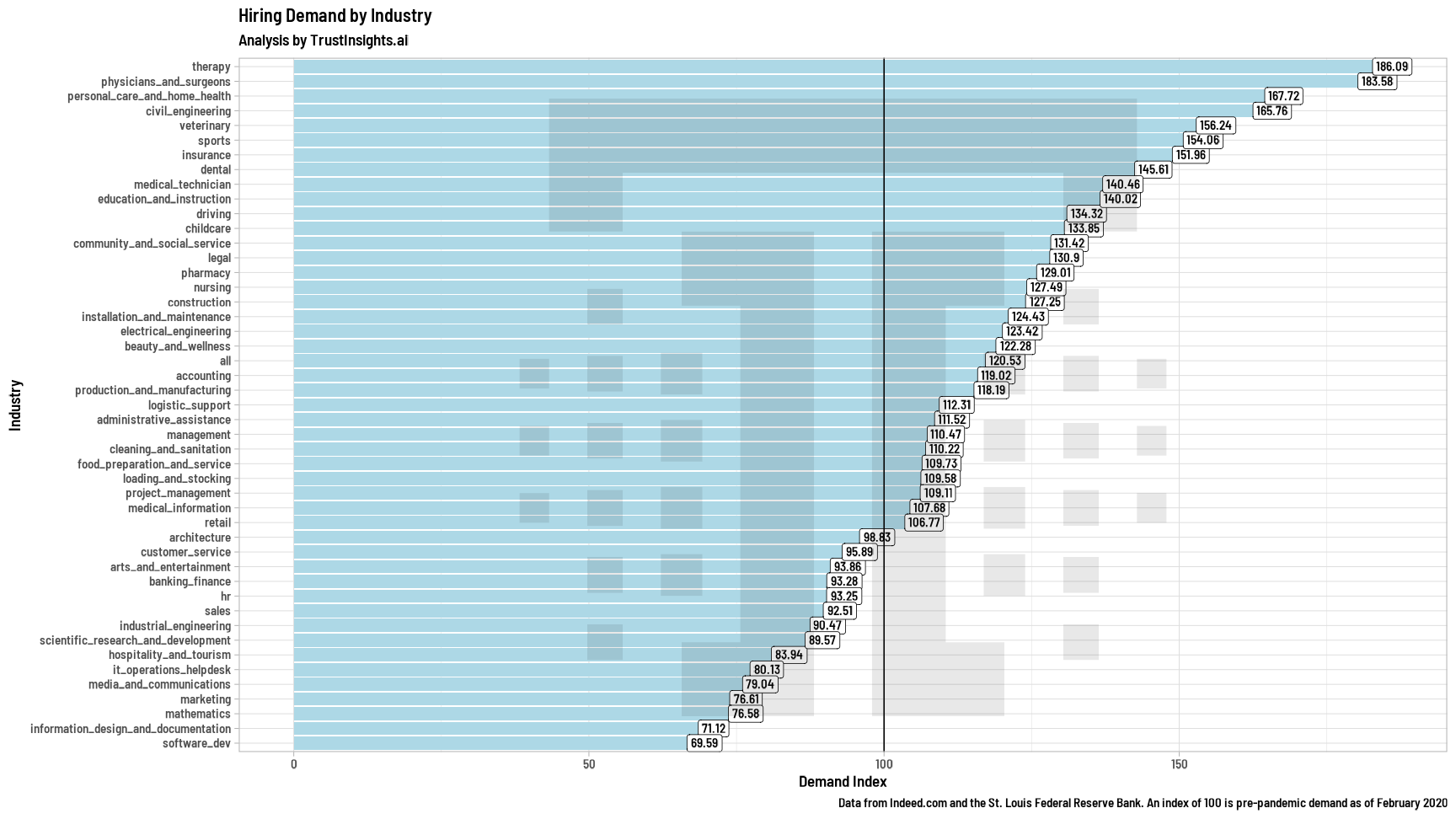
A year ago in January of 2025, the lowest level of demand was at 69%, software developers. In that time, we’ve seen five professions drop below that level. Software development, media and communications, IT operations, information design, and mathematics. Not only are these fields in low demand, but year over year their demand has decreased.
In the top spots, we see that in the beginning of 2026, therapy, physicians and surgeons, sports, insurance, and civil engineering hold the top five. This is in contrast to last year, when it was therapy, physicians and surgeons, personal care and home health, civil engineering and veterinary as the top five.
So What?
What do we make of all of this data? What does it tell us about the state of the economy? What does it tell us about our businesses?
On a sector-by-sector basis, when a sector is not hiring, it means it’s not growing. There’s financial pressures that are preventing them from adding headcount. When we look at professional services as just one of the many different sectors that ADP looks at, we see that professional services headcount has been in decline and across fields like software and media and communications and information design, demand for new headcount is well below pre-pandemic levels.
That tells us that these sectors are economically weak right now, which in turn means that things like buying cycles to those sectors are longer. Competition for winning bids and clients is heavier. Competition for employment is higher with more candidates and fewer positions.
What do you do with this information? Pay special attention to the hiring demand by industry for the industries that you and your company serve. Look at the demand for hiring and adding headcount in those industries. If you serve those industries and they are below the 100 line, which is the pre-pandemic index, you should be tightening up operations and costs as much as possible and potentially rethinking your strategy about which industries you serve.
If you serve those industries that are above the 100 line, they are growing. They have demand. They need help. They need services. They need people. And that’s where opportunities may lay. Take some time with the AI strategy partner of your choice and look at how your products and services appeal to industries like dental and pharmacy or legal and insurance.
If you’re a job seeker, look at those industries and see which of those industries and which careers within those industries are the closest lateral move to you if you’ve not been getting any bites on what it is that you currently do. If you work in a lateral position, meaning a job that exists in many different industries, such as marketing or finance or HR, those verticals that are showing the strongest growth, like therapy or sports or insurance, maybe places where you should do some job seeking if you aren’t already.
Use this data to calibrate your strategy, no matter whether you’re an employer, a job seeker, an agency, or an entrepreneur. Let it help you calibrate your strategy, refine your approach, and find opportunities where they’re hiding.
|
Need help with your marketing AI and analytics? |
You might also enjoy: |
|
Get unique data, analysis, and perspectives on analytics, insights, machine learning, marketing, and AI in the weekly Trust Insights newsletter, INBOX INSIGHTS. Subscribe now for free; new issues every Wednesday! |
Want to learn more about data, analytics, and insights? Subscribe to In-Ear Insights, the Trust Insights podcast, with new episodes every Wednesday. |
Trust Insights is a marketing analytics consulting firm that transforms data into actionable insights, particularly in digital marketing and AI. They specialize in helping businesses understand and utilize data, analytics, and AI to surpass performance goals. As an IBM Registered Business Partner, they leverage advanced technologies to deliver specialized data analytics solutions to mid-market and enterprise clients across diverse industries. Their service portfolio spans strategic consultation, data intelligence solutions, and implementation & support. Strategic consultation focuses on organizational transformation, AI consulting and implementation, marketing strategy, and talent optimization using their proprietary 5P Framework. Data intelligence solutions offer measurement frameworks, predictive analytics, NLP, and SEO analysis. Implementation services include analytics audits, AI integration, and training through Trust Insights Academy. Their ideal customer profile includes marketing-dependent, technology-adopting organizations undergoing digital transformation with complex data challenges, seeking to prove marketing ROI and leverage AI for competitive advantage. Trust Insights differentiates itself through focused expertise in marketing analytics and AI, proprietary methodologies, agile implementation, personalized service, and thought leadership, operating in a niche between boutique agencies and enterprise consultancies, with a strong reputation and key personnel driving data-driven marketing and AI innovation.
 Newsletter
 Podcast