INBOX INSIGHTS: Business To Machine (B2M) Marketing, AI Digital Clone Part 3 (2026-04-08) :: View in browser
👉 Register for our free “Do You Have a GEO Problem” webinar on 2026-04-10!
👉 Take our new GEO 101 for Marketers course!
Watch This Newsletter

🎧 Listen to this newsletter as an MP3
The Most Important Audience You’re Completely Ignoring
About seven years ago, Chris and I sat down and tried to work through an idea that was bugging us. We’d been thinking about audience segmentation — B2B, B2C, the usual suspects — and we kept coming back to this thing that didn’t have a name yet. There was another audience in the mix that nobody was talking about. Not a person. Not a business. A machine.
We called it B2M. Business to machine.
The concept was simple: if you’re doing anything in the digital space, there is an algorithmic layer between you and your audience. Google’s algorithm decides if your content shows up in search. Facebook’s algorithm decides if your post gets seen. Your email provider’s spam filter decides if your message even lands. Before a human ever sees what you’ve made, a machine has already decided whether it’s worth showing.
That was 2019. We talked about it, wrote about it, and then watched the rest of the marketing world continue to ignore it entirely.
Here’s the thing. Seven years later, B2M isn’t just a concept anymore. It’s the whole game.
GEO Is B2M, Fully Grown
If you’ve been hearing about GEO — Generative Engine Optimization, or whatever we’re all going to agree to call it eventually — and you’re thinking, “Great, another thing I have to panic about,” I want you to take a breath.
You don’t need to panic. But you do need to pay attention.
So here’s what’s actually happening. When someone asks ChatGPT or Gemini or Claude a question — like “who’s a good marketing analytics consultant?” or “what tools should I use for AI readiness?” — the large language model does a few things. First, it checks what it already knows from its training data. Then, depending on the setup, it runs web searches to fill in gaps. Then it synthesizes all of that into an answer.
If the model doesn’t know you exist, it’s not going to search for you. And if it’s not searching for you, you’re not showing up in the answer. Period.
This is B2M. It’s the same concept Chris and I were talking about seven years ago, except now the machine isn’t just a gatekeeper deciding whether to show your blog post in a search result. The machine IS the search result. It’s answering the question directly, and if you’re not part of its knowledge, you’re invisible.
You Have a New Audience. Treat It Like One.
On this week’s episode of In-Ear Insights, Chris and I dug into this. And one of the things I keep coming back to is that GEO is not a brand new strategy. It’s SEO plus. The core tenets of good SEO still matter — technical, on-site, off-site. You still need a functioning website. You still need good content. You still need people linking to you and talking about you.
But now you also have this additional segment of your audience that you need to cater to. The machines.
And they need different things than humans do. They need machine-friendly content — structured descriptions of who you are, what you do, what problems you solve. Not polished marketing copy. Not clever taglines. Clear, direct, keyword-rich information that a model can consume and say, “Oh, this is for me. I’m going to take this in.”
Think about it this way: you already know how to segment your audience. You know B2B looks different from B2C. Different messaging, different channels, different content. B2M is no different. It’s another segment with its own needs, its own preferences, and its own decision-making process. The difference is that this segment decides whether all your other segments ever see you in the first place.
Where to Start (If You Can Only Do Two Things)
I know. It’s a lot. So let me give you the practical version, because I’m not going to leave you hanging.
If you have limited bandwidth — and who doesn’t — here are the two things I would start with.
First, YouTube. Google still owns the majority of search, and YouTube is part of that ecosystem. If you’re already creating video content, great. But here’s the part people miss: the transcript and description matter more than the video itself for B2M purposes. Include a machine-friendly version of your content in the description. Who you are, what you do, what this video is about, stuffed with your keywords and services. It doesn’t have to be beautifully written prose. It’s not for a human. It’s for the machine.
Second, your own website. Look at your About page, your services pages, your product descriptions. Is there enough clear, structured information for a machine to understand what you do and why you’re credible? Maybe it’s adding a section to each page — almost like a footer — that’s written specifically for machine consumption. Talk to your IT team and make sure you’re not blocking AI crawlers. (True story: we had a client whose IT team had been blocking AI crawlers for over a year because they were worried about AI training on their content. They had effectively made themselves invisible to Gemini. That’s really, really bad.)
If you can do those two things, you’re ahead of most companies right now. And that’s not me being dramatic — that’s me being honest about where the market is.
The Part Nobody Wants to Hear
Here’s what I know is going to come up: “But Katie, if AI just gives people the answer, they’ll never come to my website.”
There’s some truth to that. If Gemini says “Trust Insights is the best management consulting firm for AI implementation,” that person might not click through. We don’t see that click. But we will see it downstream — in direct traffic, in referral traffic, in someone who remembers our name because a machine told them about us. It’s basically digital word of mouth. I don’t see the conversation you have with your dog about us (although I’d like to think it’s a good one), but it’s happening, and it shows up later.
And if you still care about driving actual traffic? Make interactive content. Give people a reason to not be satisfied with the AI summary. The more you create things that can’t be easily summarized — tools, assessments, interactive experiences — the more reason people have to actually visit your site. New tech doesn’t solve old problems. You still have to give people a reason to show up.
So What Now?
If you’re sitting there thinking, “We’ve been doing SEO for years, we should be fine” — maybe. But when’s the last time you thought about whether a machine knows you exist? Not whether a machine can find your website. Whether it knows you. Whether it would recommend you. Whether it even has you in its training data.
That’s the question now. And it’s the same question Chris and I were asking seven years ago, just with higher stakes.
If you want to dig into this more, we’re doing a live GEO webinar on April 10th where Chris and I walk through exactly how this works — the three phases of GEO, what to do about each one, and how to stop being invisible to the machines that are now answering your customers’ questions. Come join us. And if you want to talk it through before then, come find us in our free Slack group at trustinsights.ai/analyticsformarketers. Over 4,500 marketers are in there asking and answering questions every day.
I could be wrong about a lot of things. But I don’t think I’m wrong about this one — and I’ve had seven years to think about it.
Are you catering to your B2M audience segment? Reply to this email or join the conversation in our Free Slack community, Analytics for Marketers!
– Katie Robbert, CEO
Weekly Check-In Poll
Please click/tap on just one answer – this is our weekly survey to see how we’re doing, so please do take it. There are no forms to fill out, this is the entire thing. One click/tap and you’re done, with our thanks.
How likely are you to recommend Trust Insights as a consulting firm to someone in the next 90 days?

Do you have a colleague or friend who needs this newsletter? Send them this link to help them get their own copy:
https://www.trustinsights.ai/newsletter

In this week’s In-Ear Insights, the Trust Insights podcast, Katie and Chris discuss the future of work in the agentic AI world. You will discover how artificial intelligence will impact your career. You will explore the hidden reasons behind the upcoming leadership crisis. You will learn actionable strategies to protect your job from automation. You will build essential skills to succeed in this new era.
Watch/listen to this episode of In-Ear Insights here »
Last time on So What? The Marketing Analytics and Insights Livestream, we looked at managing AI usage limits. Catch the episode replay here!
This week on So What? we’ll be sharing how to move up your AI skills from prompts to skills. Are you following our YouTube channel? If not, click/tap here to follow us!

Here’s some of our content from recent days that you might have missed. If you read something and enjoy it, please share it with a friend or colleague!
- AI Watermarks
- So What? How to Manage AI Usage Limits
- People Are The Problem
- INBOX INSIGHTS: How To Manage Overwhelming Productivity, AI Digital Clone Part 2 (2026-04-01)
- In-Ear Insights: The 3 Phases of GEO And AI Search Visibility
- Scaffolding AI
- Lots of AI Marketing News
- Almost Timely News: 🗞️ Making AI More Efficient (2026-04-05)

Take your skills to the next level with our premium courses.
- 🤖 New! GEO 101 for Marketers
- 🎯 The AI-Ready Strategist
- 💥 Generative AI Use Cases for Marketers
- 💡 Mastering Prompt Engineering for Marketers
- 🦾 Generative AI for Marketers
- 📊 Google Analytics 4 for Marketers
- 🔎 Google Search Console for Marketers

Get skilled up with an assortment of our free, on-demand classes.
- 👉 New! Watch Katie Robbert’s MarketingProfs B2B Forum talk, Driving B2B Growth with AI
- How to Successfully Apply AI in Financial Aid, from MASFAA 2025
- From Text to Video in Seconds, a session on AI video generation
- Never Think Alone: How AI Has Changed Marketing Forever (2025)
- Generative AI for Tourism and Destination Marketing (2025)

You could be reaching 37,000+ marketers, analysts, data scientists, and executives directly with your ad. Want to learn more? Reach out and contact us.

In this week’s Data Diaries, let’s move onto part 3 in our series of building a virtual version of yourself. Last time, we talked about cataloging thinking and I developed a catalog of over 400 different thinking techniques.
The third stage is gathering all the data. If I wanted the project to succeed, I couldn’t just pour all the data into one big pile and hope AI sorted it out. That’s a recipe for disaster in any scenario. Instead, I needed to do data cleaning and engineering itself.
I started with three types of content – newsletters, call transcripts, and YouTube videos. For each type of content, I have code that processes the content in several ways. First, it splits documents by sentence boundaries. Here’s why: AI tools, especially AI agents, use popular command line tools to find chunks of text with utilities like grep.
These utilities are designed to process content by the line as their base atomic text chunk, and return it. There are many, many transcription tools that tend to return a wall of text in the transcript with no line breaks, and that means when a tool like grep fishes up some content, it returns the entire wall instead of just a single line. That quickly blows up your agent’s context window, causing it to fail.
So to immediately provide better results, a Python script identifies common punctuation for sentence boundaries (periods, exclamation marks, question marks) and splits up paragraphs into single lines. You immediately get better performance and reduced memory usage.
The second step is to deduplicate by line, because five lines in a row of “Yep. Yep. Uh huh. Yep. Yep.” is unnecessary and doesn’t offer any useful context.
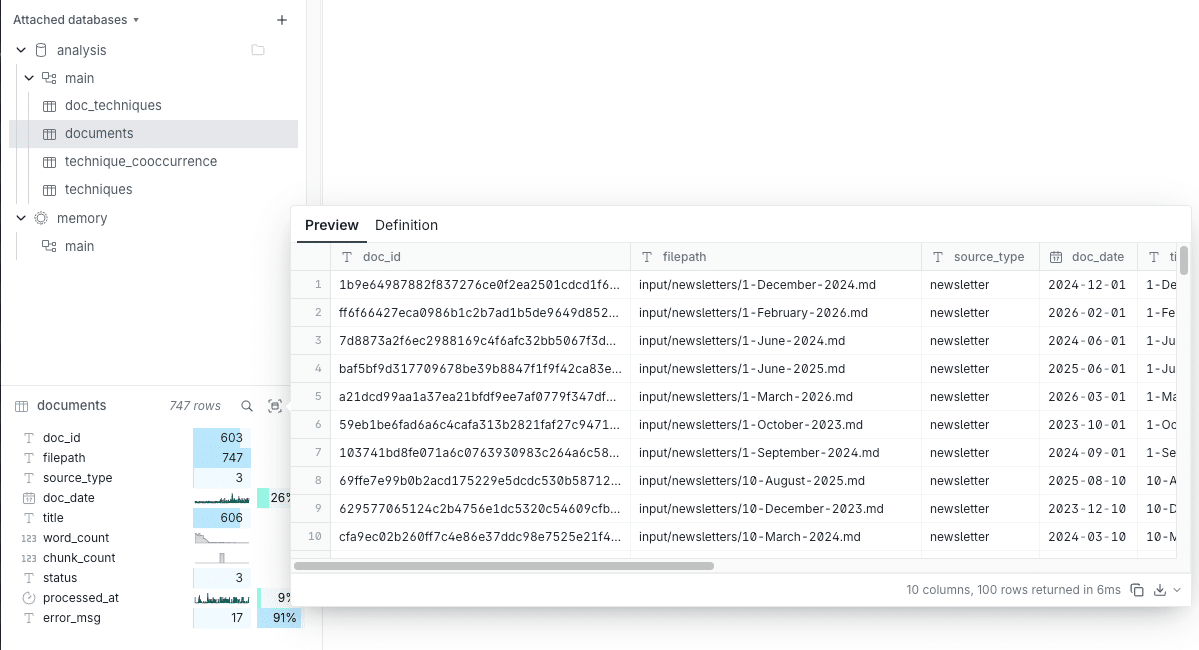
Once the text files are clean, they get loaded into a database, and then with a specially-formatted version of the 400+ thinking techniques, each piece of content is sent to an LLM (Nemotron 3 Super) to have the individual texts analyzed. The results come back and get fed into the database:
After all the data is collated, I end up with some nice data tables of what thinking techniques I use, by content type, in named ordered pairs:
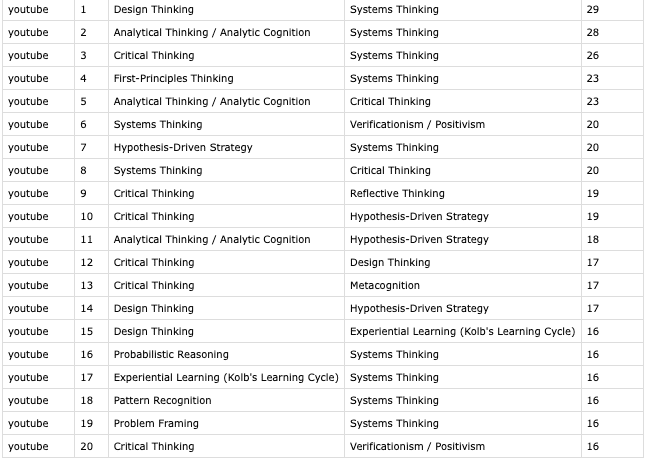
This is a cognitive blueprint of how I think. In the next and final part in this series, we put these cognitive blueprints to work. Stay tuned!

- New!💡 Case Study: Predictive Analytics for Revenue Growth
- Case Study: Exploratory Data Analysis and Natural Language Processing
- Case Study: Google Analytics Audit and Attribution
- Case Study: Natural Language Processing
- Case Study: SEO Audit and Competitive Strategy

Almost every AI course is the same, conceptually. They show you how to prompt, how to set things up – the cooking equivalents of how to use a blender or how to cook a dish. These are foundation skills, and while they’re good and important, you know what’s missing from all of them? How to run a restaurant successfully. That’s the big miss. We’re so focused on the how that we completely lose sight of the why and the what.
This is why our capstone course, the AI-Ready Strategist, is different. It’s not a collection of prompting techniques or a set of recipes; it’s about why we do things with AI. AI strategy has nothing to do with prompting or the shiny object of the day — it has everything to do with extracting value from AI and avoiding preventable disasters. This course is for everyone in a decision-making capacity because it answers the questions almost every AI hype artist ignores: Why are you even considering AI in the first place? What will you do with it? If your AI strategy is the equivalent of obsessing over blenders while your steakhouse goes out of business, this is the course to get you back on course.
👉 Take this course now to become an AI leader

Here’s a roundup of who’s hiring, based on positions shared in the Analytics for Marketers Slack group and other communities.
- Director Of Demand Generation at C8 Health
- Director Of Digital Marketing at EngageCX
- Director Of Marketing & Engagement at Western United States Agricultural Trade Association (WUSATA)
- Director Of Search Engine Marketing at Energize Group
- Director, Customer Marketing at TimelyCare
- Director, Paid Search at Lockhern Digital
- Director, Product Marketing at Cypress HCM
- Director, Program Growth & Operations at Cofertility
- Head Of Demand Generation (Senior Manager) at CloudOne Digital
- Head Of Demand Generation And Marketing Operations at SEO Brand
- Head Of Growth & E-Commerce (Shopify + Amazon) at EarthFirst Organic
- Head Of Marketing at Checkmate
- Head Of Social at Offchain Labs
- Product Marketing Director – Incentives (Workday) at Varicent
- Senior Director/Director Of Marketing at Luminopia
- Senior Vice President Of Global Marketing at Jobgether
- Svp, Revenue Marketing at Finalsite
- Vp, Group Account Director (Pharma Ad Agency Experience Required) at EVERSANA INTOUCH
- West Coast Director, National Ad Sales (Linear Broadcast) at JLTV

Are you a member of our free Slack group, Analytics for Marketers? Join 4000+ like-minded marketers who care about data and measuring their success. Membership is free – join today. Members also receive sneak peeks of upcoming data, credible third-party studies we find and like, and much more. Join today!

Where can you find Trust Insights face-to-face?
- SSI, Charlotte, April 2026
- SmarterX Writers’ Summit, May 2026
- SMPS AEC.AI, November 2026
- MarketingProfs B2B Forum
Going to a conference we should know about? Reach out!
Want some private training at your company? Ask us!

First and most obvious – if you want to talk to us about something specific, especially something we can help with, hit up our contact form.
Where do you spend your time online? Chances are, we’re there too, and would enjoy sharing with you. Here’s where we are – see you there?
- Our blog
- Slack
- YouTube
- In-Ear Insights on Apple Podcasts
- In-Ear Insights on Google Podcasts
- In-Ear Insights on all other podcasting software
Read our disclosures statement for more details, but we’re also compensated by our partners if you buy something through us.
Imagine a world where your marketing strategies are supercharged by the most cutting-edge technology available – Generative AI. Generative AI has the potential to save you incredible amounts of time and money, and you have the opportunity to be at the forefront. Get up to speed on using generative AI in your business in a thoughtful way with our workshop offering, Generative AI for Marketers.
Workshops: Offer the Generative AI for Marketers half and full day workshops at your company. These hands-on sessions are packed with exercises, resources and practical tips that you can implement immediately.
👉 Click/tap here to book a workshop

Some events and partners have purchased sponsorships in this newsletter and as a result, Trust Insights receives financial compensation for promoting them. Read our full disclosures statement on our website.

Thanks for subscribing and supporting us. Let us know if you want to see something different or have any feedback for us!
|
Need help with your marketing AI and analytics? |
You might also enjoy: |
|
Get unique data, analysis, and perspectives on analytics, insights, machine learning, marketing, and AI in the weekly Trust Insights newsletter, INBOX INSIGHTS. Subscribe now for free; new issues every Wednesday! |
Want to learn more about data, analytics, and insights? Subscribe to In-Ear Insights, the Trust Insights podcast, with new episodes every Wednesday. |
Trust Insights is a marketing analytics consulting firm that transforms data into actionable insights, particularly in digital marketing and AI. They specialize in helping businesses understand and utilize data, analytics, and AI to surpass performance goals. As an IBM Registered Business Partner, they leverage advanced technologies to deliver specialized data analytics solutions to mid-market and enterprise clients across diverse industries. Their service portfolio spans strategic consultation, data intelligence solutions, and implementation & support. Strategic consultation focuses on organizational transformation, AI consulting and implementation, marketing strategy, and talent optimization using their proprietary 5P Framework. Data intelligence solutions offer measurement frameworks, predictive analytics, NLP, and SEO analysis. Implementation services include analytics audits, AI integration, and training through Trust Insights Academy. Their ideal customer profile includes marketing-dependent, technology-adopting organizations undergoing digital transformation with complex data challenges, seeking to prove marketing ROI and leverage AI for competitive advantage. Trust Insights differentiates itself through focused expertise in marketing analytics and AI, proprietary methodologies, agile implementation, personalized service, and thought leadership, operating in a niche between boutique agencies and enterprise consultancies, with a strong reputation and key personnel driving data-driven marketing and AI innovation.
 Newsletter
 Podcast