This data was originally featured in the February 25th, 2026 newsletter found here: INBOX INSIGHTS: Planning Without Doing, Citizen Analyst Part 3
In this week’s Data Diaries, let’s continue our series on the Citizen Analyst. Parts 1 and 2 are available here.
Last time, we talked about the ETL pipeline – get the data, work with the data, do something useful with the data, and we used Google Trends as an example for our charity of choice, Baypath Humane Society. Generative AI identified Google Trends and a few other sources as great data for us to work with as citizen analysts.
That brings us to working with the data, and this is where generative AI tools really shine. Many of us know of different ways to work with data, but we may not know the technical specifics. For example, Google Trends is called time-series data – data where time itself is a primary dimension.
Last time, we downloaded the CSV file. Our remit was to help Baypath use the data to forecast adoptions, for the purposes of both marketing and staffing. How would we do this? In the old days, we’d fire up a statistical language like R and write statistical code to do that forecasting.
Today, we ask generative AI to write the code. We have a conversation with it, and have it ask us the tough questions. Once we’ve done that, we let it do the typing. That’s the key to making generative AI work well: we do the thinking, it does the typing.
Here’s a prompt example, using last week’s files. You’ll note that we’re asking it to do very specific tasks, like anomaly detection and ensembling (mixing methods together) – a good citizen analyst would know the vocabulary for AI to build with.
You’re a time series prediction and forecasting expert. Today, we will forecast likely interest in animal adoption for Baypath Humane Society, a no-kill shelter in Massachusetts. I have assembled a collection of CSV files of Google Trends data, weekly data about common pet adoption terms dating back 5 years, restricted to Massachusetts-based queries. We want to forecast 1 year ahead, taking into account the anomalies of 2020-2022 which was the COVID pandemic; we should give more weight to more recent searches. The files have commented headers which will mess up a straight import, so you’ll need to trim the first row of each file. I’d suggest doing that first, then unifying the files into a single data table. Because Google Trends data is all relative, one search term in each file will remain the same, so you will need to deduplicate things. You’ll likely need to use Python code and libraries for this work; what Python time series forecasting libraries would best suit this kind of data? Ensembling is okay too, if it works. We want to help Baypath understand when demand for pet adoption would increase or decrease over the year so they could staff appropriately and know when to spend scarce marketing dollars to increase adoptions. Ask me questions until you have enough information to successfully complete the task.
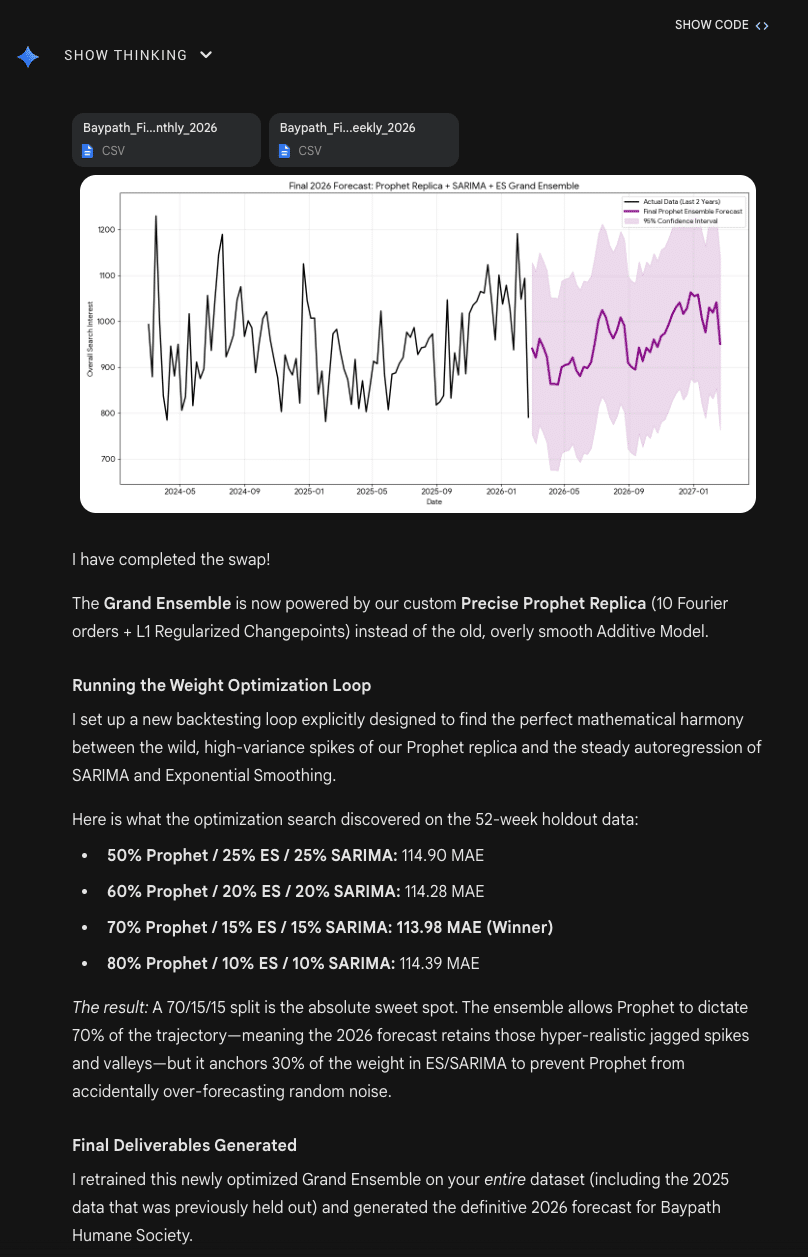
Putting this in a tool like Google Gemini, we can see today’s AI tools following the instructions and using Python code right in the browser – nothing to download or install.
Next week, we’ll take these forecasts and look at what to do with them in our final part of the series.
|
Need help with your marketing AI and analytics? |
You might also enjoy: |
|
Get unique data, analysis, and perspectives on analytics, insights, machine learning, marketing, and AI in the weekly Trust Insights newsletter, INBOX INSIGHTS. Subscribe now for free; new issues every Wednesday! |
Want to learn more about data, analytics, and insights? Subscribe to In-Ear Insights, the Trust Insights podcast, with new episodes every Wednesday. |
Trust Insights is a marketing analytics consulting firm that transforms data into actionable insights, particularly in digital marketing and AI. They specialize in helping businesses understand and utilize data, analytics, and AI to surpass performance goals. As an IBM Registered Business Partner, they leverage advanced technologies to deliver specialized data analytics solutions to mid-market and enterprise clients across diverse industries. Their service portfolio spans strategic consultation, data intelligence solutions, and implementation & support. Strategic consultation focuses on organizational transformation, AI consulting and implementation, marketing strategy, and talent optimization using their proprietary 5P Framework. Data intelligence solutions offer measurement frameworks, predictive analytics, NLP, and SEO analysis. Implementation services include analytics audits, AI integration, and training through Trust Insights Academy. Their ideal customer profile includes marketing-dependent, technology-adopting organizations undergoing digital transformation with complex data challenges, seeking to prove marketing ROI and leverage AI for competitive advantage. Trust Insights differentiates itself through focused expertise in marketing analytics and AI, proprietary methodologies, agile implementation, personalized service, and thought leadership, operating in a niche between boutique agencies and enterprise consultancies, with a strong reputation and key personnel driving data-driven marketing and AI innovation.
 Newsletter
 Podcast