INBOX INSIGHTS: Planning Without Doing, Citizen Analyst Part 3 (2026-02-25) :: View in browser
Two things to try out this week:
1. Got a stuck AI project? Try our free AI Readiness Assessment tool. A simple quiz to help predict project success.
2. Wonder how your website is seen by AI? Try our free AI View tool (limited to 10 URLs per day). It looks at your site and tells you what an AI crawler likely sees.
Watch This Newsletter

🎧 Listen to this newsletter as an MP3
Why We Plan, But Don’t Execute
Let me ask you something, and I want you to be honest with yourself: How closely are you actually tracking that Q1 roadmap you sat through endless hours of meetings to put together?
I’ll wait.
I posed this question to our free Slack community, Analytics for Marketers, last week. The responses were both hilarious and painfully relatable. One member shared that they were almost done setting the Q1 roadmap—and half of what was on it had already changed. Another admitted that their team loves to spend more time planning than doing. And honestly? I think most of us are nodding along right now.
But then the conversation took a turn that really made me stop and think. When I asked why companies seem so afraid to actually do something, the answer was blunt: they’re afraid to be held to the results, especially failure.
Yikes. But also… yeah. That tracks.
What Is CYA Paralysis?
One of our community members coined a term that I immediately wanted to steal for this newsletter: CYA Paralysis.
It’s the idea that organizations get so caught up in covering themselves—making sure no one person can be blamed if something goes wrong—that they end up doing… nothing. Or at least, nothing meaningful. Instead, they plan. And then they plan some more. They create another version of the roadmap. They schedule a meeting to discuss the roadmap. They form a committee to review the meeting notes about the roadmap.
Sound familiar?
Here’s what’s actually happening: planning feels productive. It looks productive. You’ve got documents, spreadsheets, slide decks, and Gantt charts. You can point to all that and say, “Look, we’re working on it.” But working on the plan isn’t the same as working on the thing.
Why We’d Rather Plan Than Do
Let’s break down what’s really going on because I think it goes deeper than just fear of failure.
Planning is safe. Nobody ever got fired for having a really thorough project plan. But the second you start executing, you’re exposed. Results can be measured. Outcomes can be judged. And if it doesn’t work? That’s on you (or at least, that’s what it feels like).
Planning feels like control. When everything is still in the planning phase, it’s all potential. Nothing has gone wrong yet. Every idea is still a good one. Execution is where reality shows up uninvited and starts poking holes in your beautiful strategy.
Planning has no accountability deadline. Think about it: how many times have you heard “we’re still finalizing the plan” used as a perfectly acceptable reason for not having started? There’s always one more stakeholder to consult, one more scenario to model, one more competitor to analyze. The plan is never quite done enough to act on—conveniently.
The Real Cost of Not Executing
Here’s the part that should make you uncomfortable: while you’re perfecting your roadmap, someone else is executing a mediocre one and learning from it. They’re iterating. They’re collecting real data. They’re finding out what actually works instead of guessing.
Meanwhile, your team is on version seven of a plan that’s already half-irrelevant because the market moved while you were in your planning meeting.
I’ve seen this play out more times than I can count, both at Trust Insights and in my consulting work with clients. The companies that consistently outperform aren’t the ones with the best plans. They’re the ones who are willing to execute an imperfect plan, measure the results, and adjust.
How to Break the Cycle
Ok, so what do you actually do about this? Here’s where I’ll pull out the 5P Framework, because (surprise) it’s designed for exactly this kind of problem.
- Purpose: Start by asking, “What is the one thing we need to accomplish this quarter?” Not ten things. One. If you can’t articulate a single, clear goal, that’s your first problem.
- People: Who is responsible for execution—not planning, execution? Assign a single owner. Not a committee. Not a “cross-functional team.” One person who will be accountable for making sure work gets done.
- Process: Set a hard deadline for when planning stops and doing starts. I mean it. Put it on the calendar. “Planning phase ends February 28. Execution begins March 1.” No exceptions, no extensions.
- Platform: What tools do you actually need to get started? Not which tools would be nice to have. Not which tools you should evaluate. What can you use right now to start moving?
- Performance: Define what “good enough” looks like before you begin. Not perfect. Not ideal. Good enough. Because here’s the thing—you can always optimize later, but only if you have something to optimize.
The Permission to Be Imperfect
I think the biggest mindset shift teams need to make is this: an executed plan that’s 70% right will always beat a perfect plan that never launches. Always.
You will learn more from doing than from planning. You will uncover problems you never would have anticipated in a planning meeting. And yes, some things will fail. That’s not a bug—that’s the whole point. Failure with data is infinitely more valuable than theoretical success on a whiteboard.
So here’s my challenge to you: look at your Q1 roadmap (assuming you can find it). Pick one thing on it. Just one. And commit to executing it this week. Not planning it further. Not socializing it with more stakeholders. Doing it.
Because we’re halfway through the quarter and the clock doesn’t care about your planning timeline.
Are you stuck in planning paralysis? Reply to this email or join the conversation in our Free Slack community, Analytics for Marketers!
– Katie Robbert, CEO
Weekly Check-In Poll
Please click/tap on just one answer – this is our weekly survey to see how we’re doing, so please do take it. There are no forms to fill out, this is the entire thing. One click/tap and you’re done, with our thanks.
How likely are you to recommend Trust Insights as a consulting firm to someone in the next 90 days?

Do you have a colleague or friend who needs this newsletter? Send them this link to help them get their own copy:
https://www.trustinsights.ai/newsletter

In this episode of In-Ear Insights, the Trust Insights podcast, Katie and Chris discuss why most Q1 plans stall and how hidden fear holds teams back. You’ll learn simple ways to turn a big roadmap into tiny actions you can start. You’ll discover how generative AI can suggest low‑risk steps that keep momentum without a big budget. You’ll explore how to break the blame cycle and build real progress even in risk‑averse companies. Watch the episode to start moving your plan forward.
Watch/listen to this episode of In-Ear Insights here »
Last time on So What? The Marketing Analytics and Insights Livestream, we looked at agentic AI for strategic analysis. Catch the episode replay here!
Are you following our YouTube channel? If not, click/tap here to follow us!

Here’s some of our content from recent days that you might have missed. If you read something and enjoy it, please share it with a friend or colleague!
- End of Year Purchases
- So What? Marketing Strategy Review with Agentic AI
- Frameworks as Sanity Checks
- INBOX INSIGHTS: Outsourcing Competitive Advantage, Citizen Analyst Part 2 (2026-02-18)
- In-Ear Insights: Cognitive Offloading, Deskilling, and The Impact of AI
- AI Performance Evaluation
- Year of the Horse Triggers AI Race!
- Almost Timely News: 🗞️ How To Get Started with Hosted Open Weights AI (2026-02-22)

Take your skills to the next level with our premium courses.
- 🎯 New! The AI-Ready Strategist
- 💥 Generative AI Use Cases for Marketers
- 💡 Mastering Prompt Engineering for Marketers
- 🦾 Generative AI for Marketers
- 📊 Google Analytics 4 for Marketers
- 🔎 Google Search Console for Marketers

Get skilled up with an assortment of our free, on-demand classes.
- 👉 New! Watch Katie Robbert’s MarketingProfs B2B Forum talk, Driving B2B Growth with AI
- How to Successfully Apply AI in Financial Aid, from MASFAA 2025
- From Text to Video in Seconds, a session on AI video generation
- Never Think Alone: How AI Has Changed Marketing Forever (2025)
- Generative AI for Tourism and Destination Marketing (2025)

You could be reaching 37,000+ marketers, analysts, data scientists, and executives directly with your ad. Want to learn more? Reach out and contact us.

In this week’s Data Diaries, let’s continue our series on the Citizen Analyst. Parts 1 and 2 are available here.
Last time, we talked about the ETL pipeline – get the data, work with the data, do something useful with the data, and we used Google Trends as an example for our charity of choice, Baypath Humane Society. Generative AI identified Google Trends and a few other sources as great data for us to work with as citizen analysts.
That brings us to working with the data, and this is where generative AI tools really shine. Many of us know of different ways to work with data, but we may not know the technical specifics. For example, Google Trends is called time-series data – data where time itself is a primary dimension.
Last time, we downloaded the CSV file. Our remit was to help Baypath use the data to forecast adoptions, for the purposes of both marketing and staffing. How would we do this? In the old days, we’d fire up a statistical language like R and write statistical code to do that forecasting.
Today, we ask generative AI to write the code. We have a conversation with it, and have it ask us the tough questions. Once we’ve done that, we let it do the typing. That’s the key to making generative AI work well: we do the thinking, it does the typing.
Here’s a prompt example, using last week’s files. You’ll note that we’re asking it to do very specific tasks, like anomaly detection and ensembling (mixing methods together) – a good citizen analyst would know the vocabulary for AI to build with.
You’re a time series prediction and forecasting expert. Today, we will forecast likely interest in animal adoption for Baypath Humane Society, a no-kill shelter in Massachusetts. I have assembled a collection of CSV files of Google Trends data, weekly data about common pet adoption terms dating back 5 years, restricted to Massachusetts-based queries. We want to forecast 1 year ahead, taking into account the anomalies of 2020-2022 which was the COVID pandemic; we should give more weight to more recent searches. The files have commented headers which will mess up a straight import, so you’ll need to trim the first row of each file. I’d suggest doing that first, then unifying the files into a single data table. Because Google Trends data is all relative, one search term in each file will remain the same, so you will need to deduplicate things. You’ll likely need to use Python code and libraries for this work; what Python time series forecasting libraries would best suit this kind of data? Ensembling is okay too, if it works. We want to help Baypath understand when demand for pet adoption would increase or decrease over the year so they could staff appropriately and know when to spend scarce marketing dollars to increase adoptions. Ask me questions until you have enough information to successfully complete the task.
Putting this in a tool like Google Gemini, we can see today’s AI tools following the instructions and using Python code right in the browser – nothing to download or install.
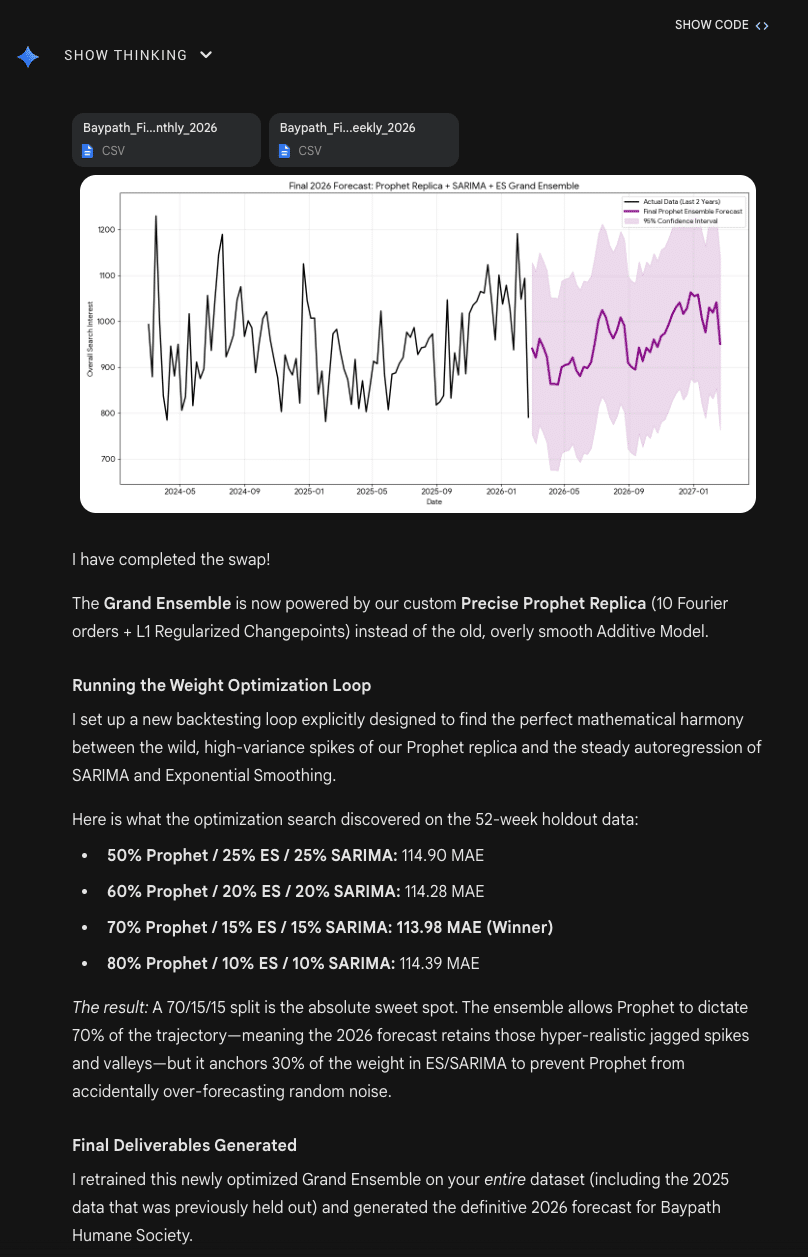
Next week, we’ll take these forecasts and look at what to do with them in our final part of the series.

- New!💡 Case Study: Predictive Analytics for Revenue Growth
- Case Study: Exploratory Data Analysis and Natural Language Processing
- Case Study: Google Analytics Audit and Attribution
- Case Study: Natural Language Processing
- Case Study: SEO Audit and Competitive Strategy

Almost every AI course is the same, conceptually. They show you how to prompt, how to set things up – the cooking equivalents of how to use a blender or how to cook a dish. These are foundation skills, and while they’re good and important, you know what’s missing from all of them? How to run a restaurant successfully. That’s the big miss. We’re so focused on the how that we completely lose sight of the why and the what.
This is why our new course, the AI-Ready Strategist, is different. It’s not a collection of prompting techniques or a set of recipes; it’s about why we do things with AI. AI strategy has nothing to do with prompting or the shiny object of the day — it has everything to do with extracting value from AI and avoiding preventable disasters. This course is for everyone in a decision-making capacity because it answers the questions almost every AI hype artist ignores: Why are you even considering AI in the first place? What will you do with it? If your AI strategy is the equivalent of obsessing over blenders while your steakhouse goes out of business, this is the course to get you back on course.
👉 Take this course now to become an AI leader

Here’s a roundup of who’s hiring, based on positions shared in the Analytics for Marketers Slack group and other communities.
- Chief Marketing Officer For Healthcare Venture Capital Fund at Healthcare Shares
- Director Of Product Marketing at Cortex
- Director Of Product Marketing at Scout Global
- Director Of Product Marketing, Cash And Home Lending at Wealthfront
- Director, Market Intelligence & Online Products at Mark Farrah Associates
- Head Of Marketing at Project Liberty
- Marketing Director (Growth & Revenue) – Payments/ Fintech at Finrec.io
- Senior Vice President Of Marketing at Blue Ocean Hire
- Vice President Marketing at Inside Sales Staff
- Vice President Marketing, Demand Generation B2b Saas at JJA.CO
- Vice President Of Marketing – Orum at Unusual Ventures
- Vp Marketing at Circit
- Vp Of Marketing at StarsHR, Inc.

Are you a member of our free Slack group, Analytics for Marketers? Join 4000+ like-minded marketers who care about data and measuring their success. Membership is free – join today. Members also receive sneak peeks of upcoming data, credible third-party studies we find and like, and much more. Join today!

Where can you find Trust Insights face-to-face?
- SSI, Charlotte, April 2026
- SMPS AEC.AI, November 2026
Going to a conference we should know about? Reach out!
Want some private training at your company? Ask us!

First and most obvious – if you want to talk to us about something specific, especially something we can help with, hit up our contact form.
Where do you spend your time online? Chances are, we’re there too, and would enjoy sharing with you. Here’s where we are – see you there?
- Our blog
- Slack
- YouTube
- In-Ear Insights on Apple Podcasts
- In-Ear Insights on Google Podcasts
- In-Ear Insights on all other podcasting software
Read our disclosures statement for more details, but we’re also compensated by our partners if you buy something through us.
Imagine a world where your marketing strategies are supercharged by the most cutting-edge technology available – Generative AI. Generative AI has the potential to save you incredible amounts of time and money, and you have the opportunity to be at the forefront. Get up to speed on using generative AI in your business in a thoughtful way with our workshop offering, Generative AI for Marketers.
Workshops: Offer the Generative AI for Marketers half and full day workshops at your company. These hands-on sessions are packed with exercises, resources and practical tips that you can implement immediately.
👉 Click/tap here to book a workshop

Some events and partners have purchased sponsorships in this newsletter and as a result, Trust Insights receives financial compensation for promoting them. Read our full disclosures statement on our website.

Thanks for subscribing and supporting us. Let us know if you want to see something different or have any feedback for us!
|
Need help with your marketing AI and analytics? |
You might also enjoy: |
|
Get unique data, analysis, and perspectives on analytics, insights, machine learning, marketing, and AI in the weekly Trust Insights newsletter, INBOX INSIGHTS. Subscribe now for free; new issues every Wednesday! |
Want to learn more about data, analytics, and insights? Subscribe to In-Ear Insights, the Trust Insights podcast, with new episodes every Wednesday. |
Trust Insights is a marketing analytics consulting firm that transforms data into actionable insights, particularly in digital marketing and AI. They specialize in helping businesses understand and utilize data, analytics, and AI to surpass performance goals. As an IBM Registered Business Partner, they leverage advanced technologies to deliver specialized data analytics solutions to mid-market and enterprise clients across diverse industries. Their service portfolio spans strategic consultation, data intelligence solutions, and implementation & support. Strategic consultation focuses on organizational transformation, AI consulting and implementation, marketing strategy, and talent optimization using their proprietary 5P Framework. Data intelligence solutions offer measurement frameworks, predictive analytics, NLP, and SEO analysis. Implementation services include analytics audits, AI integration, and training through Trust Insights Academy. Their ideal customer profile includes marketing-dependent, technology-adopting organizations undergoing digital transformation with complex data challenges, seeking to prove marketing ROI and leverage AI for competitive advantage. Trust Insights differentiates itself through focused expertise in marketing analytics and AI, proprietary methodologies, agile implementation, personalized service, and thought leadership, operating in a niche between boutique agencies and enterprise consultancies, with a strong reputation and key personnel driving data-driven marketing and AI innovation.
 Newsletter
 Podcast