INBOX INSIGHTS: Directing AI, AI Digital Clone Part 1 (2026-03-25) :: View in browser
👉 Take our new GEO 101 for Marketers course!
Watch This Newsletter

🎧 Listen to this newsletter as an MP3
Moving from Executing to Directing AI
If you know me, you know I have opinions about AI replacing people.
Strong ones. Loud ones. The kind that earns me the “ranty pants” label on LinkedIn.
So when I tell you I just rebuilt katierobbert.com using Claude’s Cowork mode — and I mean really rebuilt it, the whole site, over the course of two days — I need you to hear what I’m actually saying. Because it’s not “AI built my website.”
It’s “AI operationalized twenty years of my expertise into a website. And it didn’t write a single word I wouldn’t have written myself.”
Here’s the thing.
Most people are using AI backward. They open a tool, type a prompt, get generic output, and then spend more time fixing it than if they had just written the thing themselves. Sound familiar?
That happens because they’re starting at Platform—the fourth P in the 5P Framework by Trust Insights™—and skipping Purpose, People, and Process entirely.
I didn’t do that.
We started with Purpose. (Obviously)
Before we touched a single tool or wrote a word of copy, I had to answer the question I ask every client: what is this site actually for? Because katierobbert.com had been sitting there for a while without a clear reason to exist. Was it a portfolio? A blog? A consulting page? A vanity URL? If I couldn’t articulate the purpose, no amount of AI was going to fix that.
So we worked through it. The site exists to establish my authority as a speaker, strategist, and CEO — separate from Trust Insights — and to give people a place to book me, hire my company, or read my thinking. That clarity shaped every page we built. Without it, we would have just been making pretty pages that didn’t go anywhere.
Then we documented my brain.
Before I wrote any website copy, I worked with Claude to build the system. Not the website. The system. I fed it my existing materials — bios, podcast transcripts, blog posts, LinkedIn content, framework documentation — and together we built a comprehensive writing style guide that captures how I actually think and communicate. My signature phrases (“here’s the thing”), my anti-patterns (if I ever say “in today’s rapidly evolving landscape,” check me into a hospital), my argument structure, how I use vulnerability, how I close a post. The AI analyzed my patterns. I validated them. Over 500 lines of documented voice patterns — built collaboratively, not from scratch.
Then we built a brand system. Not “pick some nice colors.” A real brand guide — my color palette (forest greens, warm ambers, dark mode), typography rules (Rubik across the board, weight variations for hierarchy), visual tone rules, logo usage guidelines, the whole thing codified into a format AI can reference every time it works on my stuff.
Then a WordPress theme skill. Block patterns, CSS class conventions, page structure rules — so that any content generated would actually work inside my site’s existing architecture without a developer having to clean it up.
And then I packaged all three of those into a reusable plugin. So every time I open a new session with Claude on this project, it’s not starting from scratch. It’s starting from me. My brain. My brand. My technical setup. Every time.
Here’s what we actually built across two days — no code, no developers:
And when I say “we,” I want to be specific about what that means. Claude Cowork is an autonomous AI agent. I wasn’t typing code. I wasn’t manually editing CSS. I wasn’t handwriting meta descriptions. I was directing — giving strategic input, making decisions, approving or correcting output, and pointing Claude at my existing materials. The AI did the execution. I did the thinking.
That’s a meaningful distinction. Because the work that happened below? I didn’t do most of it with my hands. I did it with my brain.
Session one was about building the foundation and the first pages:
- Created a comprehensive writing style guide documenting my voice across seven different modes (ranty pants, teaching, vulnerable, CEO, collaborative, podcast, thought leadership) — including good vs. bad examples so the AI knows exactly what “sounds like Katie” means
- Built a complete brand system skill with color palettes, typography hierarchy, spacing rules, and visual identity guidelines
- Built a WordPress theme skill documenting block markup patterns, CSS custom properties, and page structure conventions
- Packaged it all into a reusable Cowork plugin that persists across sessions
- Completely rebuilt the About page from scratch — pulling from my existing bios, speaking history, credentials, and frameworks (such as 5P, TRIPS, 7D, 9C) to write a full page in my documented voice
- Built the Speaking page with a speaker bio, topic areas, and past engagements
- Built the Hire Trust Insights page, positioning our consulting and workshop services
- Built the Contact page
- Fixed a duplicate title CSS bug that was affecting every page on the site
- Set up Rank Math SEO on the Homepage and About page — custom meta titles, descriptions, and focus keywords
- Pulled in existing Trust Insights blog content and resources to populate the blog — so the site launched with real content, not placeholder posts, drawing from work I had already published
Session two was about completing SEO across the remaining pages and polishing:
- Worked through the strategic purpose of the site itself — why does katierobbert.com need to exist separately from trustinsights.ai? Who is the audience? What action should someone take when they land here? That clarity drove the SEO and content decisions for every page
- Set up Rank Math SEO on the Speaking page (score went from 14 to 16 — that one needs more content to score higher, but the metadata is solid)
- Set up Rank Math SEO on the Hire Trust Insights page (score went from 15 to 56)
- Set up Rank Math SEO on the Contact page (score went from 8 to 47)
- Set up Rank Math SEO on the Blog page (score went from 6 to 71)
- Homepage went from 21 to 82; About page went from unscored to 80
- Cleared the WP Engine cache and verified the live site
Total pages built or rebuilt: 6. Total developers hired: zero. Total hours spent pretending to be someone I’m not: also zero.
My role in all this was strategic direction. I decided what the site needed to say. I pointed Claude at the right source materials. I corrected things that didn’t sound right. I made the judgment calls — which frameworks to highlight, what the CTAs should be, and how to position the brand. Claude handled the WordPress editing, the CSS fixes, the SEO configuration, and the content structuring. It navigated the admin panel, wrote the markup, and configured the plugins.
That’s what autonomous AI looks like when you use it well. You’re not a typist. You’re a director.
And the reusable plugin means the next time I need to update the site, write a new page, or create content, I don’t have to re-explain who I am or how my site works. It’s already there. That’s the Process piece of the 5P that most people skip.
So why did this work when most AI-generated content sounds like garbage?
Because the AI wasn’t generating my expertise. It was executing it.
Every word on that site traces back to something I created — a bio I wrote, a talk I gave, a framework I developed, a phrase I’ve been saying for years. The AI’s job was to organize it, structure it for the web, match my voice patterns, and apply it consistently across six pages. That’s execution. That’s what AI is good at.
What AI can’t do is have my twenty years in pharma, operations, management, and marketing technology. It can’t decide that people come before platforms. It can’t develop the 5P Framework. It can’t know that I hate the word “utilize” or that I’d rather say “dumb stuff that works” than “strategic optimization.”
That’s mine. And because I documented it, the AI could use it. Because I didn’t document it for an AI — I documented it because I’m a nerd who believes documentation is love. (That’s for nerds. I’m a nerd.)
Here’s where you come in.
If you’re sitting there thinking, “I should document my own voice and frameworks before I let AI loose on my content” — yes. You should. Here’s where to start:
- Write down your top 5 signature phrases. The things you say so often your team finishes your sentences
- Write down your anti-patterns. The words and approaches that make you cringe when you see them in your industry
- Document a framework that you use often. Transfer your thoughts onto a page without worrying about perfection
- Write a short “what I am NOT” list. Sometimes defining what you’re not is more useful than defining what you are
- Use all that as your starting brief the next time you work with any AI tool
The difference will stun you. Not because the AI got smarter. Because you gave it something worth executing.
I’m not saying AI replaces your expertise. I’m saying it operationalizes it. There’s a massive difference. And if you don’t see that difference yet — if your AI-generated content still sounds like everyone else’s AI-generated content — that’s not a tool problem. That’s a you-haven’t-done-the-work problem.
The good news? The work isn’t hard. It takes intention. And maybe a little bit of that documentation nerdiness I keep going on about.
How are you letting AI work for you? Reply to this email or join the conversation in our Free Slack community, Analytics for Marketers!
– Katie Robbert, CEO
Weekly Check-In Poll
Please click/tap on just one answer – this is our weekly survey to see how we’re doing, so please do take it. There are no forms to fill out, this is the entire thing. One click/tap and you’re done, with our thanks.
How likely are you to recommend Trust Insights as a consulting firm to someone in the next 90 days?

Do you have a colleague or friend who needs this newsletter? Send them this link to help them get their own copy:
https://www.trustinsights.ai/newsletter

In this week’s In-Ear Insights, the Trust Insights podcast, Katie and Chris discuss virtual versions, digital twins, and AI clones. You will uncover the process of building an artificial intelligence digital twin for routine tasks. You will explore the specific steps to map your unique thinking patterns into a custom prompt. You will unlock the secret to identifying the ideal duties for your virtual clone. You will master the art of preserving human relationships while your digital counterpart answers complex questions.
Watch/listen to this episode of In-Ear Insights here »
Last time on So What? The Marketing Analytics and Insights Livestream, we looked at the LinkedIn strategy and agentic AI. Catch the episode replay here!
This week on So What? we’ll be looking at agentic product marketing. Are you following our YouTube channel? If not, click/tap here to follow us!

Here’s some of our content from recent days that you might have missed. If you read something and enjoy it, please share it with a friend or colleague!
- Data in Motion
- So What? Analyzing Your LinkedIn Strategy with Agentic AI
- Growth
- INBOX INSIGHTS: AI Strategy Commonalities, B2B Marketing Writing and AI Part 2 (2026-03-18)
- In-Ear Insights: Balancing Authenticity In An AI Automated World
- Dark Data and AI
- Neo, Stages of AI Adoption, and Dungeon Crawler Carl
- Almost Timely News: 🗞️ The Five Levels of AI Enablement (2026-03-22)

Take your skills to the next level with our premium courses.
- 🤖 New! GEO 101 for Marketers
- 🎯 The AI-Ready Strategist
- 💥 Generative AI Use Cases for Marketers
- 💡 Mastering Prompt Engineering for Marketers
- 🦾 Generative AI for Marketers
- 📊 Google Analytics 4 for Marketers
- 🔎 Google Search Console for Marketers

Get skilled up with an assortment of our free, on-demand classes.
- 👉 New! Watch Katie Robbert’s MarketingProfs B2B Forum talk, Driving B2B Growth with AI
- How to Successfully Apply AI in Financial Aid, from MASFAA 2025
- From Text to Video in Seconds, a session on AI video generation
- Never Think Alone: How AI Has Changed Marketing Forever (2025)
- Generative AI for Tourism and Destination Marketing (2025)

You could be reaching 37,000+ marketers, analysts, data scientists, and executives directly with your ad. Want to learn more? Reach out and contact us.

In this week’s Data Diaries, let’s do part 1 in a series on creating a virtual version of you. As we talked about on this week’s podcast episode, creating a virtual version of yourself is not a light undertaking, not if you want to do it well.
We start, naturally, with the 5P Framework by Trust Insights™, but not just any version of it, the AI Readiness version. Let’s go through a handful of the questions about the project; if you don’t have yes or partially/in progress for most questions, then proceeding with a virtual version/digital twin/AI clone isn’t a good idea yet.
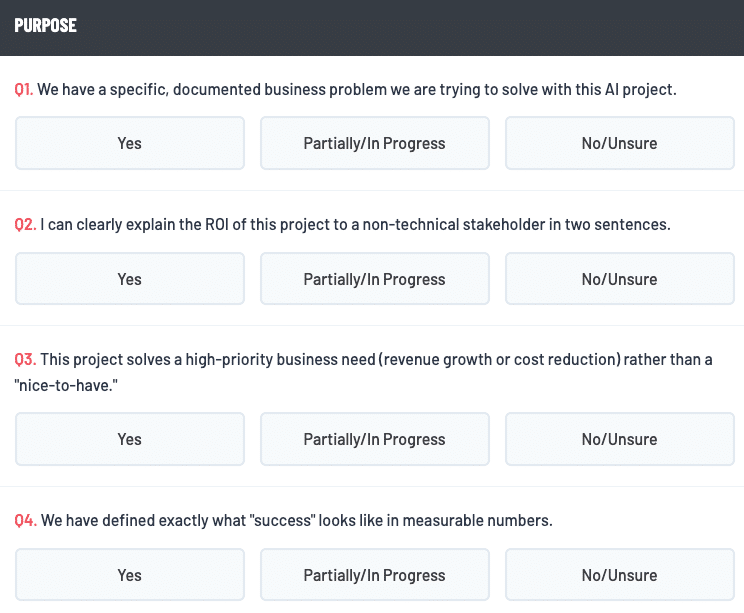
For a virtual verison, these first four questions are probably the most important:
- Q1. We have a specific, documented business problem we are trying to solve with this AI project.
- Q2. I can clearly explain the ROI of this project to a non-technical stakeholder in two sentences.
- Q3. This project solves a high-priority business need (revenue growth or cost reduction) rather than a “nice-to-have.”
- Q4. We have defined exactly what “success” looks like in measurable numbers.
For the virtual version of myself that we’re building for Trust Insights, these answers are super clear:
- A1: We need to have a backup version of me so that when I’m traveling, our clients can get timely answers that are as good as the answers they’d get from me on their most common problems.
- A2: ROI is always (earned – spent) / (spent). We have very clear spending figures, hard dollar costs for API calls (about $6). Soft dollar costs (my time) will be significantly more. Where we would mark this partially/in progress is the earnings side, because in the case of things like client retention, calculating what you “earned” by not losing a client or diminishing service is a fairly challenging measurement task.
- A3: This project solves a very high priority business need – maintaining the highest levels of client service no matter what’s going on with the humans underneath the service layer.
- A4: Success in this particular project can be measured in time to response – when I’m traveling and speaking at events, my response times can sometimes be a day or two later. With a digital twin, the Trust Insights team could respond in less than an hour, perhaps even in minutes.
For any kind of digital twin project, go through the AI Readiness Assessment first. After you’ve answered honestly, if your virtual version idea doesn’t score a B or higher, take some time to reflect on what specific answers you’d need to provide and what additional planning you need to do to ensure that it’s positioned for success.
In the next several issues, we’ll look at the preparatory work needed to assemble your virtual version of yourself, then how you process that data, and ultimately how you create your first draft of your new self. Stay tuned!

- New!💡 Case Study: Predictive Analytics for Revenue Growth
- Case Study: Exploratory Data Analysis and Natural Language Processing
- Case Study: Google Analytics Audit and Attribution
- Case Study: Natural Language Processing
- Case Study: SEO Audit and Competitive Strategy

Almost every AI course is the same, conceptually. They show you how to prompt, how to set things up – the cooking equivalents of how to use a blender or how to cook a dish. These are foundation skills, and while they’re good and important, you know what’s missing from all of them? How to run a restaurant successfully. That’s the big miss. We’re so focused on the how that we completely lose sight of the why and the what.
This is why our capstone course, the AI-Ready Strategist, is different. It’s not a collection of prompting techniques or a set of recipes; it’s about why we do things with AI. AI strategy has nothing to do with prompting or the shiny object of the day — it has everything to do with extracting value from AI and avoiding preventable disasters. This course is for everyone in a decision-making capacity because it answers the questions almost every AI hype artist ignores: Why are you even considering AI in the first place? What will you do with it? If your AI strategy is the equivalent of obsessing over blenders while your steakhouse goes out of business, this is the course to get you back on course.
👉 Take this course now to become an AI leader

Here’s a roundup of who’s hiring, based on positions shared in the Analytics for Marketers Slack group and other communities.
- Avp, Group Account Director – Market Access Marketing at Precision Medicine Group
- Chief Marketing Officer For Healthcare Venture Capital Fund at Healthcare Shares
- Director Of Channel Marketing: Worker’s Comp at Zynex Medical
- Director Of Demand Generation (Remote) at Teramind
- Director Of Integrated Omnichannel Media Operations at M3 USA
- Director Of Product Marketing at Anvilogic
- Director, Growth Marketing at True Classic
- Director, Product Marketing at Jobgether
- Head Of Growth at Refine.ink
- Head Of Growth – Membership & Community Platforms at Impact Recruiting, LLC
- Head Of Marketing (First Marketing Hire) at Regatta Data
- Vp, Marketing & Communications at Cupix

Are you a member of our free Slack group, Analytics for Marketers? Join 4000+ like-minded marketers who care about data and measuring their success. Membership is free – join today. Members also receive sneak peeks of upcoming data, credible third-party studies we find and like, and much more. Join today!

Where can you find Trust Insights face-to-face?
- SSI, Charlotte, April 2026
- SMPS AEC.AI, November 2026
Going to a conference we should know about? Reach out!
Want some private training at your company? Ask us!

First and most obvious – if you want to talk to us about something specific, especially something we can help with, hit up our contact form.
Where do you spend your time online? Chances are, we’re there too, and would enjoy sharing with you. Here’s where we are – see you there?
- Our blog
- Slack
- YouTube
- In-Ear Insights on Apple Podcasts
- In-Ear Insights on Google Podcasts
- In-Ear Insights on all other podcasting software
Read our disclosures statement for more details, but we’re also compensated by our partners if you buy something through us.
Imagine a world where your marketing strategies are supercharged by the most cutting-edge technology available – Generative AI. Generative AI has the potential to save you incredible amounts of time and money, and you have the opportunity to be at the forefront. Get up to speed on using generative AI in your business in a thoughtful way with our workshop offering, Generative AI for Marketers.
Workshops: Offer the Generative AI for Marketers half and full day workshops at your company. These hands-on sessions are packed with exercises, resources and practical tips that you can implement immediately.
👉 Click/tap here to book a workshop

Some events and partners have purchased sponsorships in this newsletter and as a result, Trust Insights receives financial compensation for promoting them. Read our full disclosures statement on our website.

Thanks for subscribing and supporting us. Let us know if you want to see something different or have any feedback for us!
|
Need help with your marketing AI and analytics? |
You might also enjoy: |
|
Get unique data, analysis, and perspectives on analytics, insights, machine learning, marketing, and AI in the weekly Trust Insights newsletter, INBOX INSIGHTS. Subscribe now for free; new issues every Wednesday! |
Want to learn more about data, analytics, and insights? Subscribe to In-Ear Insights, the Trust Insights podcast, with new episodes every Wednesday. |
Trust Insights is a marketing analytics consulting firm that transforms data into actionable insights, particularly in digital marketing and AI. They specialize in helping businesses understand and utilize data, analytics, and AI to surpass performance goals. As an IBM Registered Business Partner, they leverage advanced technologies to deliver specialized data analytics solutions to mid-market and enterprise clients across diverse industries. Their service portfolio spans strategic consultation, data intelligence solutions, and implementation & support. Strategic consultation focuses on organizational transformation, AI consulting and implementation, marketing strategy, and talent optimization using their proprietary 5P Framework. Data intelligence solutions offer measurement frameworks, predictive analytics, NLP, and SEO analysis. Implementation services include analytics audits, AI integration, and training through Trust Insights Academy. Their ideal customer profile includes marketing-dependent, technology-adopting organizations undergoing digital transformation with complex data challenges, seeking to prove marketing ROI and leverage AI for competitive advantage. Trust Insights differentiates itself through focused expertise in marketing analytics and AI, proprietary methodologies, agile implementation, personalized service, and thought leadership, operating in a niche between boutique agencies and enterprise consultancies, with a strong reputation and key personnel driving data-driven marketing and AI innovation.
 Newsletter
 Podcast