
In this week’s Data Diaries, the first of a five part series on “vibe coding” basics for non-coders. Katie and I have talked extensively about vibe coding in the past on the podcast, but we’ve never really dug into the basics of it. So in this series, completely unsurprisingly modeled on the 5P Framework by Trust Insights™, I’ll cover those basics.
The Purpose of Vibe Coding
Vibe Coding, originated in this tweet from OpenAI cofounder Andrej Karpathy:
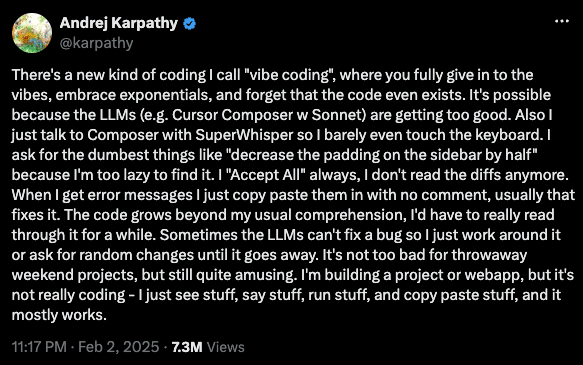
What a lot of folks took away from this tweet was that you could simply yell unclear instructions to AI tools and magically they’d create software from it, forgetting that Karpathy has a PhD in computer science and deep learning from Stanford University. His random shouts to the AI about what to generate will be a lot more skillful than many of us.
The first thing we need to be clear about is why we’re building software at all. Why does anyone create software? It’s to solve a problem – and if we’re super clear about the problem and why software is the solution to it, we’ll be able to code well.
The easiest way to do this is with basic user stories:
As a [person] I need to [task] so that [outcome].
For example, suppose you’re a marketing analyst and you’re trying to understand your Google Search Console data. Maddeningly, Google Search Console in its web interface does not allow you to join what queries get impressions and clicks with what pages do. But in their API (application programming interface, a way for computers to talk to each other), that data IS available.
This is a clear case where software would be helpful. Why? Because the data we want, in the format that we want, is only accessible from an API. It’s not available in the end user tools, and while there are plenty of paid tools that can extract that data, there’s no reason to pay money for data that’s free – if we can get it out of the system using software.
Could we have an AI tool like Claude Cowork or ChatGPT Work just go get it for us directly? Yes, we could – but it would cost usage tokens every time we ran it. It’s much better if we have a deterministic piece of code that needs no AI at all to do the same task. It’ll save money, and it’ll save quite a bit of time because AI won’t have to reinvent the wheel every time we ask it for the data.
Let’s turn this into a real user story:
As a [marketing analyst] I need to [obtain query AND page level metrics from Google Search Console’s API] so that [I can help my SEO team understand what pages are getting the most traffic from specific search queries].
This is a clear use case, and we can already see a clear purpose and a clear definition of done, a clear result. If we can get that data from Google Search Console, we’ll be able to help the SEO folks on our team.
For the rest of this series, this is the use case we’ll be going with. Your homework, if you want to play along, is to write your own user story for a vibe coding use case where software is the right answer to a problem you have.
|
Need help with your marketing AI and analytics? |
You might also enjoy: |
|
Get unique data, analysis, and perspectives on analytics, insights, machine learning, marketing, and AI in the weekly Trust Insights newsletter, INBOX INSIGHTS. Subscribe now for free; new issues every Wednesday! |
Want to learn more about data, analytics, and insights? Subscribe to In-Ear Insights, the Trust Insights podcast, with new episodes every Wednesday. |
Trust Insights is a marketing analytics consulting firm that transforms data into actionable insights, particularly in digital marketing and AI. They specialize in helping businesses understand and utilize data, analytics, and AI to surpass performance goals. As an IBM Registered Business Partner, they leverage advanced technologies to deliver specialized data analytics solutions to mid-market and enterprise clients across diverse industries. Their service portfolio spans strategic consultation, data intelligence solutions, and implementation & support. Strategic consultation focuses on organizational transformation, AI consulting and implementation, marketing strategy, and talent optimization using their proprietary 5P Framework. Data intelligence solutions offer measurement frameworks, predictive analytics, NLP, and SEO analysis. Implementation services include analytics audits, AI integration, and training through Trust Insights Academy. Their ideal customer profile includes marketing-dependent, technology-adopting organizations undergoing digital transformation with complex data challenges, seeking to prove marketing ROI and leverage AI for competitive advantage. Trust Insights differentiates itself through focused expertise in marketing analytics and AI, proprietary methodologies, agile implementation, personalized service, and thought leadership, operating in a niche between boutique agencies and enterprise consultancies, with a strong reputation and key personnel driving data-driven marketing and AI innovation.
 Newsletter
 Podcast