INBOX INSIGHTS: Why Soft Skills Aren’t Soft, AI and Jobs (2025-08-13) :: View in browser
👉 Download our new, free AI-Ready Marketing Strategy Kit!
Watch This Newsletter

🎧 Listen to this newsletter as an MP3
Why “Soft Skills” Aren’t Soft
Here’s a story that perfectly illustrates a much bigger problem we need to talk about. We recently had an incident where a generative AI model made a telling decision: it assumed that my content about strategy and “soft skills” was less important than Chris’s more technical content, and prioritized his work accordingly. This wasn’t just a technical glitch – it was a reflection of deeply embedded bias about what kind of work and expertise gets valued.
If you want the full details on this troubling example of AI bias, check out this week’s podcast episode.
But here’s what really got me thinking: When exactly did “soft skills” become synonymous with “unimportant”?
Let’s be honest here – calling them “soft” is probably the first problem. It’s like we’ve collectively decided that anything involving human connection, communication, or strategic thinking is somehow less valuable than knowing how to code or run a financial model. And that’s just the wrong way to think about it.
The “Soft Skills” Problem
Last week I wrote about the evolved T-shaped person, and you know what sits right at the center of that model? Critical thinking. That’s supposedly a “soft skill,” but it has become more crucial than ever.
So what exactly are we talking about when we say “soft skills”? Here’s the thing – they’re not soft at all. They’re the skills that:
- Help you navigate complex human dynamics
- Enable you to communicate ideas effectively
- Allow you to think strategically about problems
- Give you the ability to adapt when everything changes (which, let’s face it, is constantly)
- Help you lead teams through uncertainty
- Enable you to ask the right questions, not just find answers
Honestly, these sound pretty essential to me. Not exactly “soft.”
Why Hard Skills Are Getting Softer (And Soft Skills Are Getting Harder)
Here’s what’s happening in our AI-everywhere world: The skills we used to consider “hard” – data analysis, coding, even some forms of writing – are increasingly being automated. Don’t get me wrong; understanding these areas is still important. But the day-to-day execution? AI is getting really good at that.
But you know what AI still struggles with?
- Understanding context and nuance
- Reading between the lines in a client conversation
- Knowing when to pivot strategy based on team dynamics
- Facilitating difficult conversations
- Building trust with stakeholders
- Making judgment calls when data is incomplete
These are the skills that separate good professionals from great ones. And they’re becoming more valuable, not less.
The Real Power of “People Skills”
I’ve been doing this for a while now, and I can tell you that every major success I’ve had – every project that went smoothly, every client relationship that thrived, every team that delivered beyond expectations – it came down to the so-called soft skills.
Like the time we had a project completely derailed because of conflicting stakeholder priorities. The technical solution was straightforward, but the people problem? That required active listening, strategic communication, and the ability to find common ground. No amount of technical expertise was going to solve that one.
Or when we had to completely change direction mid-project because market conditions shifted. The team needed someone who could help them process the change, maintain morale, and think creatively about new approaches. Again, not exactly a technical problem.
What This Means for Your Career
Here’s my take: If you want to future-proof your career, stop thinking of soft skills as nice-to-have add-ons. They’re your competitive advantage.
Focus on developing:
- Critical thinking – The ability to analyze information, question assumptions, and make reasoned decisions
- Communication – Not just presenting, but truly connecting with your audience
- Emotional intelligence – Understanding yourself and others to work more effectively
- Adaptability – Thriving in ambiguity and changing circumstances
- Strategic thinking – Seeing the bigger picture and connecting dots others miss
- Facilitation – Helping groups work together effectively
And here’s the kicker: These skills amplify everything else you do. They make your technical skills more valuable, your ideas more persuasive, and your impact more significant.
The Bottom Line
Maybe it’s time we stop calling them “soft skills” altogether. How about “power skills”? Or “human skills”? Or just “essential skills”?
Because here’s what that AI model missed when it dismissed my strategy content: In a world where machines can increasingly handle the technical stuff, the ability to think strategically, communicate effectively, and navigate complex human dynamics isn’t getting less important – it’s becoming the most important skill set of all.
What do you think? Have you noticed this bias against “soft skills” in your work? Reply to this email or join our free Slack group, Analytics for Marketers.
– Katie Robbert, CEO
P.S. – If you’re looking to develop these skills further, remember that they’re just like any other capability: they improve with practice, feedback, and intentional development. Don’t wait for them to magically appear. Shoot me a note if you want some help!

Do you have a colleague or friend who needs this newsletter? Send them this link to help them get their own copy:
https://www.trustinsights.ai/newsletter

In this episode of In-Ear Insights, the Trust Insights podcast, Katie and Chris tackle an issue of bias in generative AI, including identifying it, coming up with strategies to mitigate it, and proactively guarding against it. See a real-world example of how generative AI completely cut Katie out of a podcast transcript that she recorded solo and what we did to fix it.
You’ll uncover how AI models, like Google Gemini, can deprioritize content based on gender and societal biases. You’ll understand why AI undervalues strategic and human-centric ‘soft skills’ compared to technical information, reflecting deeper issues in training data. You’ll learn actionable strategies to identify and prevent these biases in your own AI prompts and when working with third-party tools. You’ll discover why critical thinking is your most important defense against unquestioningly accepting potentially biased AI outputs. Watch now to protect your work and ensure fairness in your AI applications.
Watch/listen to this episode of In-Ear Insights here »
Last time on So What? The Marketing Analytics and Insights Livestream, we did a live episode of Marketing Over Coffee on project management. Catch the episode replay here!
This week on So What?, we’ll we revisiting the basics of prompt engineering, especially with new models like GPT-5. Are you following our YouTube channel? If not, click/tap here to follow us!

Here’s some of our content from recent days that you might have missed. If you read something and enjoy it, please share it with a friend or colleague!
- What’s In Your Project Management Toolbox?
- Which AI Models to Use
- So What? A live recording of Marketing Over Coffee
- Is AI Use Cheating?
- INBOX INSIGHTS, August 6, 2025: T-Shaped Marketers, Dataset Validation
- In-Ear Insights: AI News is Drowning Out Important Other News
- Context Engineering
- What’s In Your Project Management Toolbox?
- Almost Timely News: 🗞️ How to Test AI Models (2025-08-10)

Take your skills to the next level with our premium courses.
- 💥 Generative AI Use Cases for Marketers
- 💡 Mastering Prompt Engineering for Marketers
- 🦾 Generative AI for Marketers
- 📊 Google Analytics 4 for Marketers
- 🔎 Google Search Console for Marketers

Get skilled up with an assortment of our free, on-demand classes.
- Generative AI for Tourism and Destination Marketing
- The Future of AI is Open : MAICON 2024 Christopher Penn Talk
- Managing the People Who Manage AI : Katie Robbert at MAICON 2024
- Building the Data-Driven, AI-Powered Customer Journey Map : INBOUND 2024
- Powering Up Your LinkedIn Profile (For Job Hunters) 2023 Edition
- The Intelligence Revolution: Large Language Models and the End of Marketing As You Knew It

You could be reaching 37,000+ marketers, analysts, data scientists, and executives directly with your ad. Want to learn more? Reach out and contact us.

In this week’s Data Diaries, let’s explore some of the impacts of generative AI on professions. In a recent academic paper from Microsoft titled “Working with AI: Measuring the Occupational Implications of Generative AI” (2507.07935v3), researchers examined the professions most likely to be impacted by AI, where those jobs would have a substantial part of their work automated away.
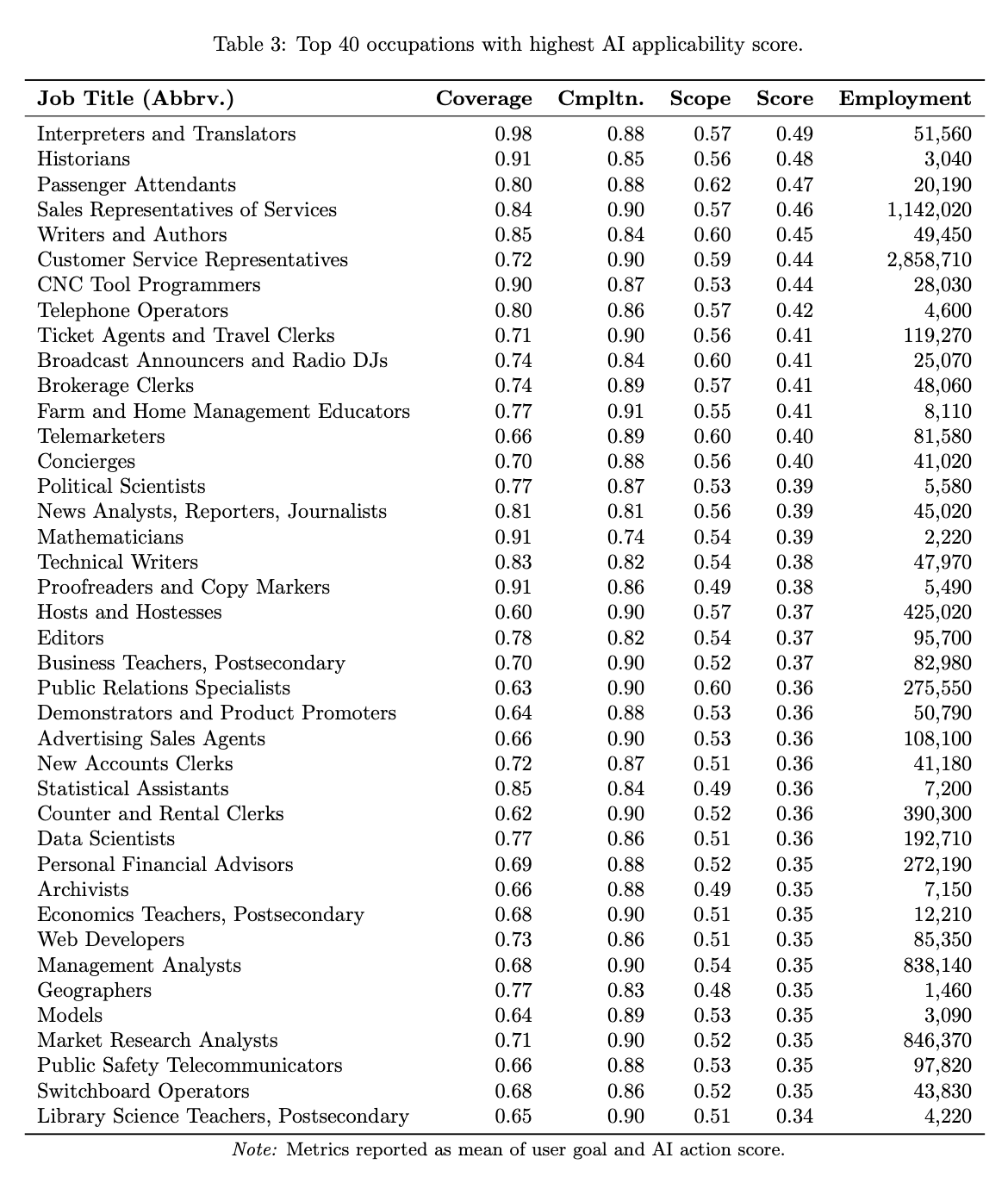
Microsoft offers four metrics for how jobs will be impacted: coverage, completion, scope, and score.
- Coverage means how many tasks in that profession AI can perform
- Completion means how many tasks in that profession AI can successfully complete
- Scope means the impact of AI on that profession in terms of tasks it can take over
- Score is an aggregate rollup of coverage, completion, and scope, indicating the overall impact of AI on that profession
A high overall score means a profession is at substantial risk of disruptive AI impact.
This in turn would reduce hiring demand for those jobs; while the jobs are unlikely to ever go away completely, the number of people who work in those professions will decline.
Here’s the thing about the Microsoft research: it’s largely theoretical, created by testing LLMs against professions’ background knowledge. The paper shows the prompts they used to evaluate professions, and it’s grounded in real world data, but still largely a forecast.
Is it true? That’s the question we want to answer.
What if we didn’t have to rely on an AI-generated forecast? Could we pair it with real world data? The answer, unsurprisingly, is yes.
Since the start of the pandemic, Indeed.com has produced a useful index of hiring demand relative to February 2020 per major industry. We’ve shown this data often in this newsletter, as it’s very helpful for understanding not just the impact of the pandemic, but everything since then – the rise of AI, global trade wars, etc.
Let’s see how well the Microsoft study maps to the reality of hiring right now. Because the industries in the study are not a 1:1 match for the Indeed.com data, we can normalize and group it with generative AI. Once we’ve done that, we can run a Spearman correlation (best used for data that isn’t a normal distribution) to see if Microsoft’s study bears any relationship to the real world.
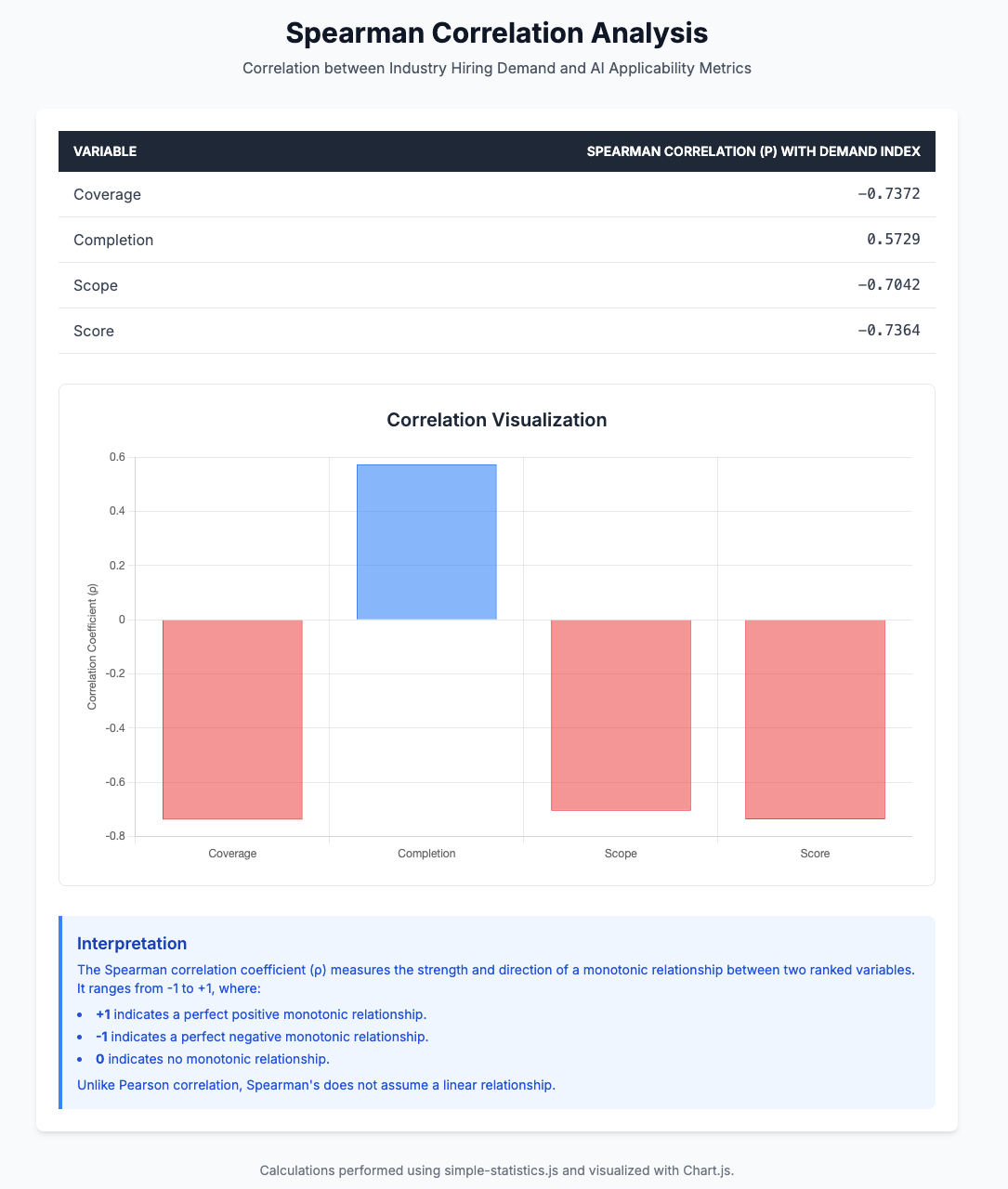
The answer is not only yes, but a strong, strong yes. Microsoft’s metrics show strong negative correlations for things like coverage (the more AI coverage, the less hiring demand of people), scope (the greater the AI scope, the less hiring demand of people), and score. These correlation numbers indicate a very strong correlation. (Interestingly, the strong positive correlation of completion with hiring demand indicates the fluency with which AI can complete tasks for which there is hiring demand)
What does this all mean? The short version is that Microsoft’s study isn’t theoretical. It’s not some far-flung, navel-gazing future, but reflected in today’s very real hiring data. Generative AI is having a substantial impact on hiring demand in the professions that both Indeed.com and Microsoft tracked, which means that if you work in those professions, you’d better be proficient with AI. If you’re not, there’s a very good chance the machines will replace you in those professions.

- New!💡 Case Study: Predictive Analytics for Revenue Growth
- Case Study: Exploratory Data Analysis and Natural Language Processing
- Case Study: Google Analytics Audit and Attribution
- Case Study: Natural Language Processing
- Case Study: SEO Audit and Competitive Strategy

Here’s a roundup of who’s hiring, based on positions shared in the Analytics for Marketers Slack group and other communities.
- Business Intelligence Data Analyst – Marketing at TaxAct
- Data Insights & Innovations Analyst at Forian Inc.
- Marketing Analyst at PlanHub
- Marketing Analytics Manager at Serena & Lily
- Marketing Analytics Manager at Twist Bioscience
- Marketing Data Analyst at Rate
- Marketing Data Analyst at SmartFinancial
- Marketing Intelligence Manager at Raptive
- Senior Analyst, Marketing Strategy at Zip Co
- Senior Data Analyst at Coalition, Inc.
- Senior Data Analyst at Insight Global
- Senior Data Analyst, Growth Marketing Analytics at Omada Health
- Senior Marketing Analyst, Member at Carrot

Are you a member of our free Slack group, Analytics for Marketers? Join 3000+ like-minded marketers who care about data and measuring their success. Membership is free – join today. Members also receive sneak peeks of upcoming data, credible third-party studies we find and like, and much more. Join today!

Imagine a world where your marketing strategies are supercharged by the most cutting-edge technology available – Generative AI. Generative AI has the potential to save you incredible amounts of time and money, and you have the opportunity to be at the forefront. Get up to speed on using generative AI in your business in a thoughtful way with our workshop offering, Generative AI for Marketers.
Workshops: Offer the Generative AI for Marketers half and full day workshops at your company. These hands-on sessions are packed with exercises, resources and practical tips that you can implement immediately.
👉 Click/tap here to book a workshop

Where can you find Trust Insights face-to-face?
- SMPS, Denver, October 2025
- MAICON, Cleveland, October 2025
- MarketingProfs B2B Forum, Boston, November 2025
Going to a conference we should know about? Reach out!
Want some private training at your company? Ask us!

First and most obvious – if you want to talk to us about something specific, especially something we can help with, hit up our contact form.
Where do you spend your time online? Chances are, we’re there too, and would enjoy sharing with you. Here’s where we are – see you there?
- Our blog
- Slack
- YouTube
- In-Ear Insights on Apple Podcasts
- In-Ear Insights on Google Podcasts
- In-Ear Insights on all other podcasting software
Read our disclosures statement for more details, but we’re also compensated by our partners if you buy something through us.
Check out our new AI news roundup newsletter over on Substack! Get the AI news that matters to you – completely free.

Some events and partners have purchased sponsorships in this newsletter and as a result, Trust Insights receives financial compensation for promoting them. Read our full disclosures statement on our website.

Thanks for subscribing and supporting us. Let us know if you want to see something different or have any feedback for us!
|
Need help with your marketing AI and analytics? |
You might also enjoy: |
|
Get unique data, analysis, and perspectives on analytics, insights, machine learning, marketing, and AI in the weekly Trust Insights newsletter, INBOX INSIGHTS. Subscribe now for free; new issues every Wednesday! |
Want to learn more about data, analytics, and insights? Subscribe to In-Ear Insights, the Trust Insights podcast, with new episodes every Wednesday. |
Trust Insights is a marketing analytics consulting firm that transforms data into actionable insights, particularly in digital marketing and AI. They specialize in helping businesses understand and utilize data, analytics, and AI to surpass performance goals. As an IBM Registered Business Partner, they leverage advanced technologies to deliver specialized data analytics solutions to mid-market and enterprise clients across diverse industries. Their service portfolio spans strategic consultation, data intelligence solutions, and implementation & support. Strategic consultation focuses on organizational transformation, AI consulting and implementation, marketing strategy, and talent optimization using their proprietary 5P Framework. Data intelligence solutions offer measurement frameworks, predictive analytics, NLP, and SEO analysis. Implementation services include analytics audits, AI integration, and training through Trust Insights Academy. Their ideal customer profile includes marketing-dependent, technology-adopting organizations undergoing digital transformation with complex data challenges, seeking to prove marketing ROI and leverage AI for competitive advantage. Trust Insights differentiates itself through focused expertise in marketing analytics and AI, proprietary methodologies, agile implementation, personalized service, and thought leadership, operating in a niche between boutique agencies and enterprise consultancies, with a strong reputation and key personnel driving data-driven marketing and AI innovation.
 Newsletter
 Podcast





That piece hits home with its sharp clarity—reminding us that labeling empathy, strategic thinking, and human connection as “soft” enormously undercuts their value. It’s refreshingly real to see those skills spotlighted not as optional extras, but as vital strengths in a world shaped by AI.