INBOX INSIGHTS: 5P Framework by Trust Insights™, B2B Marketing Writing and AI Part 1 (2026-03-11) :: View in browser
👉 Take our new GEO 101 for Marketers course!
Watch This Newsletter

🎧 Listen to this newsletter as an MP3
(Re)Introducing the 5P Framework by Trust Insights™
I have a confession: I used to think the problem with change management was that people didn’t follow the framework closely enough.
ADKAR. Kotter’s 8 Steps. Lewin’s Unfreeze-Change-Refreeze. I’ve tried all of them. They’re well-researched, well-intentioned, and — in many cases — they work. I’m not here to trash them.
But after years of leading digital transformations and AI adoption projects, I kept seeing the same thing happen: a team would pick a framework, follow it faithfully, execute every step — and still end up six months later with no way to tell whether the project actually worked.
Not because the framework failed. Because the framework never asked the right question in the first place.
Here’s what I mean. Most change management models assume you’ve already figured out why you’re doing this before you start. They assume someone, somewhere, has defined what success looks like. In practice? That almost never happens. People jump straight to the tool, the coalition, the 8-step plan — and the measurable question they were supposed to answer gets lost.
The gap nobody talks about
I went through the five most commonly used change management frameworks — ADKAR, Kotter, Lewin, McKinsey 7-S, and Bridges — and evaluated them across nine dimensions that actually matter when you’re running a real project. Things like: does this framework force you to define a measurable purpose? Does it address your people’s skills and willingness and psychological safety? Does it help you choose the right tools? Does it measure whether the change actually worked?
The pattern was striking. Every single model had at least one critical blind spot — and most of them shared the same two.
First: none of them require you to start with a measurable purpose. ADKAR starts with Awareness. Kotter starts with Urgency. Lewin starts with Unfreeze. Bridges starts with Letting Go. All valid starting points for managing change — but none of them ask, “What specific, measurable question are we trying to answer?” Without that, you can execute the framework perfectly and still have no idea whether the initiative was worth the disruption.
Second: none of them close the loop. Not one of the five major frameworks includes a built-in step for measuring performance against your original goal. Kotter’s final step is “Institute Change” — which is about embedding the change into culture, not measuring whether it produced the outcome you set out to achieve. ADKAR ends with Reinforcement — making the change stick, not proving it worked. There’s a difference.
This is the gap the 5P Framework by Trust Insights™ was built to fill. It bookends the traditional “People, Process, Technology” model with Purpose at the beginning and Performance at the end. Purpose forces you to state a measurable question before you touch anything else. Performance forces you to go back and answer it. Everything in between — People, Process, Platform — serves the Purpose and gets validated by Performance. It’s a simple structural change, but it eliminates the two most common reasons projects fail: unclear goals and unmeasured outcomes.
The frameworks aren’t wrong. They’re incomplete. And the missing pieces are the ones that matter most when someone asks, “Did this actually work?”
I wrote a full comparison — an honest look at what each model does well, where it stops short, and a side-by-side table across all nine dimensions so you can see exactly where the gaps are.
If you’ve ever followed a framework to the letter and still couldn’t prove the project was worth it, this is the piece that explains why.
Read the full comparison: The 5P Framework by Trust Insights vs. Other Change Management Models
And if you’re new to the 5P Framework entirely — or you want to see how it applies beyond change management to AI strategy, marketing audits, and more — we’ve built a full resource hub:
Explore the 5P Framework by Trust Insights™
How are you managing change in 2026? Reply to this email or join the conversation in our Free Slack community, Analytics for Marketers!
– Katie Robbert, CEO
Weekly Check-In Poll
Please click/tap on just one answer – this is our weekly survey to see how we’re doing, so please do take it. There are no forms to fill out, this is the entire thing. One click/tap and you’re done, with our thanks.
How likely are you to recommend Trust Insights as a consulting firm to someone in the next 90 days?

Do you have a colleague or friend who needs this newsletter? Send them this link to help them get their own copy:
https://www.trustinsights.ai/newsletter

In this episode of In-Ear Insights, the Trust Insights podcast, Katie and Chris discuss how to measure AI impact beyond speed. You’ll discover why quality matters more than volume when AI accelerates work. You’ll learn a six‑level framework that lets you map your AI skill growth. You’ll see practical steps to protect your role in fast‑moving companies.
Watch/listen to this episode of In-Ear Insights here »
Last time on So What? The Marketing Analytics and Insights Livestream, we looked at how to know if you have a GEO problem. Catch the episode replay here!
This week on So What? we’ll be examining the six levels of AI proficiency. Are you following our YouTube channel? If not, click/tap here to follow us!

Here’s some of our content from recent days that you might have missed. If you read something and enjoy it, please share it with a friend or colleague!
- Humanity At Risk
- So What? Do You Have A GEO Problem?
- 5P Framework by Trust Insights vs Other Change Management Models
- INBOX INSIGHTS: 7D AI Product Launch Framework, Citizen Analyst Part 4 (2026-03-04)
- In-Ear Insights: Switching AI Providers, Backup AI Capabilities
- Almost Timely News: 🗞️ How I Keep Up With Everything in AI (2026-03-08)

Take your skills to the next level with our premium courses.
- 🤖 New! GEO 101 for Marketers
- 🎯 The AI-Ready Strategist
- 💥 Generative AI Use Cases for Marketers
- 💡 Mastering Prompt Engineering for Marketers
- 🦾 Generative AI for Marketers
- 📊 Google Analytics 4 for Marketers
- 🔎 Google Search Console for Marketers

Get skilled up with an assortment of our free, on-demand classes.
- 👉 New! Watch Katie Robbert’s MarketingProfs B2B Forum talk, Driving B2B Growth with AI
- How to Successfully Apply AI in Financial Aid, from MASFAA 2025
- From Text to Video in Seconds, a session on AI video generation
- Never Think Alone: How AI Has Changed Marketing Forever (2025)
- Generative AI for Tourism and Destination Marketing (2025)

You could be reaching 37,000+ marketers, analysts, data scientists, and executives directly with your ad. Want to learn more? Reach out and contact us.

In this week’s Data Diaries, let’s talk about data, or the lack thereof. I routinely check LinkedIn every morning to see what’s happening among my network, and I saw a post recently speculating on how B2B writing has changed since the advent of generative AI.
In it, the author posited an interesting conclusion, that mediocre writing is now the norm and high quality writing has diminished. But the only proof point was an AI-generated chart with no citations or data labels.
This intrigued me. We covered the citizen analyst in an AI world in the last few issues of the newsletter, so this week I decided I would put those skills to the test. How could we prove or disprove this hypothesis, that generative AI has made B2B content more generic and less compelling?
Following the process from the past few weeks of extract, transform, and load, we first need to find B2B data. I chose three very distinct topics, one in an industry typically thought of as a lagging industry, industrial ball bearings (specifically the topic of angular ball bearings). The second topic was the consultant’s favorite: digital transformation. The third was financial services, the topic of debt service coverage ratio.
Why these three? Because they represent what I’d describe as the three phases of B2B content creation – industrial B2B tends to lag, financial services tends to be reasonably current, and folks creating content around digital transformation are fighting tooth and nail for any level of visibility, so they’re likely to use “cutting edge” tech like AI early on.
We need content to assess, so I grabbed 71,000 URLs from the AHREFS SEO software from 2011-present day, using the Crawl4AI Python package to extract the pages’ text to a central database. This took several days. Then, using Claude Code to process the data, our code scanned each article for 48 different writing metrics in 9 broad categories:
- Readability: how easily readable is the content?
- Vocabulary Richness: how linguistically rich is the content?
- Structural / Syntactic: how well structured are things like sentences?
- Tone: how emotional is the content?
- Passive Voice: how much passive voice?
- Convergence Signals: how predictable is the language?
- Descriptives: how rich is the language?
- Complexity: how unique is the vocabulary?
- Stylometry: how similar are pieces to each other?
What we would expect in an AI-forward world is that content would be more readable but more bland, a “Sea of Same” as our friend Jay Baer likes to quip. If the stereotypes about AI writing hold up, we should see incredibly predictable language, shallow, bland language, a drop in uniqueness, and high degrees of similarity. That’s essentially what AI slop is.
What do we actually see? Browse the results for yourself on our website!
Broadly speaking, we see for all 3 topics:
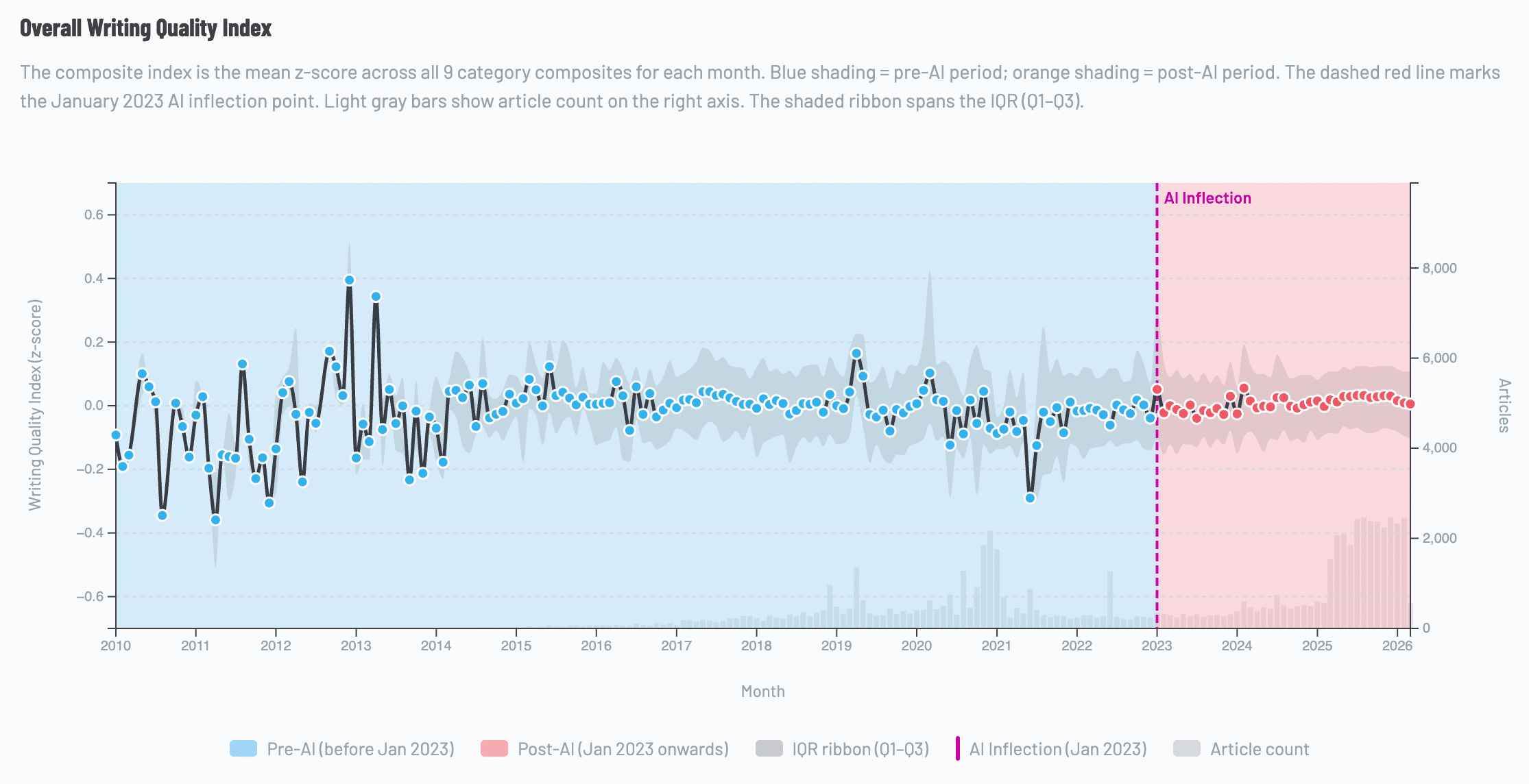
Over the past 10 years, using median as our measure of centrality, we see that writing quality broadly among these three topics has remained largely the same, but in the post-AI era has smoothed out and slightly improved.
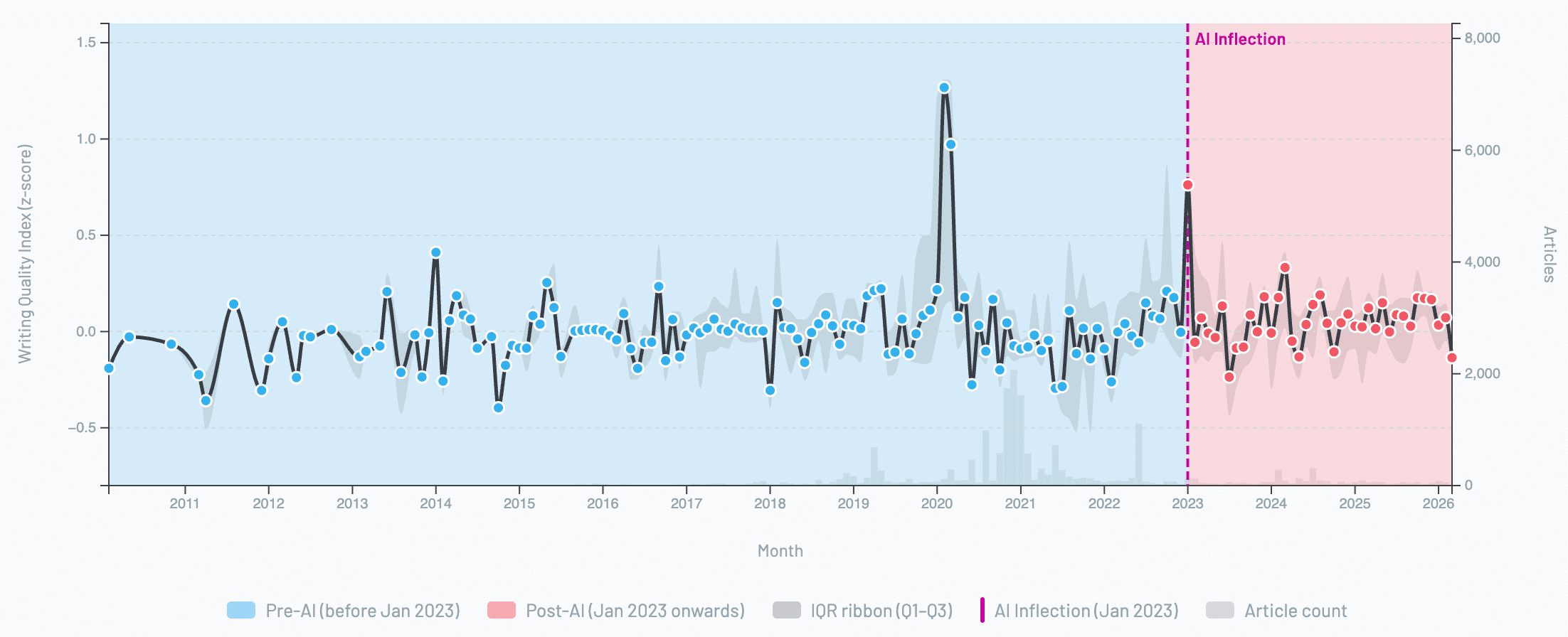
For ball bearings, we see almost no change. This might indicate that AI simply isn’t being used in this B2B sector, which is a reasonable assumption. Without investing in heavy fingerprinting of the content itself, we can’t determine from metrics alone whether or not AI is in heavy use. That said, we do not see a significant volume increase, either; one of the hallmarks of AI use is a difference in the volume of content created.
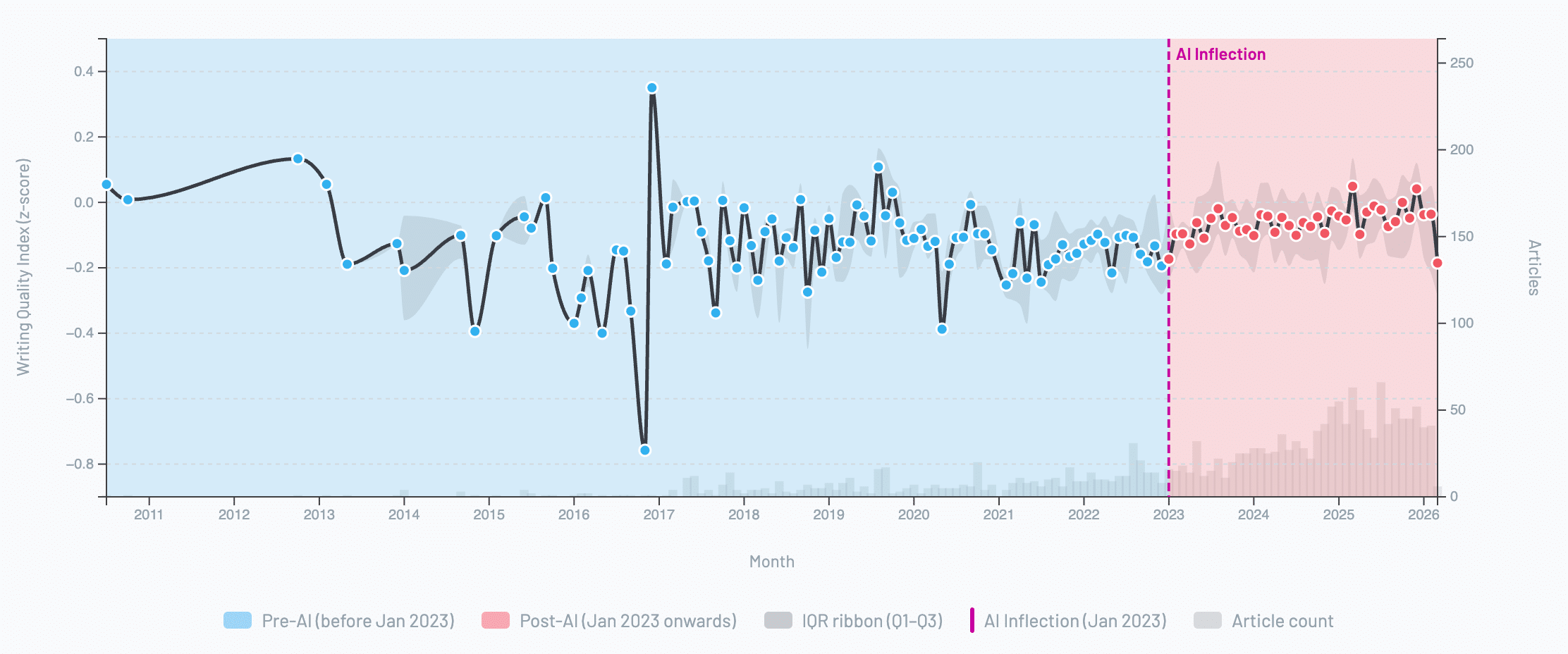
In financial services, we see the smoothing and quality increase, but more important, we see the volume increase substantially in the post-AI world.
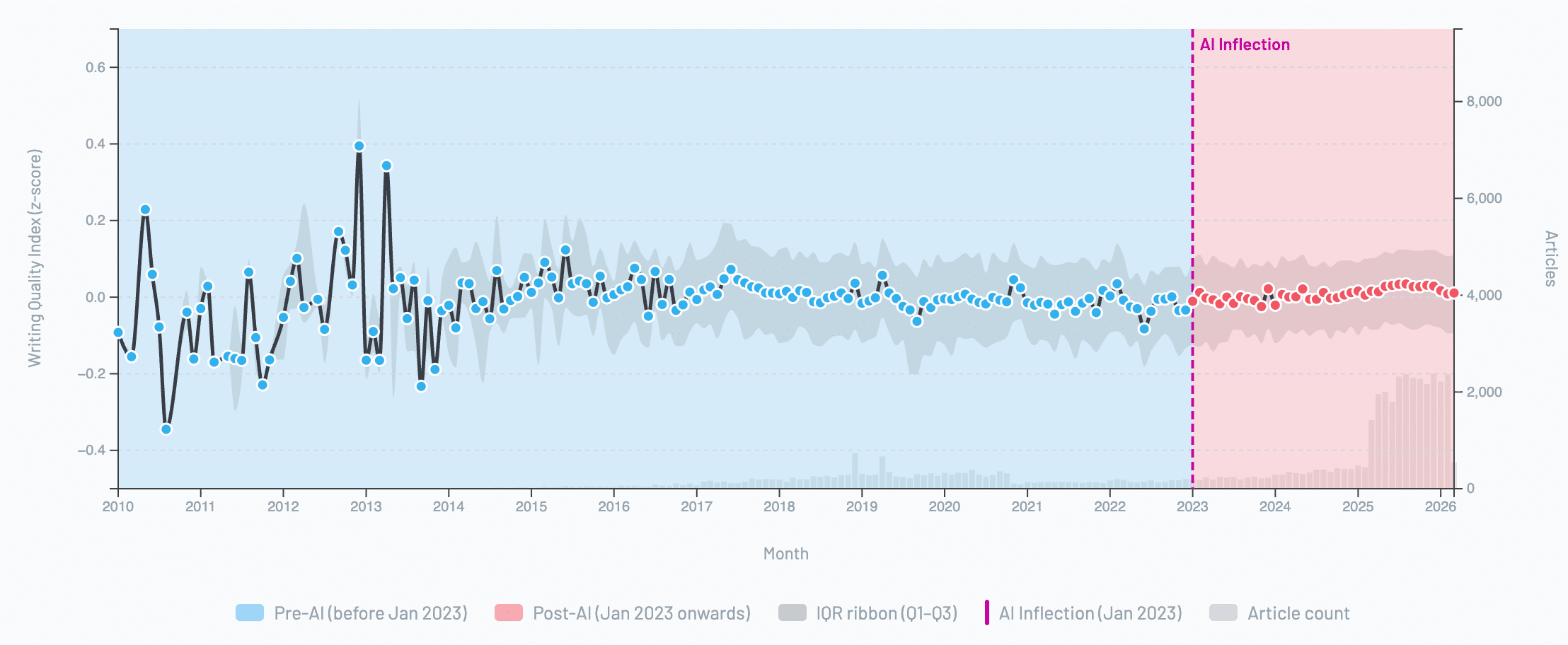
For digital transformation? There’s no question AI is in use; there’s a massive jump in content creation in 2025, far above what the industry used to produce. We also see the quality smooth out and increase.
From this initial read, do we see that AI has made B2B writing worse? Not necessarily. Over 48 different metrics, we see that writing quality has generally increased in the AI age, not decreased.
In next week’s issue, we’ll dig a bit deeper into the specific metrics and what we can glean from them about B2B writing quality and what specific things we can do with this data to improve our own writing quality. Stay tuned!

- New!💡 Case Study: Predictive Analytics for Revenue Growth
- Case Study: Exploratory Data Analysis and Natural Language Processing
- Case Study: Google Analytics Audit and Attribution
- Case Study: Natural Language Processing
- Case Study: SEO Audit and Competitive Strategy

Almost every AI course is the same, conceptually. They show you how to prompt, how to set things up – the cooking equivalents of how to use a blender or how to cook a dish. These are foundation skills, and while they’re good and important, you know what’s missing from all of them? How to run a restaurant successfully. That’s the big miss. We’re so focused on the how that we completely lose sight of the why and the what.
This is why our capstone course, the AI-Ready Strategist, is different. It’s not a collection of prompting techniques or a set of recipes; it’s about why we do things with AI. AI strategy has nothing to do with prompting or the shiny object of the day — it has everything to do with extracting value from AI and avoiding preventable disasters. This course is for everyone in a decision-making capacity because it answers the questions almost every AI hype artist ignores: Why are you even considering AI in the first place? What will you do with it? If your AI strategy is the equivalent of obsessing over blenders while your steakhouse goes out of business, this is the course to get you back on course.
👉 Take this course now to become an AI leader

Here’s a roundup of who’s hiring, based on positions shared in the Analytics for Marketers Slack group and other communities.
- Chief Marketing Officer at RateGain
- Chief Marketing Officer at Suron
- Director Of Product Marketing at easy
- Director Of Product Marketing, Gtm Narrative at ClearML
- Director Of Us Marketing at Booksy
- Director, Product Marketing at SQUIRE
- Senior Director Global Marketing at Amundi
- Svp Of Marketing at Hyperproof
- Vice President Of Marketing at Buckingham Search
- Vp Growth Marketing at Numera
- Vp Of Product Marketing at PolyAI

Are you a member of our free Slack group, Analytics for Marketers? Join 4000+ like-minded marketers who care about data and measuring their success. Membership is free – join today. Members also receive sneak peeks of upcoming data, credible third-party studies we find and like, and much more. Join today!

Where can you find Trust Insights face-to-face?
- SSI, Charlotte, April 2026
- SMPS AEC.AI, November 2026
Going to a conference we should know about? Reach out!
Want some private training at your company? Ask us!

First and most obvious – if you want to talk to us about something specific, especially something we can help with, hit up our contact form.
Where do you spend your time online? Chances are, we’re there too, and would enjoy sharing with you. Here’s where we are – see you there?
- Our blog
- Slack
- YouTube
- In-Ear Insights on Apple Podcasts
- In-Ear Insights on Google Podcasts
- In-Ear Insights on all other podcasting software
Read our disclosures statement for more details, but we’re also compensated by our partners if you buy something through us.
Imagine a world where your marketing strategies are supercharged by the most cutting-edge technology available – Generative AI. Generative AI has the potential to save you incredible amounts of time and money, and you have the opportunity to be at the forefront. Get up to speed on using generative AI in your business in a thoughtful way with our workshop offering, Generative AI for Marketers.
Workshops: Offer the Generative AI for Marketers half and full day workshops at your company. These hands-on sessions are packed with exercises, resources and practical tips that you can implement immediately.
👉 Click/tap here to book a workshop

Some events and partners have purchased sponsorships in this newsletter and as a result, Trust Insights receives financial compensation for promoting them. Read our full disclosures statement on our website.

Thanks for subscribing and supporting us. Let us know if you want to see something different or have any feedback for us!
|
Need help with your marketing AI and analytics? |
You might also enjoy: |
|
Get unique data, analysis, and perspectives on analytics, insights, machine learning, marketing, and AI in the weekly Trust Insights newsletter, INBOX INSIGHTS. Subscribe now for free; new issues every Wednesday! |
Want to learn more about data, analytics, and insights? Subscribe to In-Ear Insights, the Trust Insights podcast, with new episodes every Wednesday. |
Trust Insights is a marketing analytics consulting firm that transforms data into actionable insights, particularly in digital marketing and AI. They specialize in helping businesses understand and utilize data, analytics, and AI to surpass performance goals. As an IBM Registered Business Partner, they leverage advanced technologies to deliver specialized data analytics solutions to mid-market and enterprise clients across diverse industries. Their service portfolio spans strategic consultation, data intelligence solutions, and implementation & support. Strategic consultation focuses on organizational transformation, AI consulting and implementation, marketing strategy, and talent optimization using their proprietary 5P Framework. Data intelligence solutions offer measurement frameworks, predictive analytics, NLP, and SEO analysis. Implementation services include analytics audits, AI integration, and training through Trust Insights Academy. Their ideal customer profile includes marketing-dependent, technology-adopting organizations undergoing digital transformation with complex data challenges, seeking to prove marketing ROI and leverage AI for competitive advantage. Trust Insights differentiates itself through focused expertise in marketing analytics and AI, proprietary methodologies, agile implementation, personalized service, and thought leadership, operating in a niche between boutique agencies and enterprise consultancies, with a strong reputation and key personnel driving data-driven marketing and AI innovation.
 Newsletter
 Podcast