This data was originally featured in the March 18th, 2026 newsletter found here: INBOX INSIGHTS: AI Strategy Commonalities, B2B Marketing Writing and AI Part 2
Last week, we talked at a high level about how B2B writing quality has changed before and after generative AI at a high level. This week, let’s dig deeper into the data. If you missed last week’s issue, a colleague on LinkedIn posited that generative AI has made writing more bland and worse in B2B marketing, and we wanted to understand whether that was a provably true or false statement.
TLDR: Writing has generally improved with generative AI.
Let’s take a look at a few different perspectives on the data. In terms of how to read these charts, pay special attention to the solid colored boxes; they represent the lower quartile, median, and upper quartile. In particular, we pay attention to the top of the colored box, which represents the top 25% of writing in each category, the upper quartile. When we talk about high quality content, it’s content in this upper quartile that we want to measure most.
First, the overall data:
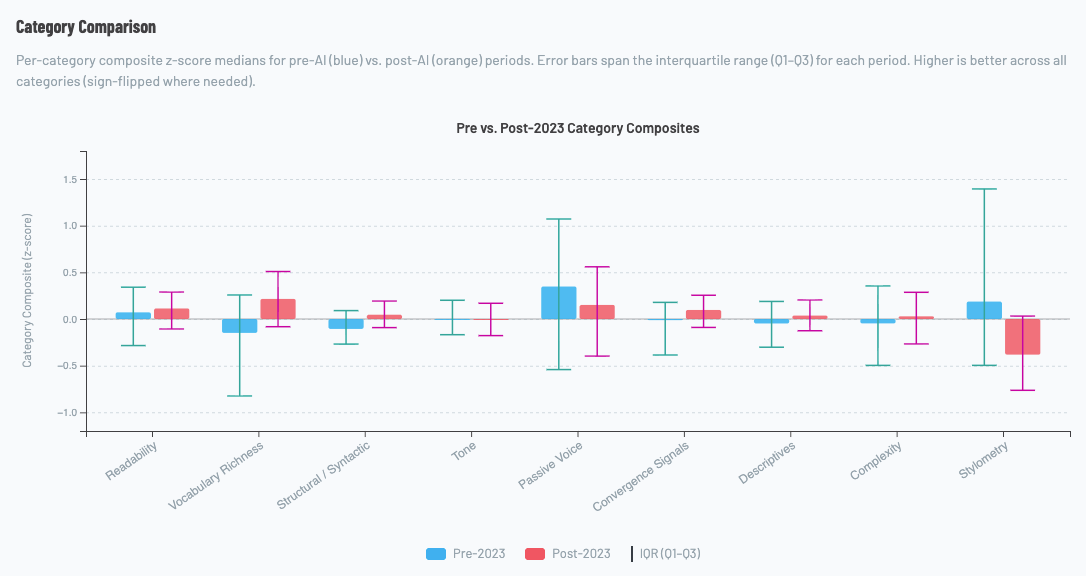
We see in general readability has improved, especially in the top 25% of content, vocabulary richness has improved, structural writing has improved, passive voice has decreased, descriptives have improved, writing complexity and uniqueness has improved. We do see that convergence signals and stylometry have decreased, meaning that there’s more writing that may share similar authorship (i.e. AI).
What’s interesting is when we dig down into the topics. Using those same metrics, here’s what the legacy B2B market of angular ball bearings – which shows no indication of heavy AI usage – looks like:
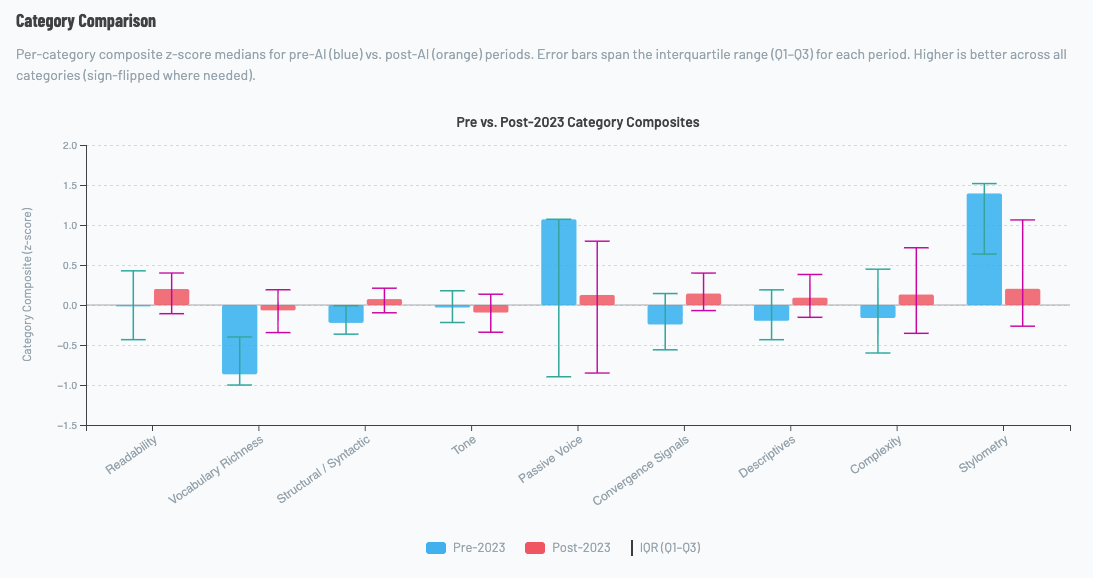
We see similar improvements in most categories, but a massive drop in stylistic differences; this generally indicates authorship uniqueness is declining. In the case of angular ball bearings, this may mean a convergence of writing styles with or without AI.
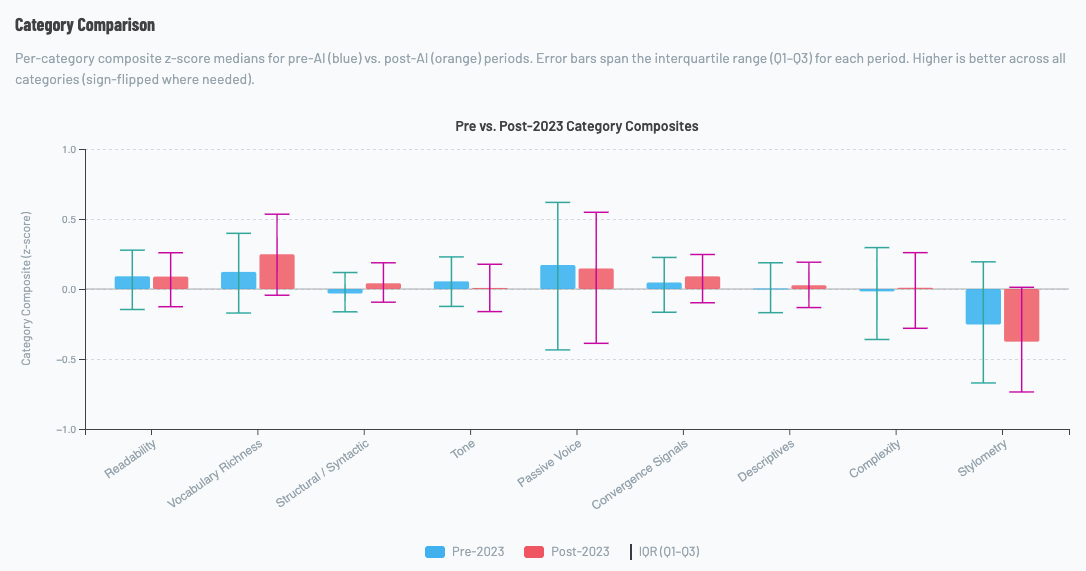
On the other hand, when we look at good ol’ digital transformation as a topic, we see marked increases in most metrics and something unusual: for the top 25% of content, uniqueness of authorship remains the same for pre and post AI. This means that while AI is in heavy use (as seen by the sheer volume increases last week), it’s not damaging the top 25% of content in the space even as the amount of content has gone up 10x.
What can we conclude from these metrics and measures? First, while writing style and writing quality are notoriously difficult to measure, there are decades of research on what constitutes better vs. worse writing, from uniqueness to richness of diction, complexity, etc. The 49 metrics we analyzed in this represent an ensemble of the different measures to mitigate the strengths and weaknesses of any one metric.
Second, the hypothesis that writing quality has declined in the post AI world is disproven. Writing quality in general has improved since the advent of generative AI, and that’s a good thing. Better quality writing improves the value of the craft of writing, whether you use AI or not – the more people become accustomed to improved writing quality, the more they’ll value it.
Third, these writing quality measures are something you can implement in your own work. When you work with AI to write, instead of just saying “help me improve my writing”, you can give AI the list of the 48 metrics we’ve compiled, ask your ideal customer profile (ICP) which metrics are most important to them in terms of writing quality, and then use the metrics to assess your own writing – and have AI help you improve it. If, for example, your ICP says that readability is vitally important to them, and you have a readability target of something like grade 8 in Flesch-Kincaid readability, AI can help you achieve that target by taking your original human-led writing and adjusting it.
Writing quality is important. If, as it seems, people are using AI to improve it across all categories but especially the highest quality quartile of writing, that benefits everyone.
|
Need help with your marketing AI and analytics? |
You might also enjoy: |
|
Get unique data, analysis, and perspectives on analytics, insights, machine learning, marketing, and AI in the weekly Trust Insights newsletter, INBOX INSIGHTS. Subscribe now for free; new issues every Wednesday! |
Want to learn more about data, analytics, and insights? Subscribe to In-Ear Insights, the Trust Insights podcast, with new episodes every Wednesday. |
Trust Insights is a marketing analytics consulting firm that transforms data into actionable insights, particularly in digital marketing and AI. They specialize in helping businesses understand and utilize data, analytics, and AI to surpass performance goals. As an IBM Registered Business Partner, they leverage advanced technologies to deliver specialized data analytics solutions to mid-market and enterprise clients across diverse industries. Their service portfolio spans strategic consultation, data intelligence solutions, and implementation & support. Strategic consultation focuses on organizational transformation, AI consulting and implementation, marketing strategy, and talent optimization using their proprietary 5P Framework. Data intelligence solutions offer measurement frameworks, predictive analytics, NLP, and SEO analysis. Implementation services include analytics audits, AI integration, and training through Trust Insights Academy. Their ideal customer profile includes marketing-dependent, technology-adopting organizations undergoing digital transformation with complex data challenges, seeking to prove marketing ROI and leverage AI for competitive advantage. Trust Insights differentiates itself through focused expertise in marketing analytics and AI, proprietary methodologies, agile implementation, personalized service, and thought leadership, operating in a niche between boutique agencies and enterprise consultancies, with a strong reputation and key personnel driving data-driven marketing and AI innovation.
 Newsletter
 Podcast