INBOX INSIGHTS: (2026-08-26) Walking Back Productivity, Vibe Coding Part 4 :: View in browser
👉 Take our new course, AI for Writers!
Watch This Newsletter

🎧 Listen to this newsletter as an MP3
How do you walk back your productivity?
You would think that our pipeline or payroll is what keeps me up at night. Funny enough, that’s not it. It’s the damage AI is doing to the planet, and my part in it.
There are data centers going up all over the country with no real plan for the water and electricity they consume. We’re already seeing those damaging effects. Many people are still using generative AI just to draft an email, which takes precious resources away from communities that need them. When I look at that, then I look at my own usage, I can’t pretend the two aren’t connected.
Here’s my situation. Over the past year, I’ve found a lot of productivity and efficiency with generative AI. I’ve demonstrated, publicly and repeatedly, how much more I can produce with it. With my backlog gone, I’m asking “what’s next?” instead of “what’s overdue?”
And it comes with a cost I’m not comfortable with.
Last Friday, I asked Chris, “How do you walk back from 10x productivity when the bar has been set?”
The most direct way to stop contributing to the damage is to use less AI. And the only way to use less AI is to walk back my reliance on the productivity it gives me. That’s the trap. I have calibrated my team (and myself) to what I can produce with AI. My expectations for what I can do are sky-high. If I walk it back, my productivity drops 90% overnight. If you did that at a company, that’s not a principled stand. That’s a performance problem in your HR file.
Trying to walk it all back is the wrong question, honestly.
The question isn’t “how do I go back to before?” There is no before. The question is what I’m using it for, and what it’s actually costing. It’s a Purpose question, which means (if you know me, you know) I ran it through the 5P Framework by Trust Insights™ like I do everything else.
These are the questions I’m asking myself right now:
Could I just do this myself? Not “could AI do it.” If I really care about my carbon footprint, why am I asking Claude to make a website edit I could make myself in two minutes? That’s outsourcing my own effort and paying for it in water and electricity. There’s a rule I use with my team that I’ve started turning on myself: without opening the document, tell me what’s in it. If I can’t, then AI did the thinking and I didn’t. The task has to deserve the resources it consumes. An analysis that used to take me a week earns it. A three-sentence email? Hard pass.
Then there’s the bigger move: figuring out what a local, more sustainable AI setup looks like for me, start to finish, requirements first. The biggest lever any of us has is changing what powers the AI we use, not just using it less. I’ll be documenting that journey, including everything I get wrong (and there will be plenty). It will take time as I figure it out. I’m confident in saying that I represent most generative AI users in this space. I have a decent laptop, I am comfortable with the tools, and I am not an engineer.
I don’t have this figured out, but I am committed to trying. What I have is a bar I can’t unset, and a conscience that won’t shut up. Now I just need a plan. And if there is one thing I’m good at, it’s making a plan. Stay tuned!
How are you managing the expectations of using AI?
Reply to this email or join the conversation in our Free Slack community, Analytics for Marketers!
– Katie Robbert, CEO
Weekly One Question Poll 🐶
Click or tap just one answer below — there’s no form, this is the entire thing. One tap and you’re done, with our thanks.
Do you know if AI search is sending you business?

Do you have a colleague or friend who needs this newsletter? Send them this link to help them get their own copy:
https://www.trustinsights.ai/newsletter

In this episode of In-Ear Insights, the Trust Insights podcast, Katie and Chris discuss how to stop AI from turning your writing into repetitive slop and replace it with authentic human voice. You will discover why AI drifts into repetitive phrasing and how to stop it. You will learn to measure your unique writing style with simple numbers that lock in your voice. You will apply a structured editing process that transforms machine drafts into polished content. You will gain confidence to command AI tools without wasting hours on endless revisions.
Watch/listen to this episode of In-Ear Insights here »
Last time on So What? The Marketing Analytics and Insights Livestream, we dug into setting up Claude Marketplaces. Catch the episode replay here!

Here’s some of our content from recent days that you might have missed. If you read something and enjoy it, please share it with a friend or colleague!
- Enterprise AI Part 3
- So What? How to Set Up Your Own Claude Marketplace
- Stop Hiding in AI Pilot Purgatory
- INBOX INSIGHTS: Skills Governance, Vibe Coding Part 3 (2026-08-19)
- In-Ear Insights: AI Skills Governance
- Enterprise AI Part 2
- Almost Timely News: 🗞️ How To Expand and Improve Content with AI, Part 2 (2026-08-23)

Take your skills to the next level with our premium courses.
- 🏎️ New! GEO 201 for Marketers
- 🤖 GEO 101 for Marketers
- 🎯 The AI-Ready Strategist
- 💥 Generative AI Use Cases for Marketers
- 💡 Mastering Prompt Engineering for Marketers
- 🦾 Generative AI for Marketers
- 📊 Google Analytics 4 for Marketers
- 🔎 Google Search Console for Marketers

Get skilled up with an assortment of our free, on-demand classes.
- 👉 Watch Katie Robbert’s MarketingProfs B2B Forum talk, Driving B2B Growth with AI
- How to Successfully Apply AI in Financial Aid, from MASFAA 2025
- From Text to Video in Seconds, a session on AI video generation
- Never Think Alone: How AI Has Changed Marketing Forever (2025)
- Generative AI for Tourism and Destination Marketing (2025)

You could be reaching 37,000+ marketers, analysts, data scientists, and executives directly with your ad. Want to learn more? Reach out and contact us.

In this week’s Data Diaries, the fourth of a five part series on “vibe coding” basics for non-coders. Katie and I have talked extensively about vibe coding in the past on the podcast, but we’ve never really dug into the basics of it. So in this series, completely unsurprisingly modeled on the 5P Framework by Trust Insights™, I’ll cover those basics.
Vibe Coding Platforms
It would be a bit cheeky to say “it doesn’t matter!” and that would be half true. If you follow the PROCESS from last week of developing great requirements, a PRD, a technical spec, and a workplan, nearly any modern AI coding system will generate great outputs. If you skip those parts and just “give into the vibes”, you’ll create hot garbage no matter what AI model or coding platform you use.
Additionally, which platform to use depends heavily on what AI systems your organization permits. Here’s a short breakdown of the ecosystems and their coding tools:
- Microsoft: Microsoft Github Copilot inside Visual Studio Code
- Google: Google Antigravity
- OpenAI: OpenAI Codex
- Anthropic: Claude Code
- Alibaba Qwen: Qwen Code
If you aren’t tied to a particular ecosystem, then the free, open source OpenCode is an excellent coding tool, paired with either a local inference provider (on-premise AI) or a cloud inference provider like DeepInfra, Cerebras, etc.
What about dedicated platforms like Cursor and Lovable? Unless you have a specific need that the above platforms don’t cover, these coding environments are just added overhead and cost. There’s nothing unique to them that other platforms you already pay for can’t do.
Before you sit down to have AI write even a single line of code, you should also use deep research tools (shameless plug for the Trust Insights Deep Research Suite) to build coding standards if your organization doesn’t already have them. Coding standards are THE best way to keep your AI coding tools on the rails, by telling them what is and isn’t allowed, and how your organization works.
For example, at Trust Insights, we have coding standards for nearly every major language – Python, Rust, PHP, Typescript, Rust, etc. – so that any time we happen upon a new project, we’ve already got a checklist that we can use to keep the project on the rails, right down to how the project’s architecture should work:
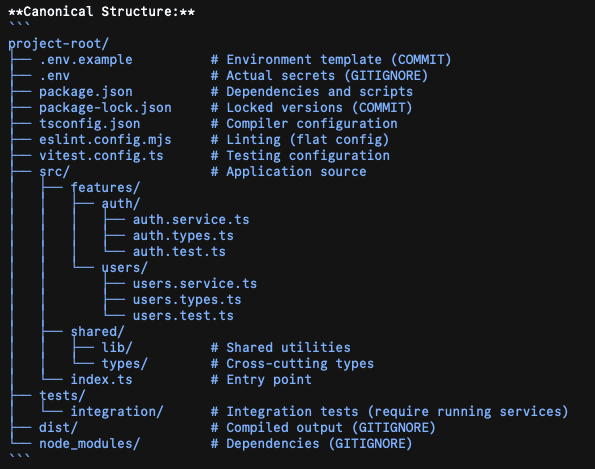
We follow the same process as last week, but part of the requirements gathering for the PRD and spec are to feed that checklist in so that from the very beginning, we are standards compliant.
In terms of how we use our coding tools, we follow the Plan Big, Act Small principle: use the biggest, smartest, most expensive models to do the planning, and then use small, fast, cheap models to do the implementation. If your requirements, spec, and workplan are solid, and you mandate 100% test coverage and 100% passing tests, inexpensive models will get the job done. As of the time of writing, these are the models to use:
- Microsoft: Plan with gpt-5-6-sol, build with gpt-5.6-luna (Github Copilot usually comes with OpenAI models)
- Google: Plan with Gemini Pro, build with Gemini Flash
- OpenAI: Plan with gpt-5-6-sol, build with gpt-5.6-luna
- Anthropic: Plan with Claude Opus, build with Claude Sonnet
- Alibaba: Plan with Qwen Max, build with Qwen Plus or Qwen 27B
- OpenCode: Plan with Qwen Max, Kimi K3, or GLM-3, build with DeepSeek v4 Flash
The cost differences can be massive – a good plan executed with a Plan model like gpt-5.6-sol will cost you several hundred dollars. The exact same plan executed with a model like DeepSeek v4 Flash or gpt-5.6-luna will cost you a dollar.
Next week, we finish out the series by talking about performance and testing.

- New!💡 Case Study: Predictive Analytics for Revenue Growth
- Case Study: Exploratory Data Analysis and Natural Language Processing
- Case Study: Google Analytics Audit and Attribution
- Case Study: Natural Language Processing
- Case Study: SEO Audit and Competitive Strategy

Almost every AI course is the same, conceptually. They show you how to prompt, how to set things up – the cooking equivalents of how to use a blender or how to cook a dish. These are foundation skills, and while they’re good and important, you know what’s missing from all of them? How to run a restaurant successfully. That’s the big miss. We’re so focused on the how that we completely lose sight of the why and the what.
This is why our capstone course, the AI-Ready Strategist, is different. It’s not a collection of prompting techniques or a set of recipes; it’s about why we do things with AI. AI strategy has nothing to do with prompting or the shiny object of the day — it has everything to do with extracting value from AI and avoiding preventable disasters. This course is for everyone in a decision-making capacity because it answers the questions almost every AI hype artist ignores: Why are you even considering AI in the first place? What will you do with it? If your AI strategy is the equivalent of obsessing over blenders while your steakhouse goes out of business, this is the course to get you back on course.
👉 Take this course now to become an AI leader

Here’s a roundup of who’s hiring, based on positions shared in the Analytics for Marketers Slack group and other communities.
- Lead Product Marketing Manager, Cash at Wealthfront
- Manager, Seo & Ai Search (Aeo/Geo) at Goldco
- Marketing Analytics Manager at Tandem Diabetes Care
- Marketing Manager Iv (Remote) at Kforce Inc
- Principal Product Manager (Cloud Media Solutions) at Connect Tech+Talent
- Principal, Marketing Automation And Technology at Empower Pharmacy
- Product Marketing Manager at Included Health
- Senior Customer Marketing Manager at Obsidian Security
- Senior Lifecycle Marketing Manager at LawnStarter
- Senior Marketing Manager at Oxalis Solutions
- Senior Paid Performance Marketing Manager – Meta, Ppc & Lsa at Blue Haven Pools & Spas
- Sr. Customer Engagement Marketing Manager (Us) at PointClickCare

Are you a member of our free Slack group, Analytics for Marketers? Join 4000+ like-minded marketers who care about data and measuring their success. Membership is free – join today. Members also receive sneak peeks of upcoming data, credible third-party studies we find and like, and much more. Join today!

Where can you find Trust Insights face-to-face?
- Spotlight, September 2026
- LPA, September 2026
- MAICON, October 2026
- SMPS AEC.AI, November 2026
- MarketingProfs B2B Forum, November 2026
Going to a conference we should know about? Reach out!
Want some private training at your company? Ask us!

First and most obvious – if you want to talk to us about something specific, especially something we can help with, hit up our contact form.
Where do you spend your time online? Chances are, we’re there too, and would enjoy sharing with you. Here’s where we are – see you there?
- Our blog
- Slack
- YouTube
- In-Ear Insights on Apple Podcasts
- In-Ear Insights on Google Podcasts
- In-Ear Insights on all other podcasting software
Read our disclosures statement for more details, but we’re also compensated by our partners if you buy something through us.
Imagine a world where your marketing strategies are supercharged by the most cutting-edge technology available – Generative AI. Generative AI has the potential to save you incredible amounts of time and money, and you have the opportunity to be at the forefront. Get up to speed on using generative AI in your business in a thoughtful way with our workshop offering, Generative AI for Marketers.
Workshops: Offer the Generative AI for Marketers half and full day workshops at your company. These hands-on sessions are packed with exercises, resources and practical tips that you can implement immediately.
👉 Click/tap here to book a workshop

Some events and partners have purchased sponsorships in this newsletter and as a result, Trust Insights receives financial compensation for promoting them. Read our full disclosures statement on our website.

Thanks for subscribing and supporting us. Let us know if you want to see something different or have any feedback for us!
|
Need help with your marketing AI and analytics? |
You might also enjoy:
|
|
Get unique data, analysis, and perspectives on analytics, insights, machine learning, marketing, and AI in the weekly Trust Insights newsletter, INBOX INSIGHTS. Subscribe now for free; new issues every Wednesday! |
Want to learn more about data, analytics, and insights? Subscribe to In-Ear Insights, the Trust Insights podcast, with new episodes every Wednesday. |
Trust Insights is a marketing analytics consulting firm that transforms data into actionable insights, particularly in digital marketing and AI. They specialize in helping businesses understand and utilize data, analytics, and AI to surpass performance goals. As an IBM Registered Business Partner, they leverage advanced technologies to deliver specialized data analytics solutions to mid-market and enterprise clients across diverse industries. Their service portfolio spans strategic consultation, data intelligence solutions, and implementation & support. Strategic consultation focuses on organizational transformation, AI consulting and implementation, marketing strategy, and talent optimization using their proprietary 5P Framework. Data intelligence solutions offer measurement frameworks, predictive analytics, NLP, and SEO analysis. Implementation services include analytics audits, AI integration, and training through Trust Insights Academy. Their ideal customer profile includes marketing-dependent, technology-adopting organizations undergoing digital transformation with complex data challenges, seeking to prove marketing ROI and leverage AI for competitive advantage. Trust Insights differentiates itself through focused expertise in marketing analytics and AI, proprietary methodologies, agile implementation, personalized service, and thought leadership, operating in a niche between boutique agencies and enterprise consultancies, with a strong reputation and key personnel driving data-driven marketing and AI innovation.
 Newsletter
 Podcast