INBOX INSIGHTS: Your Org Chart Blocked Your AI, Vibe Coding Part 1 (2026-08-05) :: View in browser
👉 Read our newest paper on what jobs AI can actually take!
Watch This Newsletter

🎧 Listen to this newsletter as an MP3
You Didn’t Stall. Your Org Chart Blocked You.
Let me describe your past year with AI rollouts, and you tell me how close I get.
You ran the pilots. More than one. They worked. You built the deck, you presented the results to leadership, and leadership said, “This is great.”
So now they’re back with the 2027 directive: increase AI usage across the organization, with a real budget attached this time.
This is where you start to panic.
Because you still have your AI Champions. You’re still running the office hours. You’re still answering the questions. People are using it. And usage is flat. The same people who were using it in March are the people using it now.
That’s where you are right now: sitting with a directive, a budget, a team of champions, and no idea where to go from here.
That’s not a failure.
A lot of people are quietly carrying this around like they blew it. You didn’t. Almost everyone who did the pilot work right is standing in the same spot, asking the same question. What’s next?
Here’s the thing. Nobody has a good answer because we’re not looking in the right place for one. We look at the tools. We look at the budget. We look at whatever model came out last week.
The starting place was always People. And “People” isn’t just who’s on your team. It’s how your people are arranged. Almost nobody thinks of that as an AI problem.
Your structure decides what you’re able to see
Every organization has a structure. Most of us inherited ours and stopped noticing it, the way you stop noticing the layout of your own house.
You only start noticing when problems show up. The stove is too small to cook for everybody at once. The laundry is in the basement when it really should be on the first floor. The bathroom is on a different level than the bedrooms. That one door swings out instead of in, so you can’t put anything behind it, and whoever designed it clearly never carried a laundry basket through it.
You don’t fix any of it because you don’t have the time or the budget to move a bathroom, so you get creative. You do laundry in shifts, you prep on the dining room table, and you get very good at working around a layout you’d never have chosen.
That’s organizational structure, especially the inflexible kind. It decides who talks to whom, who approves what, and (this is the part that matters) what you can see from where you sit.
Within every organization, there are four basic structures. Yours is one of them, or a mix of two.
Hierarchical. Chain of command, layers of management, information moves up and comes back down. This is the least flexible of the four, and it is what most enterprise-sized companies are working with. Not because they don’t know better. Because changing an organizational structure is a far bigger lift than learning to live with its limitations, so you learn to live with them.
The problem for AI is that everything moves vertically. Your best use case in customer service has no path to the person in finance doing the same task under a different name.
Functional. Grouped by specialty. Marketing here, finance there, HR, IT, ops. Deep expertise in every box. The problem is you scope AI by department, and AI opportunity isn’t department-shaped. It’s task-shaped. So five departments build five slightly different versions of “summarize this long document,” none of which knows the other four exist. Flat. Few layers, lots of autonomy, everyone starts their own work. Which sounds collaborative and isn’t. Everybody’s heads down on their own thing, so flat organizations get really good at optimizing what they already do and stay bad at inventing what they don’t.
In this type of organization, the pilots went well. It’s also why nothing came after them, because scaling requires somebody to say “we’re all doing it this way now,” and a flat structure has nobody whose job that is. Enthusiasm becomes your routing system; enthusiasm is not a routing system.
Matrix. Two reporting lines, usually function plus project or region. Matrix is the closest of the four to how AI work actually wants to move, because it already assumes people work across boxes.
But most companies shy away from it for reasons that have nothing to do with AI. Billing gets messy. Resource sharing gets contentious. When one person’s time is split between two bosses, somebody has to decide whose budget that hour comes out of, and that argument happens every week. (If you’re in a matrix and you just sighed, I see you.)
Notice what all four have in common. Every one of them organizes people by who they report to. Not one of them organizes people by what they actually do all day.
And what people do all day is the only thing AI can see.
We have data on that. We just published a research study (you can read the whole thing here) where we broke 434 occupations from the federal O*NET job database into individual tasks, then scored each one with our TRIPS Framework by Trust Insights: Time, Repetitiveness, Importance, Pain, and Sufficient data, the five things that tell you whether a task is a good candidate for AI.
AI-suited work showed up in every single category we looked at. Not clustered in the obvious ones. Spread across all of them. (Directional, not a leaderboard, and we sell AI enablement work, so read our numbers knowing that.)
Back to the house
Here’s why the workarounds stopped working.
A too-small stove isn’t a problem when you’re making dinner for your family. One burner at a time, one dish at a time, and it comes out fine.
It becomes a problem the day you host the holiday. Now the stove dictates the menu. Nothing about the house changed. What changed is the size of what you’re trying to do in it.
So it becomes a potluck. Everybody brings a dish they’re responsible for. That’s a smart answer to not having the space, and it’s also how you lose oversight of what ends up on the table. It might not be the meal you envisioned. It’s the meal somebody brought to the literal table.
That’s what your AI program is right now. Every champion brought a dish, all perfectly good and aligned with the goals, none of them planned together. That’s not a criticism. It’s the reasonable response to a kitchen that couldn’t handle more.
Eventually, you have to decide which problem you actually have. Either you work within the structure and live with the potluck, or the structure has to change.
And AI is no help with that call, because AI can’t see any of it. It doesn’t know your stove is small or that the laundry is in the basement. It hums along doing what it’s asked in whatever corner you put it. Every limitation in this house is obvious to you and invisible to it.
What to do Next
Look at your org chart and figure out which of the four you mostly are. Not perfectly. Most companies are one structure with a little of another mixed in, and “mostly” is good enough.
Then name the limitation that comes with it. Hierarchical, nothing travels sideways. Functional, you scoped AI by department when the opportunity is task-shaped. Flat, nobody has the authority to standardize. Matrix, the coordination cost is real and somebody has to be willing to pay it.
That’s your 2027 constraint. Not model choice, not budget, not whether people are bought in. Whatever your structure has always been bad at is exactly what scaling AI is about to ask you to do.
And whichever one it is, somebody has to own the meal. That role has to exist before the next pilot, not after it.
That’s the gap we built the AI Enablement Package for. Ninety days, fixed fee, mapping AI opportunity at the task level across your actual roles instead of by department, and handing you back a prioritized sequence instead of another list. It’s a diagnostic, not an implementation. If you want to see how it works, and view sample outputs, read more here.
The moral of the story
Your AI program didn’t stall because your people are resistant or because you picked the wrong tool. It stalled because it reached the edge of what your structure can see, and structures don’t reorganize themselves just because a pilot went well.
You can’t redraw the org chart, and I’m not suggesting you try. But you can give somebody the authority to move a proven workflow out of one box and into another. That’s what’s next.
What shape is your organization, and where does your best AI use case get stuck?
Reply to this email or join the conversation in our Free Slack community, Analytics for Marketers!
– Katie Robbert, CEO
Weekly Check-In Poll
Please click/tap on just one answer – this is our weekly survey to see how we’re doing, so please do take it. There are no forms to fill out, this is the entire thing. One click/tap and you’re done, with our thanks.
How likely are you to recommend Trust Insights as a consulting firm to someone in the next 90 days?

Do you have a colleague or friend who needs this newsletter? Send them this link to help them get their own copy:
https://www.trustinsights.ai/newsletter

In this episode of In-Ear Insights, the Trust Insights podcast, Katie and Chris discuss why a popular claim about artificial intelligence taking over jobs misses the mark. You will discover how to break your daily tasks into clear steps that reveal what computers handle. You will learn a testing method that separates work worth automating from tasks requiring your human touch. You will uncover ways to upgrade your routine without fearing career changes. You will gain the confidence to restructure your workflow for lasting efficiency.
Watch/listen to this episode of In-Ear Insights here »
Last time on So What? The Marketing Analytics and Insights Livestream, we walked through why AI detectors fail and how they work. Catch the episode replay here!
This week on So What? we’re exploring theoretical AI usage. Are you following our YouTube channel? If not, click/tap here to follow us!

Here’s some of our content from recent days that you might have missed. If you read something and enjoy it, please share it with a friend or colleague!
- AI Command Line Tools Part 3
- So What? How AI Detectors Work
- Stop Chasing Use Cases
- INBOX INSIGHTS: Did I Write This Post, Responsible AI Part 4 (2026-07-29)
- In-Ear Insights: The Problems With AI Detectors
- AI Command Line Tools Part 2
- Almost Timely News: 🗞️ Can AI Be An Investment Expert? (2026-08-02)

Take your skills to the next level with our premium courses.
- 🏎️ New! GEO 201 for Marketers
- 🤖 GEO 101 for Marketers
- 🎯 The AI-Ready Strategist
- 💥 Generative AI Use Cases for Marketers
- 💡 Mastering Prompt Engineering for Marketers
- 🦾 Generative AI for Marketers
- 📊 Google Analytics 4 for Marketers
- 🔎 Google Search Console for Marketers

Get skilled up with an assortment of our free, on-demand classes.
- 👉 Watch Katie Robbert’s MarketingProfs B2B Forum talk, Driving B2B Growth with AI
- How to Successfully Apply AI in Financial Aid, from MASFAA 2025
- From Text to Video in Seconds, a session on AI video generation
- Never Think Alone: How AI Has Changed Marketing Forever (2025)
- Generative AI for Tourism and Destination Marketing (2025)

You could be reaching 37,000+ marketers, analysts, data scientists, and executives directly with your ad. Want to learn more? Reach out and contact us.
 In this week’s Data Diaries, the first of a five part series on “vibe coding” basics for non-coders. Katie and I have talked extensively about vibe coding in the past on the podcast, but we’ve never really dug into the basics of it. So in this series, completely unsurprisingly modeled on the 5P Framework by Trust Insights™, I’ll cover those basics.
The Purpose of Vibe Coding
Vibe Coding, originated in this tweet from OpenAI cofounder Andrej Karpathy:
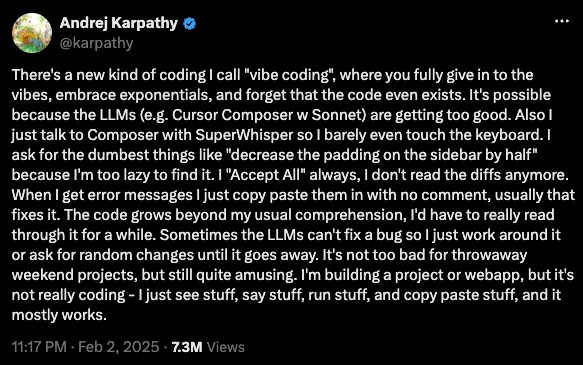
What a lot of folks took away from this tweet was that you could simply yell unclear instructions to AI tools and magically they’d create software from it, forgetting that Karpathy has a PhD in computer science and deep learning from Stanford University. His random shouts to the AI about what to generate will be a lot more skillful than many of us.
The first thing we need to be clear about is why we’re building software at all. Why does anyone create software? It’s to solve a problem – and if we’re super clear about the problem and why software is the solution to it, we’ll be able to code well.
The easiest way to do this is with basic user stories:
As a [person] I need to [task] so that [outcome].
For example, suppose you’re a marketing analyst and you’re trying to understand your Google Search Console data. Maddeningly, Google Search Console in its web interface does not allow you to join what queries get impressions and clicks with what pages do. But in their API (application programming interface, a way for computers to talk to each other), that data IS available.
This is a clear case where software would be helpful. Why? Because the data we want, in the format that we want, is only accessible from an API. It’s not available in the end user tools, and while there are plenty of paid tools that can extract that data, there’s no reason to pay money for data that’s free – if we can get it out of the system using software.
Could we have an AI tool like Claude Cowork or ChatGPT Work just go get it for us directly? Yes, we could – but it would cost usage tokens every time we ran it. It’s much better if we have a deterministic piece of code that needs no AI at all to do the same task. It’ll save money, and it’ll save quite a bit of time because AI won’t have to reinvent the wheel every time we ask it for the data.
Let’s turn this into a real user story:
As a [marketing analyst] I need to [obtain query AND page level metrics from Google Search Console’s API] so that [I can help my SEO team understand what pages are getting the most traffic from specific search queries].
This is a clear use case, and we can already see a clear purpose and a clear definition of done, a clear result. If we can get that data from Google Search Console, we’ll be able to help the SEO folks on our team.
For the rest of this series, this is the use case we’ll be going with. Your homework, if you want to play along, is to write your own user story for a vibe coding use case where software is the right answer to a problem you have.

- New!💡 Case Study: Predictive Analytics for Revenue Growth
- Case Study: Exploratory Data Analysis and Natural Language Processing
- Case Study: Google Analytics Audit and Attribution
- Case Study: Natural Language Processing
- Case Study: SEO Audit and Competitive Strategy

Almost every AI course is the same, conceptually. They show you how to prompt, how to set things up – the cooking equivalents of how to use a blender or how to cook a dish. These are foundation skills, and while they’re good and important, you know what’s missing from all of them? How to run a restaurant successfully. That’s the big miss. We’re so focused on the how that we completely lose sight of the why and the what.
This is why our capstone course, the AI-Ready Strategist, is different. It’s not a collection of prompting techniques or a set of recipes; it’s about why we do things with AI. AI strategy has nothing to do with prompting or the shiny object of the day — it has everything to do with extracting value from AI and avoiding preventable disasters. This course is for everyone in a decision-making capacity because it answers the questions almost every AI hype artist ignores: Why are you even considering AI in the first place? What will you do with it? If your AI strategy is the equivalent of obsessing over blenders while your steakhouse goes out of business, this is the course to get you back on course.
👉 Take this course now to become an AI leader

Here’s a roundup of who’s hiring, based on positions shared in the Analytics for Marketers Slack group and other communities.
- Director Of Martech at ID.me
- Director Of Product Marketing at Nielsen
- Director, Marketing Analytics & Insights at Quest Software
- Head Of Digital & Demand Generation at Scout Global
- Marketing Director at PRESWERX
- Media Director at New York Technology Partners
- Senior Director Of Marketing at AristaMD
- Vice President Global Marketing at Securden, Inc
- Vice President Marketing at Spree Finance
- Vp Of Demand Generation at Gold & Aron
- Vp Of Marketing (B2b) at Mindbody
- Vp Of Marketing at MLabs

Are you a member of our free Slack group, Analytics for Marketers? Join 4000+ like-minded marketers who care about data and measuring their success. Membership is free – join today. Members also receive sneak peeks of upcoming data, credible third-party studies we find and like, and much more. Join today!

Where can you find Trust Insights face-to-face?
- LPA, September 2026
- MAICON, October 2026
- SMPS AEC.AI, November 2026
- MarketingProfs B2B Forum, November 2026
Going to a conference we should know about? Reach out!
Want some private training at your company? Ask us!

First and most obvious – if you want to talk to us about something specific, especially something we can help with, hit up our contact form.
Where do you spend your time online? Chances are, we’re there too, and would enjoy sharing with you. Here’s where we are – see you there?
- Our blog
- Slack
- YouTube
- In-Ear Insights on Apple Podcasts
- In-Ear Insights on Google Podcasts
- In-Ear Insights on all other podcasting software
Read our disclosures statement for more details, but we’re also compensated by our partners if you buy something through us.
Imagine a world where your marketing strategies are supercharged by the most cutting-edge technology available – Generative AI. Generative AI has the potential to save you incredible amounts of time and money, and you have the opportunity to be at the forefront. Get up to speed on using generative AI in your business in a thoughtful way with our workshop offering, Generative AI for Marketers.
Workshops: Offer the Generative AI for Marketers half and full day workshops at your company. These hands-on sessions are packed with exercises, resources and practical tips that you can implement immediately.
👉 Click/tap here to book a workshop

Some events and partners have purchased sponsorships in this newsletter and as a result, Trust Insights receives financial compensation for promoting them. Read our full disclosures statement on our website.

Thanks for subscribing and supporting us. Let us know if you want to see something different or have any feedback for us!
|
Need help with your marketing AI and analytics? |
You might also enjoy: |
|
Get unique data, analysis, and perspectives on analytics, insights, machine learning, marketing, and AI in the weekly Trust Insights newsletter, INBOX INSIGHTS. Subscribe now for free; new issues every Wednesday! |
Want to learn more about data, analytics, and insights? Subscribe to In-Ear Insights, the Trust Insights podcast, with new episodes every Wednesday. |
Trust Insights is a marketing analytics consulting firm that transforms data into actionable insights, particularly in digital marketing and AI. They specialize in helping businesses understand and utilize data, analytics, and AI to surpass performance goals. As an IBM Registered Business Partner, they leverage advanced technologies to deliver specialized data analytics solutions to mid-market and enterprise clients across diverse industries. Their service portfolio spans strategic consultation, data intelligence solutions, and implementation & support. Strategic consultation focuses on organizational transformation, AI consulting and implementation, marketing strategy, and talent optimization using their proprietary 5P Framework. Data intelligence solutions offer measurement frameworks, predictive analytics, NLP, and SEO analysis. Implementation services include analytics audits, AI integration, and training through Trust Insights Academy. Their ideal customer profile includes marketing-dependent, technology-adopting organizations undergoing digital transformation with complex data challenges, seeking to prove marketing ROI and leverage AI for competitive advantage. Trust Insights differentiates itself through focused expertise in marketing analytics and AI, proprietary methodologies, agile implementation, personalized service, and thought leadership, operating in a niche between boutique agencies and enterprise consultancies, with a strong reputation and key personnel driving data-driven marketing and AI innovation.
 Newsletter
 Podcast





This hits way too close to home. We had two successful AI pilots last quarter, but usage still hasn’t spread beyond the early adopters. I never considered our rigid hierarchical org chart was the actual blocker.
Absolutely, and we find ourselves learning along the way too.