This data was originally featured in the August 27th, 2025 newsletter found here: INBOX INSIGHTS, August 27, 2025: Organizational Assessments, 2025 Hiring Demand by Industry
In this week’s Data Diaries, let’s take a step back and look at the USA economy and hiring demand as it has changed year to date (apologies to our non USA friends). We’ve been running this series now for several years and every month we publish a snapshot of hiring demand by industry.
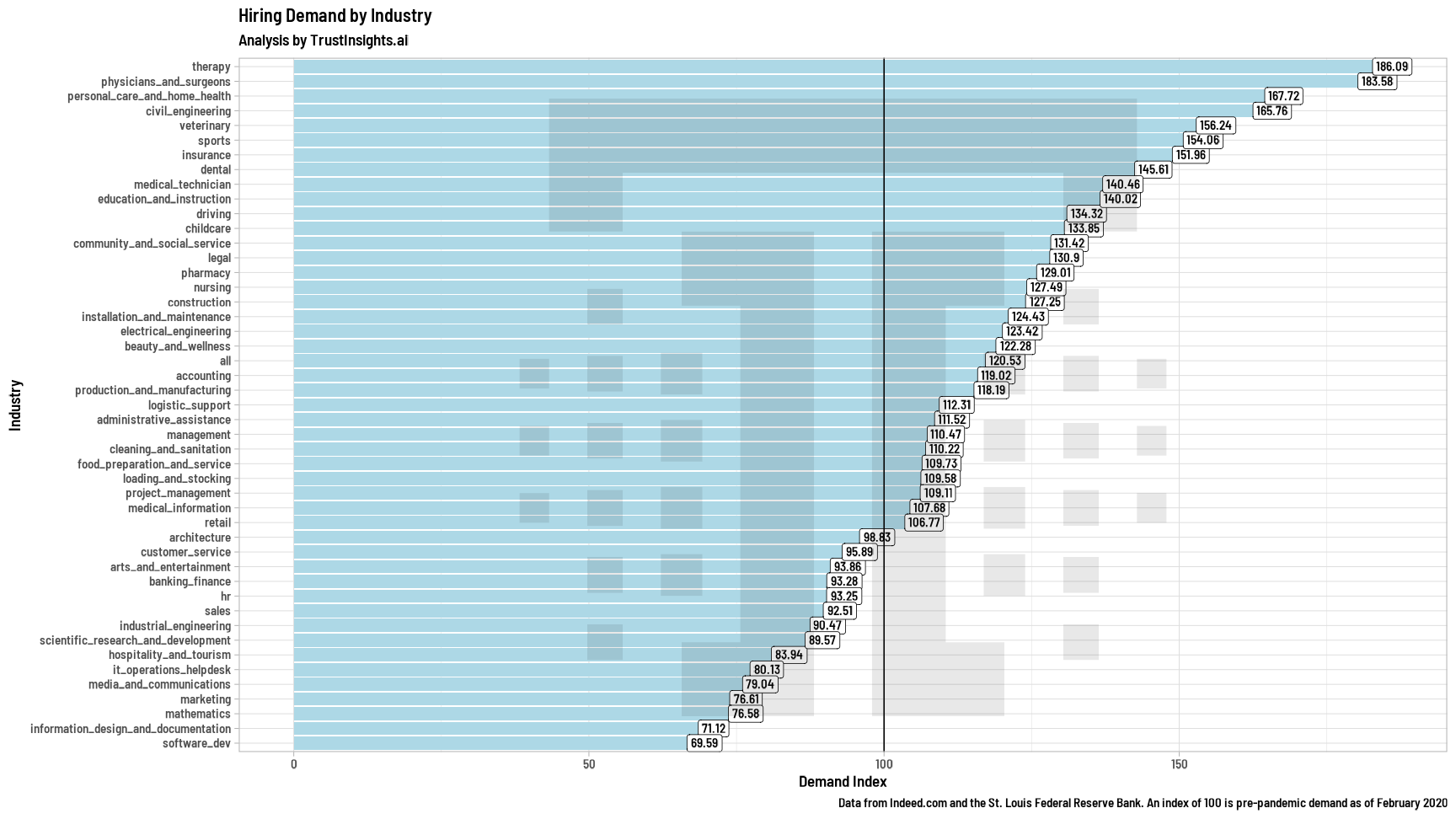
As a reminder, hiring demand is a number produced by Indeed.com in their datasets that they publish to the St. Louis Federal Reserve Bank. This data is freely available to anyone who uses the Federal Reserve Bank’s data tools. The Indeed.com data is benchmarked against an index of one hundred representing hiring demand as of February 2020.
For example, here’s the hiring demand as of January 7, 2025:
And here’s the snapshot of the hiring demand as of today:
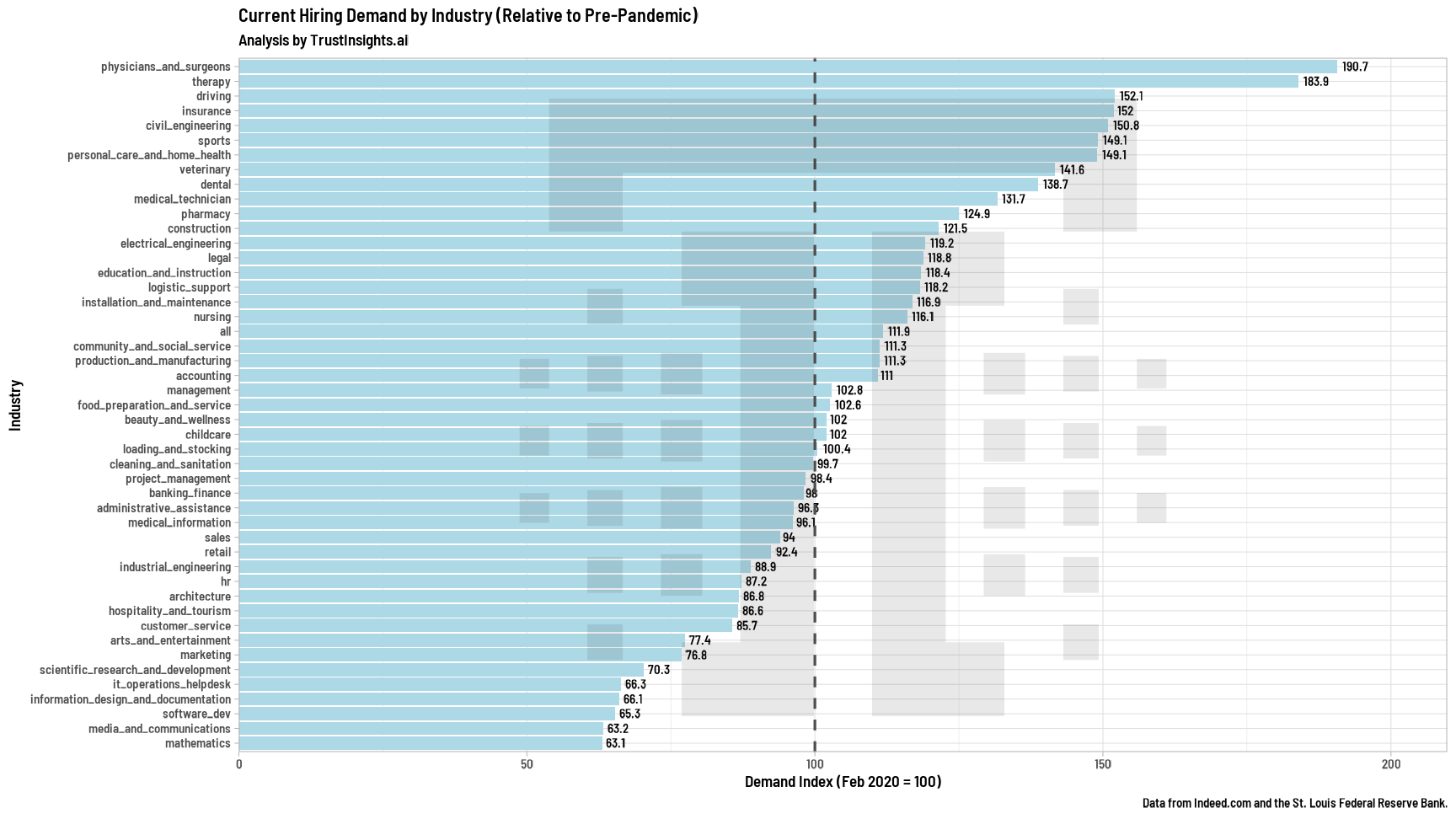
It’s challenging to eyeball the differences between these two because of the sheer number of industries that we’re keeping track of. It’s also hard to get a big picture perspective as to the health of the economy overall. But what if we were to do a big comparison of the two data sets to see how things have changed since January of this year?
Let’s take a look:
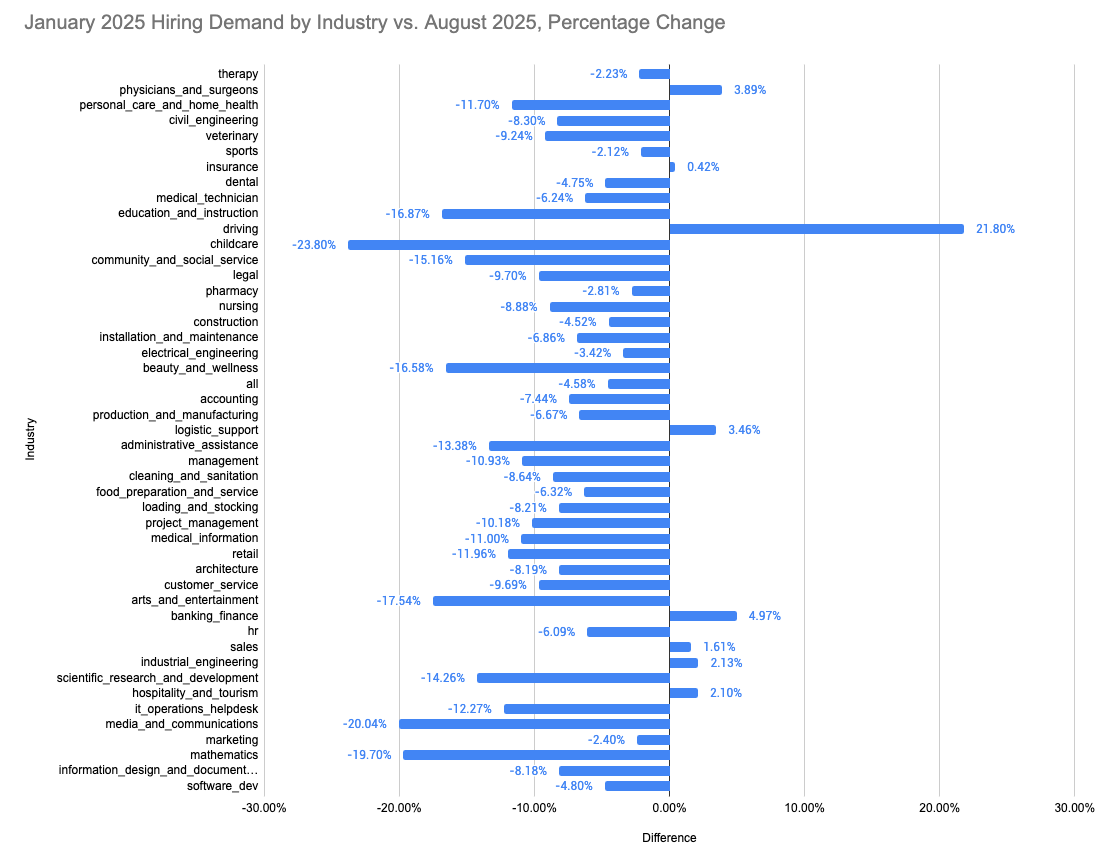
What we see paints a relatively grim picture of the USA economy. We can see that for almost every industry there has been a substantial drop in hiring demand. The top three industries that have seen any growth since the beginning of the year are driving, meaning truck driving and logistics, banking and finance, and physicians and surgeons.
The bottom three industries that have seen the largest declines are mathematics, media and communications, and childcare.
Overall, 8 industries show growth this year, while 38 show declines. On average, hiring demand across the USA economy has declined by 7.13%.
And some industries like software development, which were at the bottom of the pile back in January, have seen further declines and further softening. Close to home, marketing, which was the fourth least in demand industry at the beginning of the year, declined an additional 2.4%.
What does this data tell us? At its heart, this data tells us that the US economy is in trouble. Hiring demand is down, in some cases, double digits. That means finding a job is harder, the job search will take longer and it’ll be harder for companies to hire qualified candidates because there’ll just be so many of them.
What’s the cause of this? The challenge with anything involving hiring is that there are multiple, sometimes conflicting forces acting on the hiring market. Everything from tariffs and trade wars to geopolitical changes to technological impacts like generative AI can alter the dynamics of the hiring market. There’s no one single thing to point a finger at and say, “Yes, that right there is the problem”, no matter how tempting that might be.
What do we do with this information? For folks who are looking for work or thinking about leaving their positions, this is not a job seekers market. If you are currently employed and want to change jobs, make sure you have something lined up before you leave your current position. Don’t leave a job unless it is absolutely intolerable.
For employers, you have your pick of candidates, but the challenge you’re going to run into is just how many of them there are and how AI is muddying the waters by making every candidate look equally qualified. ChatGPT can apply astonishing, highly convincing amounts of Estée Lauder on swine.
For marketers and sales, what we see in a declining hiring demand situation will also be reflected in marketing itself. If people are not willing to invest in full time employees because of economic softness, they’re also going to be hard to convince to purchase things. We will have to do a better job of demonstrating value and expect longer sales cycles.
[postsignature}
 Newsletter
 Podcast