INBOX INSIGHTS: Organizational Assessments, 2025 Hiring Demand by Industry (2025-08-27) :: View in browser
👉 Pre-register for our new course, the AI-Ready Strategist!
Watch This Newsletter

🎧 Listen to this newsletter as an MP3
The Organizational Readiness Assessment That Actually Works
I want to tell you a story about one of my more spectacular failures. Years ago, I was tasked with rolling out a new project management system—MS Project 2010 and SharePoint. On paper, it was a solid platform. In reality, it was a disaster. I tried to launch it not once, not twice, but three separate times. Each time, it failed.
Why? Because I was never given a clear “why.” I couldn’t tell the teams why we were switching, other than “leadership wants this.” The teams, who were perfectly happy with their own tracking tools, were never consulted. The new platform didn’t solve their problems; it just created new ones. The result was a massive waste of time, money, and, quite frankly, my sanity.
Sound familiar? Today, the pressure isn’t about SharePoint; it’s about AI. Every leader, every team, every company is feeling the heat to “do something with AI.” So we jump. We sign up for a tool, we task a team with “finding a use case,” and we cross our fingers. More often than not, it ends the same way my SharePoint project did: with a fizzle, not a bang.
The problem wasn’t the technology itself—it was that nobody had honestly assessed whether we were actually ready for this kind of transformation.
That’s why I’ve developed what I call the “brutally honest” readiness assessment – based on the 5P Framework. It’s not just a quick checklist you can breeze through to feel good about yourself. This thing forces you to confront the real gaps in your organization, and trust me, there are always gaps.
Why Most Readiness Assessments Miss the Mark
The thing about most AI readiness assessments is that they’re designed to make you feel confident about moving forward, not to actually prepare you for success. They ask surface-level questions like “Do you have leadership buy-in?” without digging into what that actually means.
Real readiness assessment means asking the uncomfortable questions. Like: Does your team actually know how to use AI beyond “write me a blog post”? (Spoiler alert: probably not.) Have you identified every single person who will be impacted by this change? Do you know what happens when your lead scoring suddenly triples your qualified leads?
The Five Pillars, But Deeper
The assessment I’ve built covers the same five foundational areas as the 5P Framework—Purpose, People, Process, Platform, and Performance—but it goes far beyond just checking boxes. Each section includes dozens of specific questions designed to uncover the real state of your readiness.
Purpose: Beyond “We Want to Use AI”
Most organizations think having a purpose means saying “we want to improve efficiency with AI.” That’s not a purpose, that’s a wish. The purpose section of this assessment digs into whether you’ve actually connected your AI initiatives to specific business objectives, whether you’ve documented success metrics, and whether leadership has articulated how this connects to your long-term vision.
One question that always trips people up: “Is there consensus among stakeholders regarding initiative scope, boundaries, and expected outcomes?” I can’t tell you how many times I’ve seen projects derail because sales thought they were getting one thing, marketing expected another, and IT was building something completely different.
People: The Make-or-Break Factor
People are the linchpin of any successful AI implementation, and the assessment reflects that reality. We’re not just talking about whether someone on your team has used ChatGPT. It’s a good starting point, but your team needs more experience than that.
This section breaks down into three critical areas:
Team AI Literacy and Skills: Do your people actually know how to do deep research with AI? Can they create effective prompts? Do they understand the limitations? If generative AI has only been used at the surface level (like to create content), you’re not ready to effectively leverage AI for complex business processes.
Leadership and Stakeholder Buy-In: Is there visible, active executive sponsorship? Have you identified all the stakeholders who need to be engaged? I’m talking about everyone—if you’re implementing automated lead scoring, that impacts sales, marketing, customer support, development, IT, and leadership. Have they all been looped in?
Change Management: Here’s where it gets real. Real tough, that is. Is your organizational culture actually receptive to workflow changes? Do you have established change management methodologies? Have you identified potential resistance and addressed it proactively?
One of my favorite questions in this section is: “Have early adopters and internal champions been identified to support adoption and engagement?” Change management is often seen as a cultural shift, and you need your culture carriers on board to support your initiatives.
Process: The Foundation Everything Else Builds On
The process section exposes something most organizations don’t want to admit: their current processes aren’t well-defined or documented. If you can’t clearly articulate how something works today, you definitely can’t improve it with AI tomorrow.
Existing Workflow Efficiency: Are your current processes actually documented and understood by all stakeholders? (Even at Trust Insights, we don’t have everything documented perfectly—it’s an ongoing challenge.) But here’s the thing: the more you have documented, the easier it becomes to introduce new technology and manage change.
AI Governance and Ethical Guidelines: Do you have established governance structures for AI implementation? Are there documented ethical guidelines? Have you identified potential risks and mitigation strategies for each initiative?
This is where the assessment gets into the nitty-gritty of compliance requirements, regulatory considerations, and industry-specific guidelines. If you’re handling PHI, PII, or operating under GDPR, HIPAA, or COPPA regulations, you need to know how AI fits into those requirements.
Platform: More Than Just “Does It Work?”
The platform assessment goes way deeper than basic compatibility questions. We’re talking about whether your current martech stack can actually integrate with AI solutions, whether you have the APIs and data exchange mechanisms necessary, and whether your existing technology environment is flexible enough to accommodate new solutions.
Technical Expertise and Support: Do you have sufficient technical knowledge to implement and manage AI solutions? Are IT and technical resources allocated and committed? Do you have access to specialized expertise, either internal or external?
Infrastructure Readiness: Can your current technology environment actually support AI solutions? Have computing, storage, and processing capabilities been assessed? Is your security environment sufficient for sensitive data use?
Performance: The 6Cs Deep Dive
This is where the assessment gets seriously comprehensive. The performance section breaks down into six critical areas—what I call the 6Cs of data quality: Clean, Complete, Comprehensive, Chosen, Credible, and Calculable.
Each C includes multiple detailed questions about your data foundation, from whether your data is free from significant errors and duplications to whether you have established processes for ongoing data quality maintenance.
For example, under “Credible,” we ask: Are your data sources reliable and trusted? Have you documented data sources and origin for key assets? Do you have established standards for data source evaluation? Have potential data biases been identified and addressed?
The Real Assessment
When you complete this assessment honestly (and I mean brutally honest), most organizations score around 2.3 out of 5. That’s not a failure—that’s reality. It means you have work to do before you start implementing AI solutions.
Scores below 3 in any category indicate areas requiring focused attention before proceeding with implementation. Categories scoring 3-4 represent areas for ongoing improvement. Only categories scoring 5 indicate organizational strengths that can actually support successful AI adoption.
Why This Level of Detail Matters
I know this feels like a lot. Trust me, I get it. But here’s what I’ve learned from watching countless AI implementations: the organizations that succeed are the ones that do this deep assessment work upfront. The ones that skip it? They’re the ones calling me six weeks later asking how to fix the chaos.
This assessment forces you to move from vague feelings about readiness to concrete evaluation of your organizational capabilities. It identifies gaps before they become expensive problems. And it creates a roadmap for addressing those gaps systematically.
Your Next Step
When it comes to initiatives, where are the failure points? Is it people? Is it the process? How long do new things last, and how quickly do those ideas get shelved? The next time you want to introduce a new technology, or change a process, take a step back and assess the readiness of your organization with a critical eye.
Are you being honest about the “readiness” of your organization? Reply to this email or join our free Slack group, Analytics for Marketers.
– Katie Robbert, CEO
p.s. If you want a copy of the 5P Readiness Assessment, it is available in our new course, the AI-Ready Strategist, live on September 2nd. You can pre-order now through August 29th with the discount code: strategy2025 – go to trustinsights.ai/aistrategycourse

Do you have a colleague or friend who needs this newsletter? Send them this link to help them get their own copy:
https://www.trustinsights.ai/newsletter

In this episode of In-Ear Insights, the Trust Insights podcast, Katie and Chris discuss why enterprise generative AI projects often fail to reach production.
You’ll learn why a high percentage of enterprise generative AI projects reportedly fail to make it out of pilot, uncovering the real reasons beyond just the technology. You’ll discover how crucial human factors like change management, user experience, and executive sponsorship are for successful AI implementation. You’ll explore the untapped potential of generative AI in back-office operations and process optimization, revealing how to bridge the critical implementation gap. You’ll also gain insights into the changing landscape for consultants and agencies, understanding how a strong AI strategy will secure your competitive advantage. Watch now to transform your approach to AI adoption and drive real business results!
Watch/listen to this episode of In-Ear Insights here »
Last time on So What? The Marketing Analytics and Insights Livestream, we put the new ChatGPT GPT-5 to the test for gender bias versus Google Gemini and Deepseek. Find out which model won. Catch the episode replay here!
This week on So What?, we’ll walk through the process of writing a book with AI. Are you following our YouTube channel? If not, click/tap here to follow us!

Here’s some of our content from recent days that you might have missed. If you read something and enjoy it, please share it with a friend or colleague!
- Google Tag Gateway
- So What? AI Bias Benchmark Testing
- Using AI for KPIs
- INBOX INSIGHTS, August 20, 2025: Common Leadership Mistakes, AI Beauty Standards
- In-Ear Insights: Reviewing AI Data Privacy Basics
- Which AI Models To Use Part 2
- Almost Timely News: 🗞️ How To Find A Job Using AI (2025-08-24)

Take your skills to the next level with our premium courses.
- 🎯 New! The AI-Ready Strategist
- 💥 Generative AI Use Cases for Marketers
- 💡 Mastering Prompt Engineering for Marketers
- 🦾 Generative AI for Marketers
- 📊 Google Analytics 4 for Marketers
- 🔎 Google Search Console for Marketers

Get skilled up with an assortment of our free, on-demand classes.
- Never Think Alone: How AI Has Changed Marketing Forever (2025)
- Generative AI for Tourism and Destination Marketing (2025)
- The Future of AI is Open : MAICON 2024 Christopher Penn Talk
- Managing the People Who Manage AI : Katie Robbert at MAICON 2024
- Building the Data-Driven, AI-Powered Customer Journey Map : INBOUND 2024
- Powering Up Your LinkedIn Profile (For Job Hunters) 2023 Edition

You could be reaching 37,000+ marketers, analysts, data scientists, and executives directly with your ad. Want to learn more? Reach out and contact us.

In this week’s Data Diaries, let’s take a step back and look at the USA economy and hiring demand as it has changed year to date (apologies to our non USA friends). We’ve been running this series now for several years and every month we publish a snapshot of hiring demand by industry.
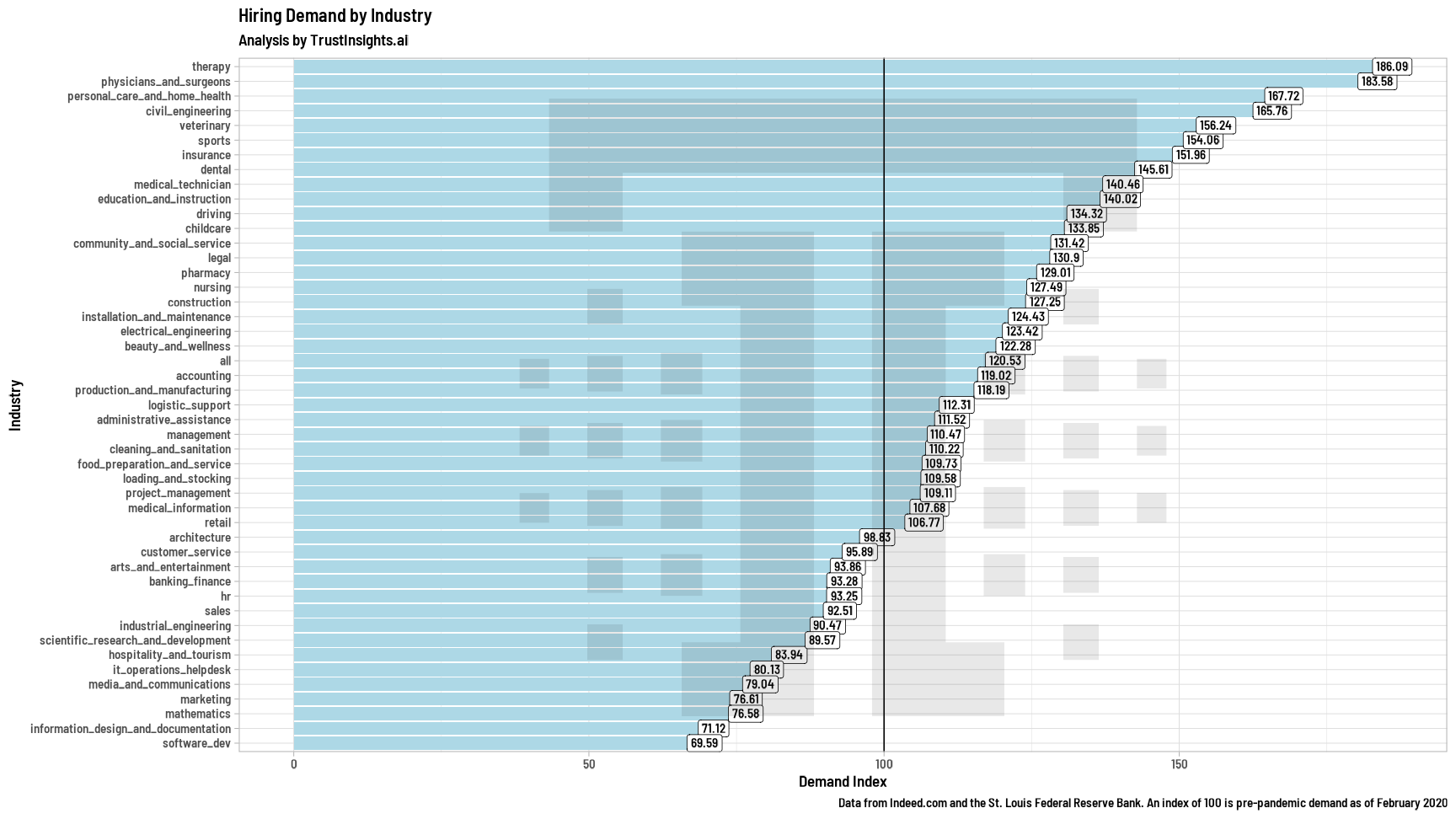
As a reminder, hiring demand is a number produced by Indeed.com in their datasets that they publish to the St. Louis Federal Reserve Bank. This data is freely available to anyone who uses the Federal Reserve Bank’s data tools. The Indeed.com data is benchmarked against an index of one hundred representing hiring demand as of February 2020.
For example, here’s the hiring demand as of January 7, 2025:
And here’s the snapshot of the hiring demand as of today:
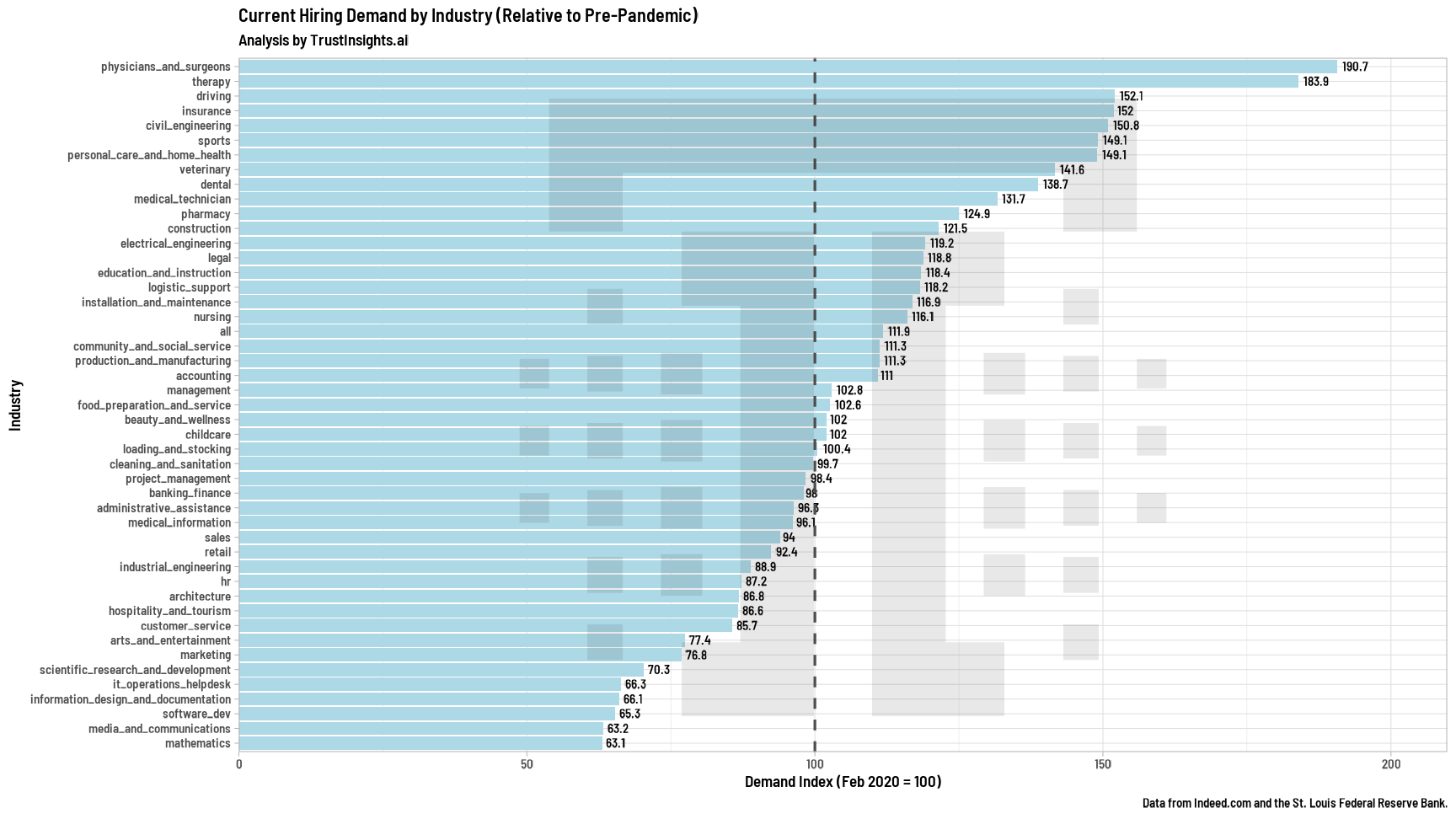
It’s challenging to eyeball the differences between these two because of the sheer number of industries that we’re keeping track of. It’s also hard to get a big picture perspective as to the health of the economy overall. But what if we were to do a big comparison of the two data sets to see how things have changed since January of this year?
Let’s take a look:
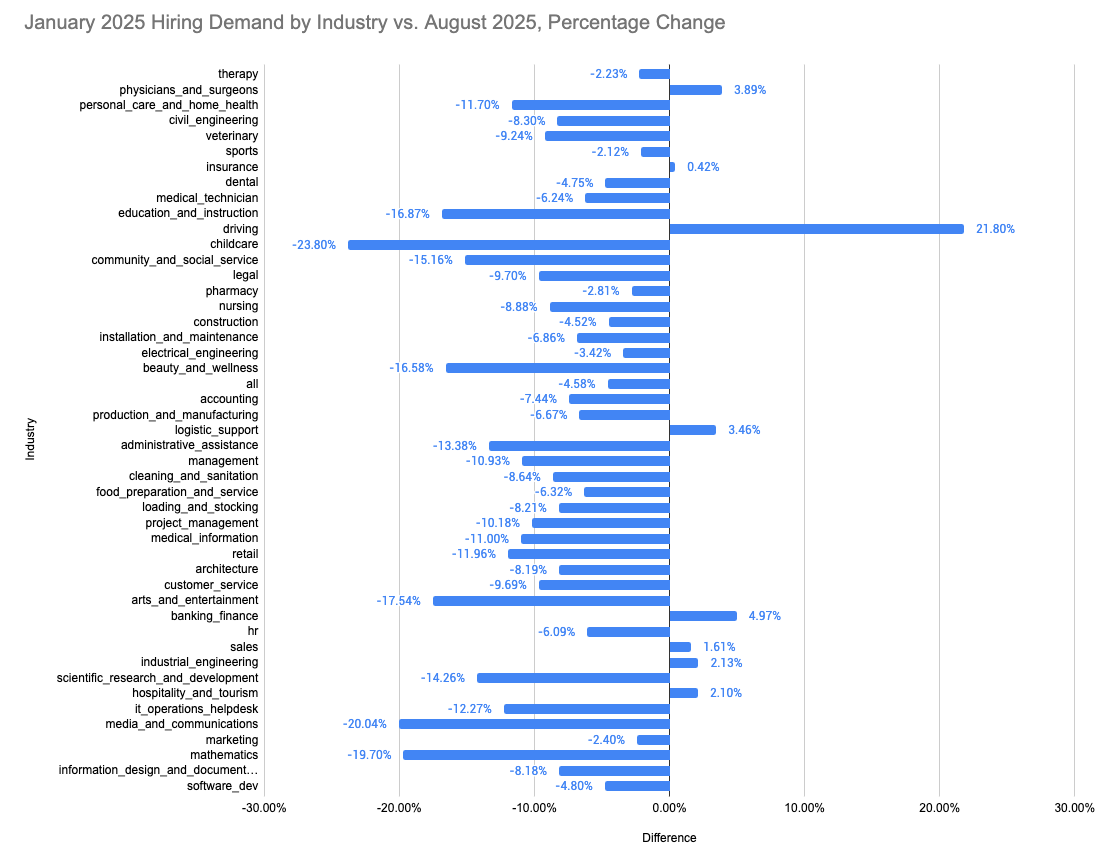
What we see paints a relatively grim picture of the USA economy. We can see that for almost every industry there has been a substantial drop in hiring demand. The top three industries that have seen any growth since the beginning of the year are driving, meaning truck driving and logistics, banking and finance, and physicians and surgeons.
The bottom three industries that have seen the largest declines are mathematics, media and communications, and childcare.
Overall, 8 industries show growth this year, while 38 show declines. On average, hiring demand across the USA economy has declined by 7.13%.
And some industries like software development, which were at the bottom of the pile back in January, have seen further declines and further softening. Close to home, marketing, which was the fourth least in demand industry at the beginning of the year, declined an additional 2.4%.
What does this data tell us? At its heart, this data tells us that the US economy is in trouble. Hiring demand is down, in some cases, double digits. That means finding a job is harder, the job search will take longer and it’ll be harder for companies to hire qualified candidates because there’ll just be so many of them.
What’s the cause of this? The challenge with anything involving hiring is that there are multiple, sometimes conflicting forces acting on the hiring market. Everything from tariffs and trade wars to geopolitical changes to technological impacts like generative AI can alter the dynamics of the hiring market. There’s no one single thing to point a finger at and say, “Yes, that right there is the problem”, no matter how tempting that might be.
What do we do with this information? For folks who are looking for work or thinking about leaving their positions, this is not a job seekers market. If you are currently employed and want to change jobs, make sure you have something lined up before you leave your current position. Don’t leave a job unless it is absolutely intolerable.
For employers, you have your pick of candidates, but the challenge you’re going to run into is just how many of them there are and how AI is muddying the waters by making every candidate look equally qualified. ChatGPT can apply astonishing, highly convincing amounts of Estée Lauder on swine.
For marketers and sales, what we see in a declining hiring demand situation will also be reflected in marketing itself. If people are not willing to invest in full time employees because of economic softness, they’re also going to be hard to convince to purchase things. We will have to do a better job of demonstrating value and expect longer sales cycles.

- New!💡 Case Study: Predictive Analytics for Revenue Growth
- Case Study: Exploratory Data Analysis and Natural Language Processing
- Case Study: Google Analytics Audit and Attribution
- Case Study: Natural Language Processing
- Case Study: SEO Audit and Competitive Strategy

Almost every AI course is the same, conceptually. They show you how to prompt, how to set things up – the cooking equivalents of how to use a blender or how to cook a dish. These are foundation skills, and while they’re good and important, you know what’s missing from all of them? How to run a restaurant successfully. That’s the big miss. We’re so focused on the how that we completely lose sight of the why and the what.
This is why our new course, the AI-Ready Strategist, is different. It’s not a collection of prompting techniques or a set of recipes; it’s about why we do things with AI. AI strategy has nothing to do with prompting or the shiny object of the day — it has everything to do with extracting value from AI and avoiding preventable disasters. This course is for everyone in a decision-making capacity because it answers the questions almost every AI hype artist ignores: Why are you even considering AI in the first place? What will you do with it? If your AI strategy is the equivalent of obsessing over blenders while your steakhouse goes out of business, this is the course to get you back on course.
👉 Pre-register today! The course begins September 2.

Here’s a roundup of who’s hiring, based on positions shared in the Analytics for Marketers Slack group and other communities.
- Business Analytics Manager at Virtual Business Office Associates
- Customer Data And Insights Manager at Prosum
- Data Analyst (Adobe) – Part-Time at NMQ Digital
- Data Analyst at Brooksource
- Data Analyst at Insight Global
- Director Of Business Intelligence & Analytics at Integra Connect
- Ecommerce Manager at LookOurWay
- Manager, Managerial Consulting V at Kaiser Permanente
- Paid Social Strategist at Blue Wheel
- Performance Marketing Manager at Headlight
- Sales And Marketing Specialist at RUBIN FINANCIAL GROUP
- Senior Manager, Product Marketing at SimplePractice
- Senior Marketing Analyst, Member at Carrot
- Senior Product Manager Prm, Reporting & Insights at Muck Rack
- Social Media Strategies at Fast Supplements LLC

Are you a member of our free Slack group, Analytics for Marketers? Join 3000+ like-minded marketers who care about data and measuring their success. Membership is free – join today. Members also receive sneak peeks of upcoming data, credible third-party studies we find and like, and much more. Join today!

Where can you find Trust Insights face-to-face?
- SMPS, Denver, October 2025
- MAICON, Cleveland, October 2025
- Generative AI for B2B Marketers, London, October 2025
- MarketingProfs B2B Forum, Boston, November 2025
Going to a conference we should know about? Reach out!
Want some private training at your company? Ask us!

First and most obvious – if you want to talk to us about something specific, especially something we can help with, hit up our contact form.
Where do you spend your time online? Chances are, we’re there too, and would enjoy sharing with you. Here’s where we are – see you there?
- Our blog
- Slack
- YouTube
- In-Ear Insights on Apple Podcasts
- In-Ear Insights on Google Podcasts
- In-Ear Insights on all other podcasting software
Read our disclosures statement for more details, but we’re also compensated by our partners if you buy something through us.
Imagine a world where your marketing strategies are supercharged by the most cutting-edge technology available – Generative AI. Generative AI has the potential to save you incredible amounts of time and money, and you have the opportunity to be at the forefront. Get up to speed on using generative AI in your business in a thoughtful way with our workshop offering, Generative AI for Marketers.
Workshops: Offer the Generative AI for Marketers half and full day workshops at your company. These hands-on sessions are packed with exercises, resources and practical tips that you can implement immediately.
👉 Click/tap here to book a workshop

Some events and partners have purchased sponsorships in this newsletter and as a result, Trust Insights receives financial compensation for promoting them. Read our full disclosures statement on our website.

Thanks for subscribing and supporting us. Let us know if you want to see something different or have any feedback for us!
|
Need help with your marketing AI and analytics? |
You might also enjoy: |
|
Get unique data, analysis, and perspectives on analytics, insights, machine learning, marketing, and AI in the weekly Trust Insights newsletter, INBOX INSIGHTS. Subscribe now for free; new issues every Wednesday! |
Want to learn more about data, analytics, and insights? Subscribe to In-Ear Insights, the Trust Insights podcast, with new episodes every Wednesday. |
Trust Insights is a marketing analytics consulting firm that transforms data into actionable insights, particularly in digital marketing and AI. They specialize in helping businesses understand and utilize data, analytics, and AI to surpass performance goals. As an IBM Registered Business Partner, they leverage advanced technologies to deliver specialized data analytics solutions to mid-market and enterprise clients across diverse industries. Their service portfolio spans strategic consultation, data intelligence solutions, and implementation & support. Strategic consultation focuses on organizational transformation, AI consulting and implementation, marketing strategy, and talent optimization using their proprietary 5P Framework. Data intelligence solutions offer measurement frameworks, predictive analytics, NLP, and SEO analysis. Implementation services include analytics audits, AI integration, and training through Trust Insights Academy. Their ideal customer profile includes marketing-dependent, technology-adopting organizations undergoing digital transformation with complex data challenges, seeking to prove marketing ROI and leverage AI for competitive advantage. Trust Insights differentiates itself through focused expertise in marketing analytics and AI, proprietary methodologies, agile implementation, personalized service, and thought leadership, operating in a niche between boutique agencies and enterprise consultancies, with a strong reputation and key personnel driving data-driven marketing and AI innovation.
 Newsletter
 Podcast