This data was origially featured in the September 3rd, 2025 newsletter found here: INBOX INSIGHTS, September 3, 2025: Becoming AI Ready, Leading Economic Indicators
In this week’s Data Diaries, let’s examine a few more leading economic indicators. Last week we looked at hiring demand to understand the state of the economy based on what industries we’re hiring.
While that data was revelatory, that’s only one slice of the pie. There are plenty of other leading economic indicators we can use to understand the state of the world, or at the very least the USA. Using data from the St. Louis Federal Reserve Bank’s FRED Economic Data System, we can take a big picture look at the overall economy.
As we’ve discussed many times in past issues of the newsletter, A leading economic indicator is a bellwether, a canary in the coal mine that tells us how things are going based on current economic situations and inputs into the overall economy. If inputs are on the decline, then we know that outputs will decline shortly thereafter.
The contrast is lagging economic indicators, things like when the National Bureau of Economic Research designates a recession. This happens two quarters after the actual recession, so it’s not particularly useful for forecasting and planning.
Let’s look at 4 leading economic series and see what they have to say.
Our first is real disposable personal income:

This is a measure of how much disposable income people have in the USA. The higher it is, the more spare money people have to spend on things. What we see is in the last twelve months, disposable income hit a peak in early 2025 and has flattened off since then.
Our second is the ADP non farm private payroll:

Employment data in the USA comes from many different sources, but ADP is one of the longstanding series that is privately managed, meaning that is not subject to government review. What we see is that in the last twelve months, employment peaked in early January and has leveled off and begun to decline.
Our third series is Real Personal Consumption Expenditures:
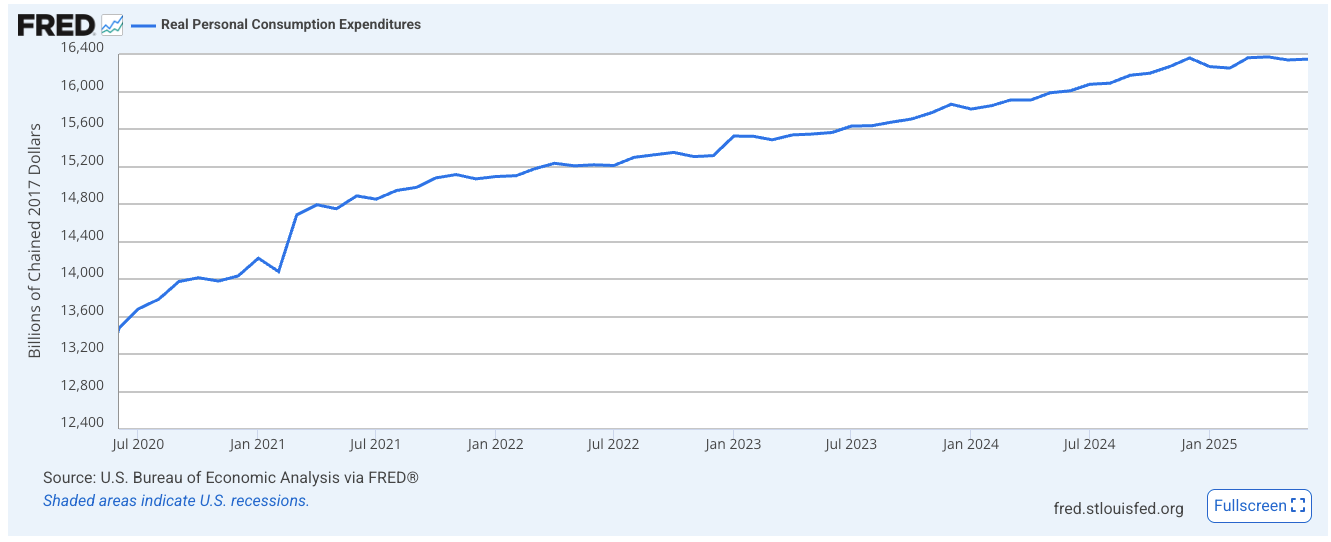
This is a measure of what people actually spend. Whereas disposable personal income was how much people earn. This is what they’re actually spending and we see that spending was on an increase for the last four years and then immediately flattened out in January of 2025.
Our fourth series is the producer price index:

What we see is that the producer price index spiked at the midst of the pandemic and then began to decline thereafter. Beginning in January of this year, the producer price index began to increase again, indicating that companies were paying more for the goods and services they consume to make their products and services.
Each of these data series is important and each of them conveys information about a certain part of the economy. But the real value of this data is when we put it all together. What we see is that broadly speaking the consumer income has flattened out. And as a result, expenditures and consumer spending has flattened out. We see hiring flattening out. And we see prices of goods and services for companies increasing. This paints the picture of an economy that is struggling, which aligns with last week’s newsletter focused entirely on hiring demand and how hiring in general has declined 7% this year.
As annual planning season begins, this data can help us plan ahead. The big picture is that we should expect a softer economy, that we should expect sales to take longer, that we should expect value to become more important to the consumer and to B2B. Forward thinking planners should be considering how to intelligently implement AI, to reduce costs where possible, and look for opportunities to increase revenue by bundling or unbundling products and services to reach price points more palatable to what people are willing to spend.
The most important thing you can do is that planning, to do scenario planning that anticipates different possible outcomes and have plans in place so that no matter what happens, you’re not taken by surprise. No matter which way the wind blows, you’re ready to tack into it.
|
Need help with your marketing AI and analytics? |
You might also enjoy: |
|
Get unique data, analysis, and perspectives on analytics, insights, machine learning, marketing, and AI in the weekly Trust Insights newsletter, INBOX INSIGHTS. Subscribe now for free; new issues every Wednesday! |
Want to learn more about data, analytics, and insights? Subscribe to In-Ear Insights, the Trust Insights podcast, with new episodes every Wednesday. |
Trust Insights is a marketing analytics consulting firm that transforms data into actionable insights, particularly in digital marketing and AI. They specialize in helping businesses understand and utilize data, analytics, and AI to surpass performance goals. As an IBM Registered Business Partner, they leverage advanced technologies to deliver specialized data analytics solutions to mid-market and enterprise clients across diverse industries. Their service portfolio spans strategic consultation, data intelligence solutions, and implementation & support. Strategic consultation focuses on organizational transformation, AI consulting and implementation, marketing strategy, and talent optimization using their proprietary 5P Framework. Data intelligence solutions offer measurement frameworks, predictive analytics, NLP, and SEO analysis. Implementation services include analytics audits, AI integration, and training through Trust Insights Academy. Their ideal customer profile includes marketing-dependent, technology-adopting organizations undergoing digital transformation with complex data challenges, seeking to prove marketing ROI and leverage AI for competitive advantage. Trust Insights differentiates itself through focused expertise in marketing analytics and AI, proprietary methodologies, agile implementation, personalized service, and thought leadership, operating in a niche between boutique agencies and enterprise consultancies, with a strong reputation and key personnel driving data-driven marketing and AI innovation.
 Newsletter
 Podcast