INBOX INSIGHTS: Who Owns AI, Marketing Jobs Report (2026-02-04) :: View in browser
Two new things to try out this week:
1. Got a stuck AI project? Try out Katie’s new, free AI Readiness Assessment tool. A simple quiz to help predict project success.
2. Wonder how your website is seen by AI? Try Chris’ new, free AI View tool (limited to 10 URLs per day while it’s in beta). It looks at your site and tells you what an AI crawler likely sees.
Watch This Newsletter

🎧 Listen to this newsletter as an MP3
Who Owns AI When Everyone Owns AI?
Who owns AI when everyone owns AI? Hint: It’s nobody. Let’s dig in.
I’ve had a front-row seat to a lot of ‘AI transformations’ lately, and I’ve noticed a recurring, awkward silence. It usually happens right after a big leadership meeting where everyone agrees that ‘AI is the future.’ The meeting ends, everyone heads back to their desks, and then… nothing happens.
The problem isn’t the technology; it’s the lack of a designated driver. Right now, CEOs are telling their teams to ‘leverage AI’ as if it’s a single checkbox on a to-do list. But without a clear owner, your marketing team is looking at IT, IT is looking at Operations, and everyone is wondering if they’re even allowed to press the ‘go’ button. When everyone ‘owns’ the transformation in theory, the result isn’t innovation—it’s paralysis.
In the rush to stay competitive, we’re forgetting that AI isn’t a self-driving car; it’s an assistant that needs a manager. When everyone is responsible for ‘innovating,’ most people just keep doing what they’ve always done because it’s safe.
I wish I could say this was unusual. It’s not.
The Ownership Vacuum
Here’s the uncomfortable truth about AI in most organizations right now: when AI is “everyone’s job,” it becomes nobody’s job.
You’ve probably seen this play out. Leadership announces an AI initiative. There’s initial excitement. People experiment with ChatGPT on their lunch breaks. Maybe someone builds a cool prototype. And then… nothing. The prototype sits unused. The experiments don’t scale. The momentum dies.
Why? Because nobody was clearly responsible for making it stick.
This isn’t a technology problem. It’s an ownership problem. And I get it—you’re not alone in facing this. Every organization I talk to is wrestling with the same question: who exactly is supposed to own AI when it touches every department but belongs to none of them?
The Hiring Fantasy (And Why It Won’t Save You)
If you’ve been reading industry publications, you might think the answer is to hire your way out of this. Create an AI Product Manager role! Build a Center of Excellence! Establish an AI governance team!
That advice sounds great if you’re a Fortune 500 company with budget to spare. But let’s be honest about reality for the rest of us.
Your headcount is probably frozen. Mine is too. Even if you could hire, you’re competing for a tiny talent pool where qualified candidates command salaries that would blow your budget. And “Centers of Excellence”? That phrase alone makes most small and mid-sized organizations roll their eyes—it sounds like something designed for companies with 5,000 employees and dedicated innovation labs.
So what do the rest of us do? We work with what we have.
The In-Housing Problem
Before we talk solutions, let’s name the real issue I opened with: the in-housing problem.
When you rely on external consultants or vendors for AI capability, knowledge walks out the door when they do. You’re not building internal muscle; you’re renting someone else’s. And every time you rent, you start from scratch when the engagement ends.
I’ve seen this happen with agencies, consultants, and even vendors who implement tools and then disappear. The company is left with technology they don’t fully understand and processes nobody internally can maintain.
The solution isn’t to never use external help—sometimes you need it. The solution is to be intentional about what stays when they leave. And that means assigning clear internal ownership from day one.
A Framework That Works Without New Headcount
At Trust Insights, we use the 5P Framework—Purpose, People, Process, Platform, Performance—for almost everything. It works particularly well for sorting out AI ownership because it forces you to think beyond just “who does the work” to “who’s responsible for what kind of decision.”
- Purpose Ownership: Who decides why you’re using AI in the first place? This person ensures AI initiatives align with business goals, not just technical possibility. In most organizations, this should sit with a senior leader who understands strategy.
- People Ownership: Who’s responsible for making sure your team can actually use AI effectively? This includes training, skill development, and addressing the human side of adoption. Often this falls naturally to HR or a team lead.
- Process Ownership: Who ensures AI fits into how work actually gets done? This person maps workflows, identifies where AI adds value, and documents how humans and machines work together.
- Platform Ownership: Who manages the actual tools—selection, security, integration, and maintenance? This is usually IT, but with a critical caveat: they need a seat at the strategy table, not just implementation orders.
- Performance Ownership: Who measures whether any of this is working? They track adoption, outcomes, and ROI.
Your Practical Responsibility Matrix
Here’s where this gets actionable. Take this matrix and adapt it to your reality:
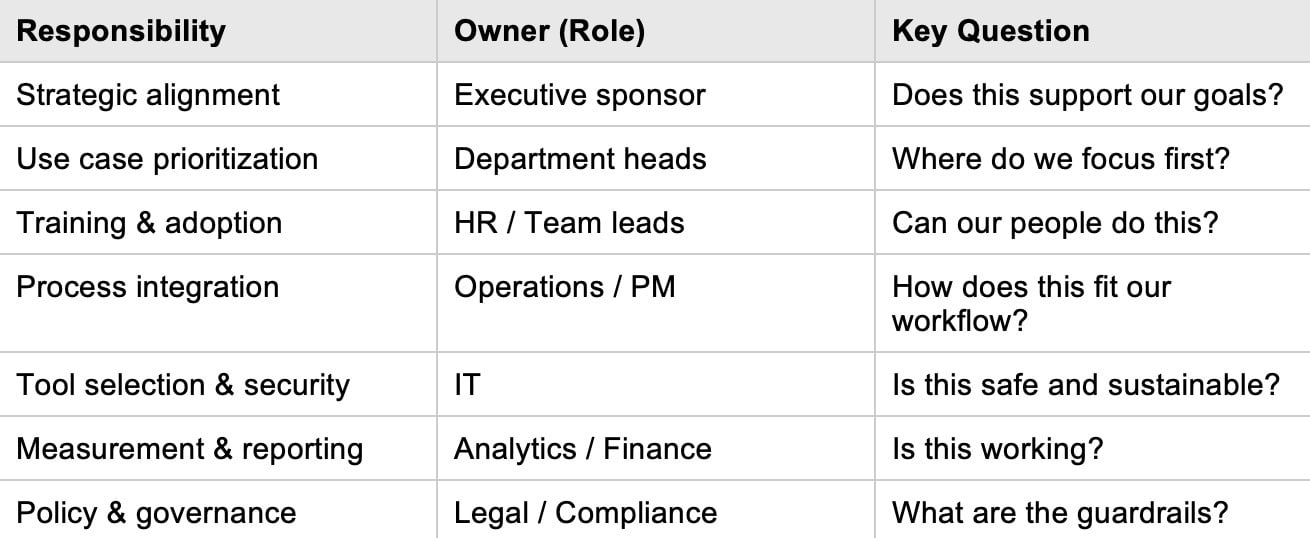
Notice something important: none of these require a new hire. They require assigning ownership to people who already exist in your organization.
The Bottom Line
I know this isn’t the sexy answer. There’s no shiny new job title, no dedicated team, no innovation lab. But here’s what I’ve learned after years of helping organizations actually get things done: clarity beats resources almost every time.
A clear owner with limited time will outperform a vague “everyone’s responsible” approach with unlimited budget. Every single time.
So here’s what I want you to do this week: print out that matrix. Fill in actual names from your organization. Have a conversation with each person about what ownership means. Make it explicit.
Stop waiting for the perfect AI hire. Start assigning ownership to the people you already have. That’s how capability stays in-house when everyone else walks out the door.
Next week we’ll explore why AI training fails and what to do about it.
How are you assigning ownership for AI? Reply to this email or join the conversation in our Free Slack community, Analytics for Marketers!
– Katie Robbert, CEO
Weekly Check-In Poll
Please click/tap on just one answer – this is our weekly survey to see how we’re doing, so please do take it. There are no forms to fill out, this is the entire thing. One click/tap and you’re done, with our thanks.
How likely are you to recommend Trust Insights as a consulting firm to someone in the next 90 days?

Do you have a colleague or friend who needs this newsletter? Send them this link to help them get their own copy:
https://www.trustinsights.ai/newsletter

In this episode of In-Ear Insights, the Trust Insights podcast, Katie and Chris discuss autonomous AI agents and the mindset shift required for total automation.
You’ll learn the risks of experimental autonomous systems and how to protect your data. You’ll discover ways to connect AI to your calendar and task managers for better scheduling. You’ll build a mindset that turns repetitive tasks into permanent automated systems. You’ll prepare your current workflows for the next generation of digital personal assistants.
Watch/listen to this episode of In-Ear Insights here »
Last time on So What? The Marketing Analytics and Insights Livestream, we did a tour of Claude Code. Catch the episode replay here!
This week on So What? we’ll be learning more about the all-new Claude Cowork plugins. Are you following our YouTube channel? If not, click/tap here to follow us!

Here’s some of our content from recent days that you might have missed. If you read something and enjoy it, please share it with a friend or colleague!
- Trust Insights Workshop Review
- So What? Introduction to Claude Code
- INBOX INSIGHTS: The 10/20/70 Rule, AI Watermarks (2026-01-28)
- In-Ear Insights: Durable Skills in the Agentic AI World
- Now with More Claude CoWork, GURU Acquisition, and AI Agents!
- Almost Timely News: 🗞️ Using Local AI for Document Scanning (2026-02-01)

Take your skills to the next level with our premium courses.
- 🎯 New! The AI-Ready Strategist
- 💥 Generative AI Use Cases for Marketers
- 💡 Mastering Prompt Engineering for Marketers
- 🦾 Generative AI for Marketers
- 📊 Google Analytics 4 for Marketers
- 🔎 Google Search Console for Marketers

Get skilled up with an assortment of our free, on-demand classes.
- 👉 New! Watch Katie Robbert’s MarketingProfs B2B Forum talk, Driving B2B Growth with AI
- How to Successfully Apply AI in Financial Aid, from MASFAA 2025
- From Text to Video in Seconds, a session on AI video generation
- Never Think Alone: How AI Has Changed Marketing Forever (2025)
- Generative AI for Tourism and Destination Marketing (2025)
- The Future of AI is Open : MAICON 2024 Christopher Penn Talk
- Managing the People Who Manage AI : Katie Robbert at MAICON 2024
- Building the Data-Driven, AI-Powered Customer Journey Map : INBOUND 2024
- Powering Up Your LinkedIn Profile (For Job Hunters) 2023 Edition

You could be reaching 37,000+ marketers, analysts, data scientists, and executives directly with your ad. Want to learn more? Reach out and contact us.

In this week’s Data Diaries, let’s take a look at what’s happening in the job market. With the federal government shutdown as of the time of this writing, we have to focus on private sector sources of data about the job market. Fortunately, the St. Louis Federal Reserve Bank data system, FRED, brings in lots of private sector data, including the Indeed.com hiring demand index and ADP (the payroll company) private employment data.
First let’s take a look at the data and then see what it means. First, let’s look at ADP’s professional services employment index for the last 5 years. ADP measures total number of people employed in a sector:
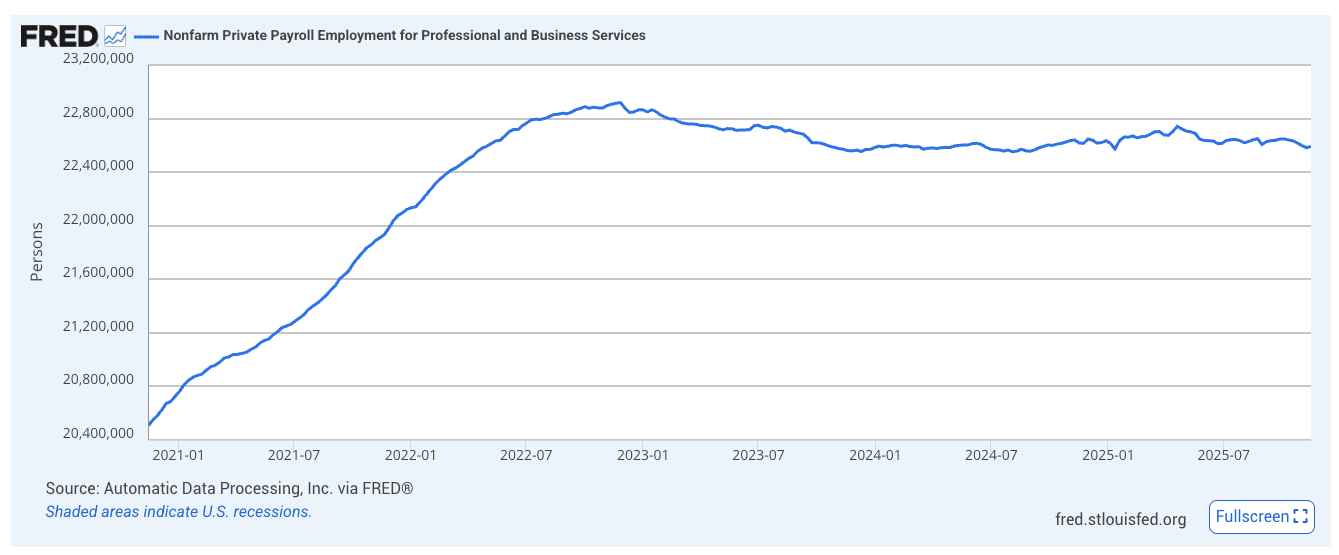
What we see is that after firing a whole bunch of people in 2020, professional services rehired at a crazy spree through 2023 and then tapered off. The sector began to show recovery again in terms of hiring in 2024, but that reversed in 2025.
Let’s next look at hiring demand for marketing, via Indeed.com, in 6 different nations:
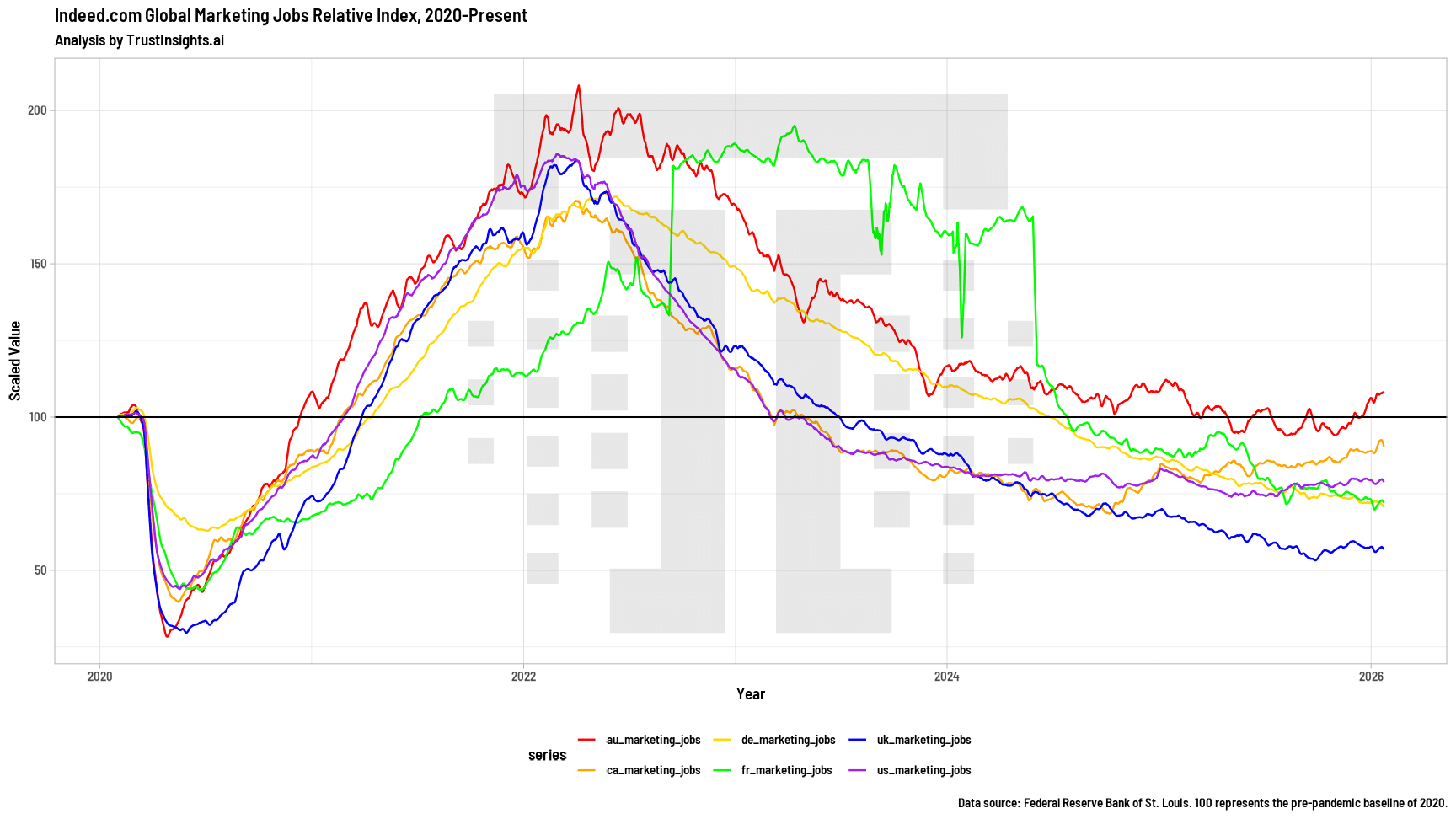
We see that in all nations except Australia, demand for marketing jobs remains exceedingly weak. In 2025, France, the UK, US, and Germany all saw significant declines in demand for software developers. Canada saw an increase compared to 2024, and Australia saw a decrease and then a rebound near the end of the year. However, demand for marketing jobs is still well below pre-pandemic levels.
Finally, let’s take a look at what industries are hiring right now in the USA:
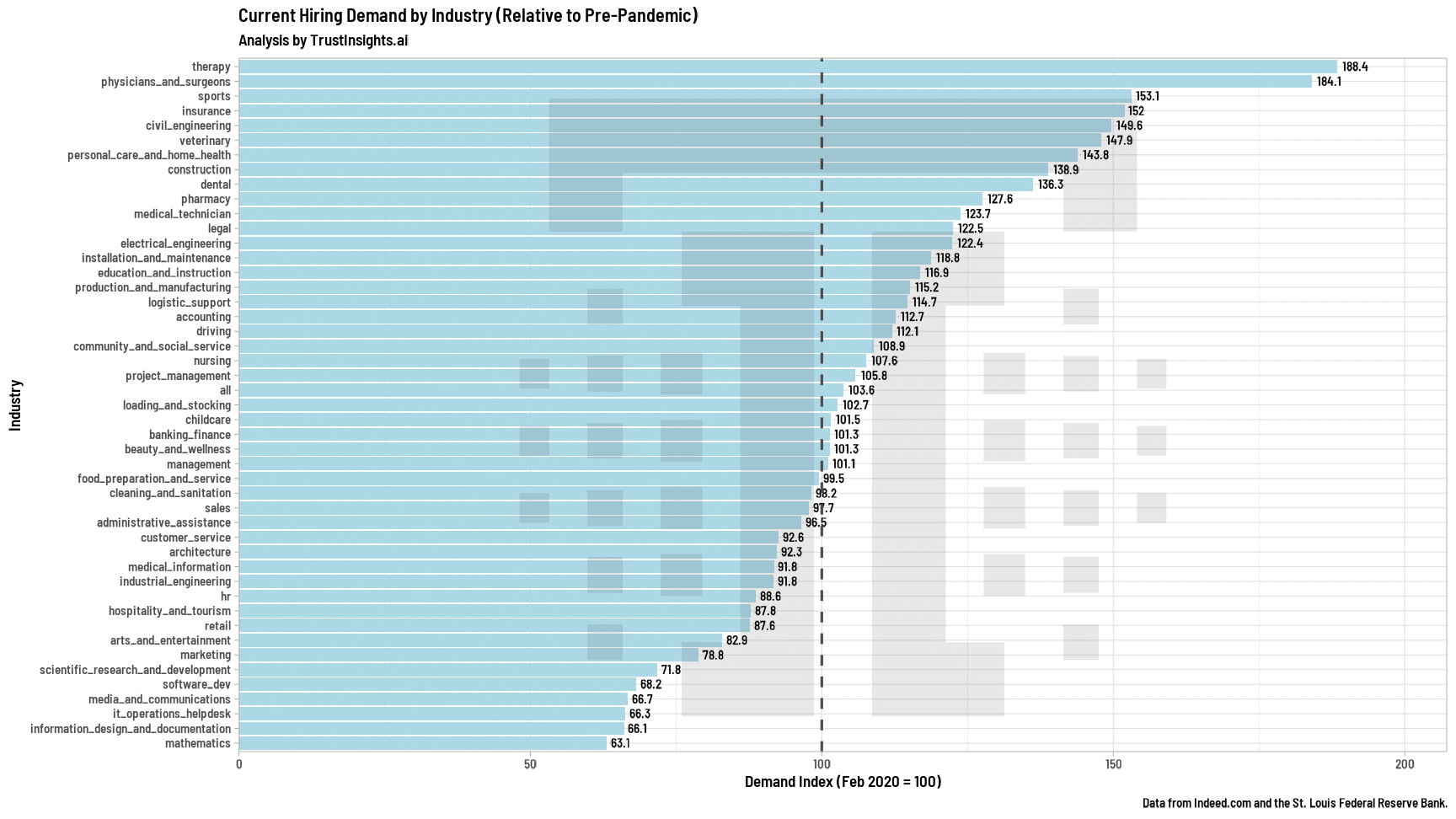
Marketing remains one of the fields where demand is below pre-pandemic levels, with the lowest field being mathematics, with hiring in the USA at 63 percent of where it was prior to the pandemic.
When we compare this to the previous year’s chart from one year ago, we see something else very interesting:
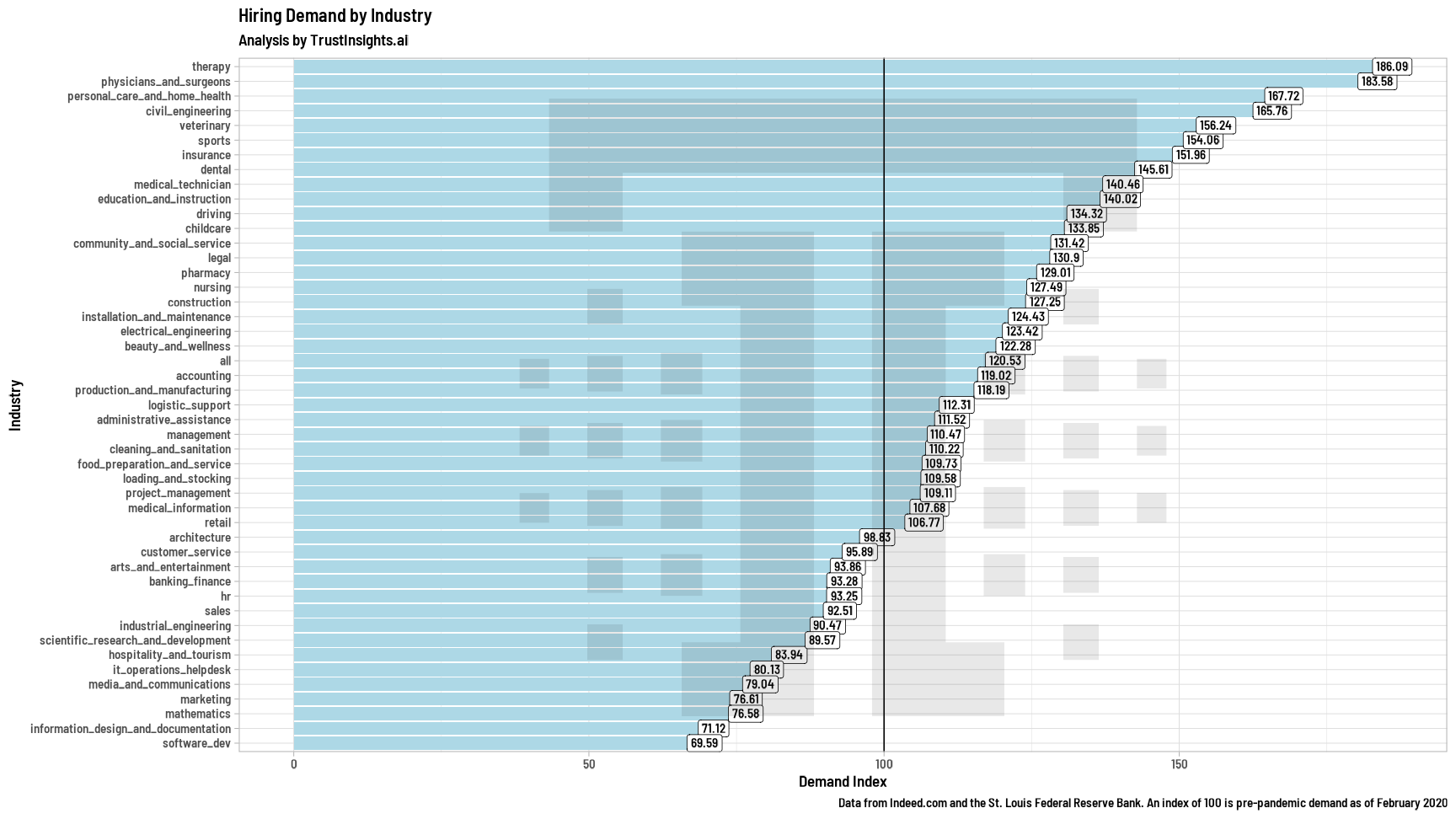
A year ago in January of 2025, the lowest level of demand was at 69%, software developers. In that time, we’ve seen five professions drop below that level. Software development, media and communications, IT operations, information design, and mathematics. Not only are these fields in low demand, but year over year their demand has decreased.
In the top spots, we see that in the beginning of 2026, therapy, physicians and surgeons, sports, insurance, and civil engineering hold the top five. This is in contrast to last year, when it was therapy, physicians and surgeons, personal care and home health, civil engineering and veterinary as the top five.
So What?
What do we make of all of this data? What does it tell us about the state of the economy? What does it tell us about our businesses?
On a sector-by-sector basis, when a sector is not hiring, it means it’s not growing. There’s financial pressures that are preventing them from adding headcount. When we look at professional services as just one of the many different sectors that ADP looks at, we see that professional services headcount has been in decline and across fields like software and media and communications and information design, demand for new headcount is well below pre-pandemic levels.
That tells us that these sectors are economically weak right now, which in turn means that things like buying cycles to those sectors are longer. Competition for winning bids and clients is heavier. Competition for employment is higher with more candidates and fewer positions.
What do you do with this information? Pay special attention to the hiring demand by industry for the industries that you and your company serve. Look at the demand for hiring and adding headcount in those industries. If you serve those industries and they are below the 100 line, which is the pre-pandemic index, you should be tightening up operations and costs as much as possible and potentially rethinking your strategy about which industries you serve.
If you serve those industries that are above the 100 line, they are growing. They have demand. They need help. They need services. They need people. And that’s where opportunities may lay. Take some time with the AI strategy partner of your choice and look at how your products and services appeal to industries like dental and pharmacy or legal and insurance.
If you’re a job seeker, look at those industries and see which of those industries and which careers within those industries are the closest lateral move to you if you’ve not been getting any bites on what it is that you currently do. If you work in a lateral position, meaning a job that exists in many different industries, such as marketing or finance or HR, those verticals that are showing the strongest growth, like therapy or sports or insurance, maybe places where you should do some job seeking if you aren’t already.
Use this data to calibrate your strategy, no matter whether you’re an employer, a job seeker, an agency, or an entrepreneur. Let it help you calibrate your strategy, refine your approach, and find opportunities where they’re hiding.

- New!💡 Case Study: Predictive Analytics for Revenue Growth
- Case Study: Exploratory Data Analysis and Natural Language Processing
- Case Study: Google Analytics Audit and Attribution
- Case Study: Natural Language Processing
- Case Study: SEO Audit and Competitive Strategy

Almost every AI course is the same, conceptually. They show you how to prompt, how to set things up – the cooking equivalents of how to use a blender or how to cook a dish. These are foundation skills, and while they’re good and important, you know what’s missing from all of them? How to run a restaurant successfully. That’s the big miss. We’re so focused on the how that we completely lose sight of the why and the what.
This is why our new course, the AI-Ready Strategist, is different. It’s not a collection of prompting techniques or a set of recipes; it’s about why we do things with AI. AI strategy has nothing to do with prompting or the shiny object of the day — it has everything to do with extracting value from AI and avoiding preventable disasters. This course is for everyone in a decision-making capacity because it answers the questions almost every AI hype artist ignores: Why are you even considering AI in the first place? What will you do with it? If your AI strategy is the equivalent of obsessing over blenders while your steakhouse goes out of business, this is the course to get you back on course.
👉 Take this course now to become an AI leader

Here’s a roundup of who’s hiring, based on positions shared in the Analytics for Marketers Slack group and other communities.
- Accounting & Auditing Ai Trainer, $90–$110/Hour at LinkedIn
- Chief Marketing Officer at Siluet
- Chief Of Staff at INSUREX
- Demand Generation Manager at UnDigital
- Director Of Marketing at Classkick
- Growth Marketing Manager at ApprentiScope
- Marketing Development Manager, South Florida at Pleina Group
- Performance Marketing Manager at Omnia 1 Analytics
- Senior Marketing Manager at Signos
- Senior Marketing Manager – Help Employees Take Control Of Their Employment Data at MyEmployment
- Senior Marketing Strategist at Penn Creative
- Strategy, Content, And Communications Lead at Notion Strategies Collective

Are you a member of our free Slack group, Analytics for Marketers? Join 4000+ like-minded marketers who care about data and measuring their success. Membership is free – join today. Members also receive sneak peeks of upcoming data, credible third-party studies we find and like, and much more. Join today!

Where can you find Trust Insights face-to-face?
- Tourism Industry Association of Alberta, Edmonton, February 2026
- Social Media Marketing World, Anaheim, April 2026
- SMPS AEC.AI, November 2026
Going to a conference we should know about? Reach out!
Want some private training at your company? Ask us!

First and most obvious – if you want to talk to us about something specific, especially something we can help with, hit up our contact form.
Where do you spend your time online? Chances are, we’re there too, and would enjoy sharing with you. Here’s where we are – see you there?
- Our blog
- Slack
- YouTube
- In-Ear Insights on Apple Podcasts
- In-Ear Insights on Google Podcasts
- In-Ear Insights on all other podcasting software
Read our disclosures statement for more details, but we’re also compensated by our partners if you buy something through us.
Imagine a world where your marketing strategies are supercharged by the most cutting-edge technology available – Generative AI. Generative AI has the potential to save you incredible amounts of time and money, and you have the opportunity to be at the forefront. Get up to speed on using generative AI in your business in a thoughtful way with our workshop offering, Generative AI for Marketers.
Workshops: Offer the Generative AI for Marketers half and full day workshops at your company. These hands-on sessions are packed with exercises, resources and practical tips that you can implement immediately.
👉 Click/tap here to book a workshop

Some events and partners have purchased sponsorships in this newsletter and as a result, Trust Insights receives financial compensation for promoting them. Read our full disclosures statement on our website.

Thanks for subscribing and supporting us. Let us know if you want to see something different or have any feedback for us!
|
Need help with your marketing AI and analytics? |
You might also enjoy: |
|
Get unique data, analysis, and perspectives on analytics, insights, machine learning, marketing, and AI in the weekly Trust Insights newsletter, INBOX INSIGHTS. Subscribe now for free; new issues every Wednesday! |
Want to learn more about data, analytics, and insights? Subscribe to In-Ear Insights, the Trust Insights podcast, with new episodes every Wednesday. |
Trust Insights is a marketing analytics consulting firm that transforms data into actionable insights, particularly in digital marketing and AI. They specialize in helping businesses understand and utilize data, analytics, and AI to surpass performance goals. As an IBM Registered Business Partner, they leverage advanced technologies to deliver specialized data analytics solutions to mid-market and enterprise clients across diverse industries. Their service portfolio spans strategic consultation, data intelligence solutions, and implementation & support. Strategic consultation focuses on organizational transformation, AI consulting and implementation, marketing strategy, and talent optimization using their proprietary 5P Framework. Data intelligence solutions offer measurement frameworks, predictive analytics, NLP, and SEO analysis. Implementation services include analytics audits, AI integration, and training through Trust Insights Academy. Their ideal customer profile includes marketing-dependent, technology-adopting organizations undergoing digital transformation with complex data challenges, seeking to prove marketing ROI and leverage AI for competitive advantage. Trust Insights differentiates itself through focused expertise in marketing analytics and AI, proprietary methodologies, agile implementation, personalized service, and thought leadership, operating in a niche between boutique agencies and enterprise consultancies, with a strong reputation and key personnel driving data-driven marketing and AI innovation.
 Newsletter
 Podcast