This data was originally featured in the August 13th, 2025 newsletter found here: INBOX INSIGHTS, August 13, 2025: Why Soft Skills Aren’t Soft, AI and Jobs
In this week’s Data Diaries, let’s explore some of the impacts of generative AI on professions. In a recent academic paper from Microsoft titled “Working with AI: Measuring the Occupational Implications of Generative AI” (2507.07935v3), researchers examined the professions most likely to be impacted by AI, where those jobs would have a substantial part of their work automated away.
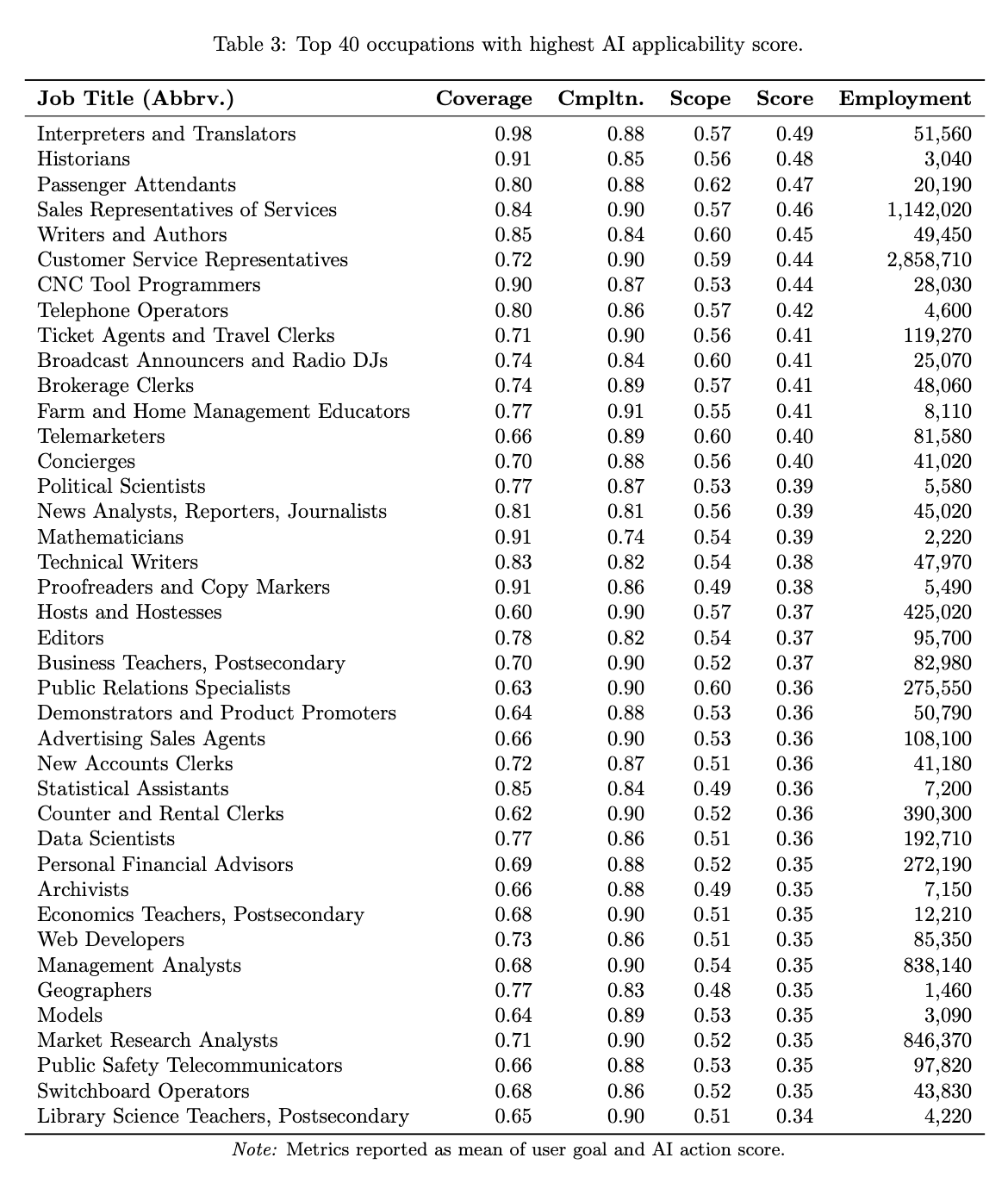
Microsoft offers four metrics for how jobs will be impacted: coverage, completion, scope, and score.
- Coverage means how many tasks in that profession AI can perform
- Completion means how many tasks in that profession AI can successfully complete
- Scope means the impact of AI on that profession in terms of tasks it can take over
- Score is an aggregate rollup of coverage, completion, and scope, indicating the overall impact of AI on that profession
A high overall score means a profession is at substantial risk of disruptive AI impact.
This in turn would reduce hiring demand for those jobs; while the jobs are unlikely to ever go away completely, the number of people who work in those professions will decline.
Here’s the thing about the Microsoft research: it’s largely theoretical, created by testing LLMs against professions’ background knowledge. The paper shows the prompts they used to evaluate professions, and it’s grounded in real world data, but still largely a forecast.
Is it true? That’s the question we want to answer.
What if we didn’t have to rely on an AI-generated forecast? Could we pair it with real world data? The answer, unsurprisingly, is yes.
Since the start of the pandemic, Indeed.com has produced a useful index of hiring demand relative to February 2020 per major industry. We’ve shown this data often in this newsletter, as it’s very helpful for understanding not just the impact of the pandemic, but everything since then – the rise of AI, global trade wars, etc.
Let’s see how well the Microsoft study maps to the reality of hiring right now. Because the industries in the study are not a 1:1 match for the Indeed.com data, we can normalize and group it with generative AI. Once we’ve done that, we can run a Spearman correlation (best used for data that isn’t a normal distribution) to see if Microsoft’s study bears any relationship to the real world.
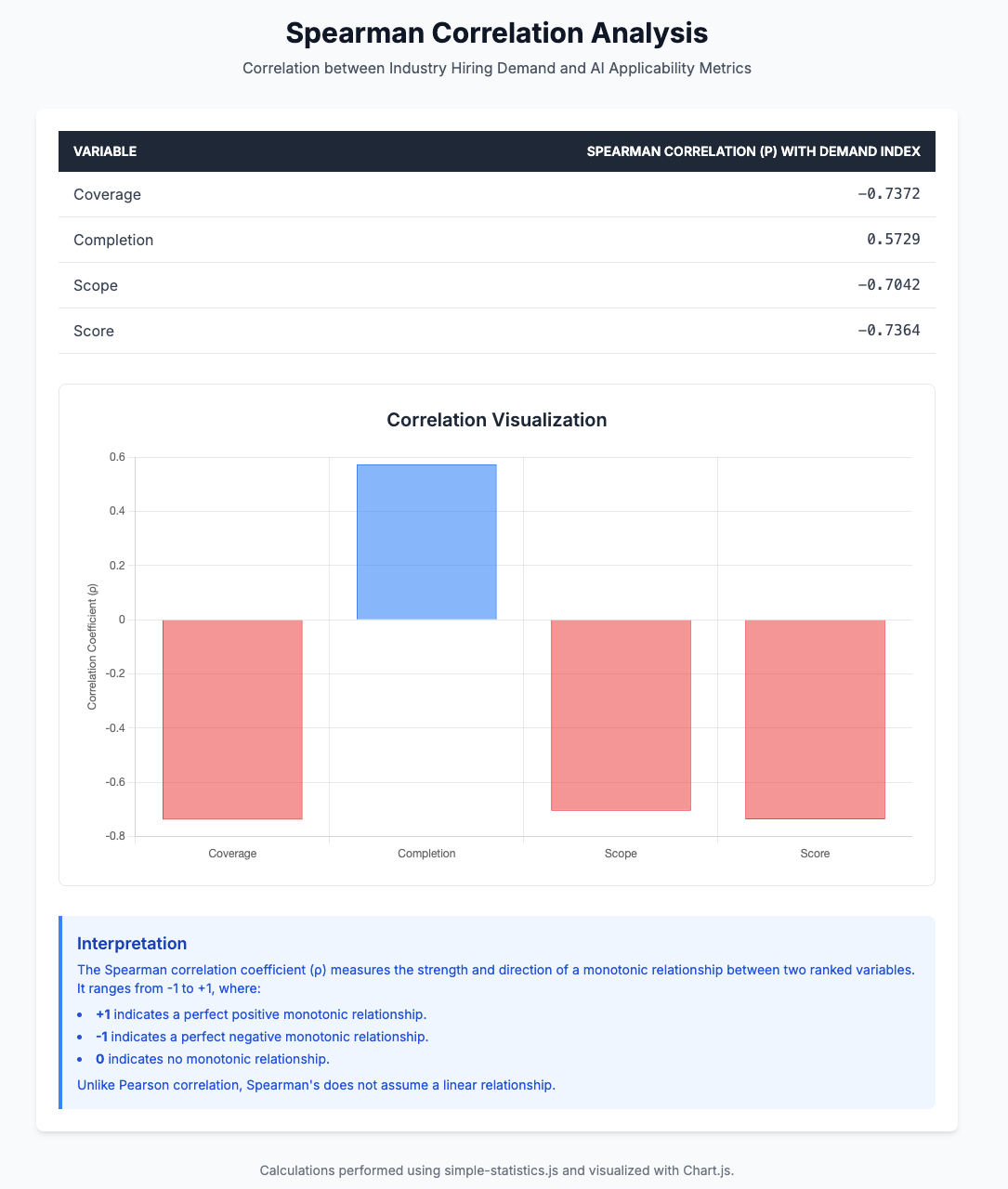
The answer is not only yes, but a strong, strong yes. Microsoft’s metrics show strong negative correlations for things like coverage (the more AI coverage, the less hiring demand of people), scope (the greater the AI scope, the less hiring demand of people), and score. These correlation numbers indicate a very strong correlation. (Interestingly, the strong positive correlation of completion with hiring demand indicates the fluency with which AI can complete tasks for which there is hiring demand)
What does this all mean? The short version is that Microsoft’s study isn’t theoretical. It’s not some far-flung, navel-gazing future, but reflected in today’s very real hiring data. Generative AI is having a substantial impact on hiring demand in the professions that both Indeed.com and Microsoft tracked, which means that if you work in those professions, you’d better be proficient with AI. If you’re not, there’s a very good chance the machines will replace you in those professions.
|
Need help with your marketing AI and analytics? |
You might also enjoy: |
|
Get unique data, analysis, and perspectives on analytics, insights, machine learning, marketing, and AI in the weekly Trust Insights newsletter, INBOX INSIGHTS. Subscribe now for free; new issues every Wednesday! |
Want to learn more about data, analytics, and insights? Subscribe to In-Ear Insights, the Trust Insights podcast, with new episodes every Wednesday. |
Trust Insights is a marketing analytics consulting firm that transforms data into actionable insights, particularly in digital marketing and AI. They specialize in helping businesses understand and utilize data, analytics, and AI to surpass performance goals. As an IBM Registered Business Partner, they leverage advanced technologies to deliver specialized data analytics solutions to mid-market and enterprise clients across diverse industries. Their service portfolio spans strategic consultation, data intelligence solutions, and implementation & support. Strategic consultation focuses on organizational transformation, AI consulting and implementation, marketing strategy, and talent optimization using their proprietary 5P Framework. Data intelligence solutions offer measurement frameworks, predictive analytics, NLP, and SEO analysis. Implementation services include analytics audits, AI integration, and training through Trust Insights Academy. Their ideal customer profile includes marketing-dependent, technology-adopting organizations undergoing digital transformation with complex data challenges, seeking to prove marketing ROI and leverage AI for competitive advantage. Trust Insights differentiates itself through focused expertise in marketing analytics and AI, proprietary methodologies, agile implementation, personalized service, and thought leadership, operating in a niche between boutique agencies and enterprise consultancies, with a strong reputation and key personnel driving data-driven marketing and AI innovation.
 Newsletter
 Podcast