INBOX INSIGHTS: AI Strategy Commonalities, B2B Marketing Writing and AI Part 2 (2026-03-18) :: View in browser
👉 Take our new GEO 101 for Marketers course!
Watch This Newsletter

🎧 Listen to this newsletter as an MP3
The One Thing Every AI Strategy Has in Common
A bartender told me a story recently that I haven’t been able to shake. The parking system in her building is run by an AI startup — a buddy of the building owner. It scans your plate, logs your entry, tracks your space, monitors duration, calculates what you owe, processes the data, generates a record, and… never sends you a bill. Eight steps of sophisticated data collection. And the one thing it was built to do? It doesn’t do that.
I keep thinking about that parking system because it’s the most honest picture of where we are with AI right now. Not the conference keynote version. The real one.
Every failed AI initiative I’ve looked at — every stalled pilot, every abandoned project, every training program that produced certificates but not capability — has the same root cause. Leadership bought the shiny thing to avoid doing the hard thing.
That’s it. That’s the whole pattern.
It shows up everywhere once you start looking. Companies are running AI pilots that collect data, process inputs, generate outputs, and produce beautiful dashboards — but nobody can tell you what business outcome the pilot delivered this quarter. They’re measuring activity, not results. Meetings held, models trained, dashboards built. Check, check, check. Revenue generated? Decisions improved? Crickets.
It shows up in training. The instinct was right — people need to learn how to use AI. The execution was wrong. Most organizations rolled out the same 101 course for everyone: the intern, the VP, the data scientist, and the operations manager all sat through identical training on prompt engineering basics. I say this as someone whose company built generic AI training too. We did it. And then we realized that completion rates tell you nothing about capability. A workshop where the CMO learns to audit AI outputs for brand risk is fundamentally different from one where a junior analyst learns to build a workflow. The hard work is assessing where each person actually is and what they specifically need. Most organizations skipped that step because assessment is slow and messy.
It shows up in infrastructure. Companies want the electric train — the cutting-edge AI, the automation, the intelligent agents — but their data lives in seventeen systems that don’t talk to each other. Their CRM hasn’t been cleaned since 2019. Half their analytics run on spreadsheets one person maintains and nobody else understands. The AI budget got approved. The data infrastructure budget didn’t. And in many organizations, the data team has been raising this flag for years. Leadership just didn’t fund the fix.
And it shows up in talent. AI has automated the entry-level work that used to train future leaders — the research, the data pulls, the first drafts. All the unglamorous tasks that taught junior employees how the business actually works. That pipeline is gone, and nobody has replaced it. We celebrated the efficiency gains without asking where the next generation of leaders comes from.
Four different symptoms. Same disease. Leadership keeps buying solutions to avoid doing the work that makes those solutions actually function.
So before you approve your next AI initiative, answer four questions:
- Who’s building judgment? How are you developing the next generation of leaders now that AI handles their old proving ground?
- Where is each person today? Have you assessed your team’s actual AI proficiency before buying training?
- What’s under the hood? When was the last time someone audited the data infrastructure your AI is supposed to run on?
- What does done look like? Can you articulate the specific business outcome this pilot produces, in one sentence?
If you can’t answer all four, that’s your to-do list. Not another platform evaluation. Not another vendor demo. The work that makes everything else work.
How is AI integration going for you? Reply to this email or join the conversation in our Free Slack community, Analytics for Marketers!
– Katie Robbert, CEO
Weekly Check-In Poll
Please click/tap on just one answer – this is our weekly survey to see how we’re doing, so please do take it. There are no forms to fill out, this is the entire thing. One click/tap and you’re done, with our thanks.
How likely are you to recommend Trust Insights as a consulting firm to someone in the next 90 days?

Do you have a colleague or friend who needs this newsletter? Send them this link to help them get their own copy:
https://www.trustinsights.ai/newsletter

In this week’s In-Ear Insights, the Trust Insights podcast, Katie and Chris discuss balancing authenticity in an AI forward world. You will uncover the major flaw of automated social media accounts. You will learn the secrets to spot robotic replies. You will explore techniques to transform artificial intelligence into a helpful companion. You will master the balance between speed and true personality.
Watch/listen to this episode of In-Ear Insights here »
Last time on So What? The Marketing Analytics and Insights Livestream, we looked at the six levels of AI proficiency. Catch the episode replay here!
This week on So What? we’ll be reviewing LinkedIn strategy and how to analyze it with agentic AI. Are you following our YouTube channel? If not, click/tap here to follow us!

Here’s some of our content from recent days that you might have missed. If you read something and enjoy it, please share it with a friend or colleague!
- Dark Data and AI
- So What? Six levels of AI Proficiency
- What We Learned About AI
- INBOX INSIGHTS: 5P Framework by Trust Insights™, B2B Marketing Writing and AI Part 1 (2026-03-11)
- In-Ear Insights: Measuring and Improving AI Proficiency
- Humanity At Risk
- Almost Timely News: 🗞️ How To Measure Whether AI Will Take Your Job (2026-03-15)

Take your skills to the next level with our premium courses.
- 🤖 New! GEO 101 for Marketers
- 🎯 The AI-Ready Strategist
- 💥 Generative AI Use Cases for Marketers
- 💡 Mastering Prompt Engineering for Marketers
- 🦾 Generative AI for Marketers
- 📊 Google Analytics 4 for Marketers
- 🔎 Google Search Console for Marketers

Get skilled up with an assortment of our free, on-demand classes.
- 👉 New! Watch Katie Robbert’s MarketingProfs B2B Forum talk, Driving B2B Growth with AI
- How to Successfully Apply AI in Financial Aid, from MASFAA 2025
- From Text to Video in Seconds, a session on AI video generation
- Never Think Alone: How AI Has Changed Marketing Forever (2025)
- Generative AI for Tourism and Destination Marketing (2025)

You could be reaching 37,000+ marketers, analysts, data scientists, and executives directly with your ad. Want to learn more? Reach out and contact us.
 Last week, we talked at a high level about how B2B writing quality has changed before and after generative AI at a high level. This week, let’s dig deeper into the data. If you missed last week’s issue, a colleague on LinkedIn posited that generative AI has made writing more bland and worse in B2B marketing, and we wanted to understand whether that was a provably true or false statement.
TLDR: Writing has generally improved with generative AI.
Let’s take a look at a few different perspectives on the data. In terms of how to read these charts, pay special attention to the solid colored boxes; they represent the lower quartile, median, and upper quartile. In particular, we pay attention to the top of the colored box, which represents the top 25% of writing in each category, the upper quartile. When we talk about high quality content, it’s content in this upper quartile that we want to measure most.
First, the overall data:
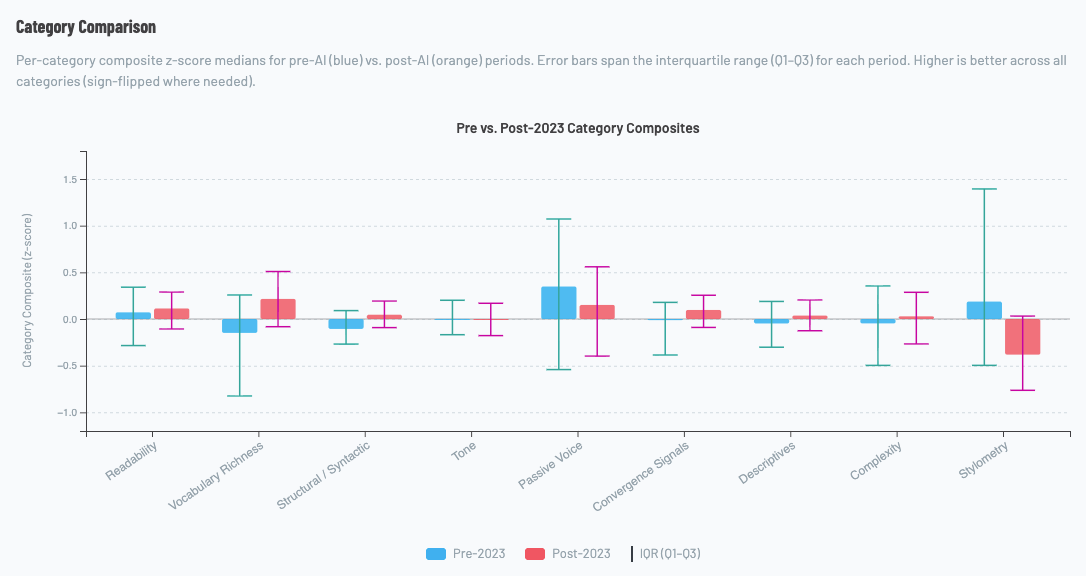
We see in general readability has improved, especially in the top 25% of content, vocabulary richness has improved, structural writing has improved, passive voice has decreased, descriptives have improved, writing complexity and uniqueness has improved. We do see that convergence signals and stylometry have decreased, meaning that there’s more writing that may share similar authorship (i.e. AI).
What’s interesting is when we dig down into the topics. Using those same metrics, here’s what the legacy B2B market of angular ball bearings – which shows no indication of heavy AI usage – looks like:
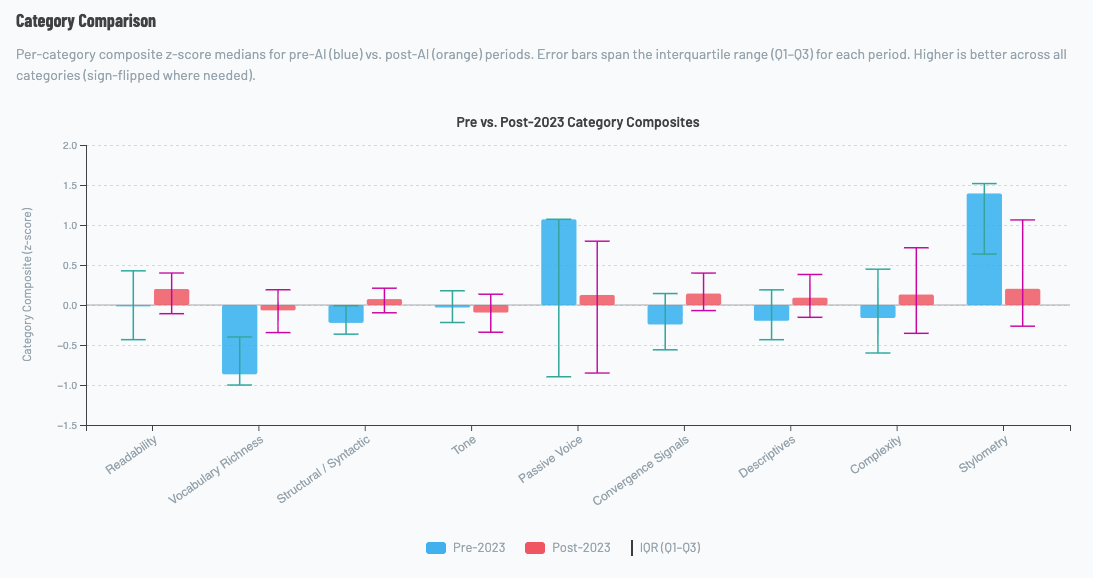
We see similar improvements in most categories, but a massive drop in stylistic differences; this generally indicates authorship uniqueness is declining. In the case of angular ball bearings, this may mean a convergence of writing styles with or without AI.
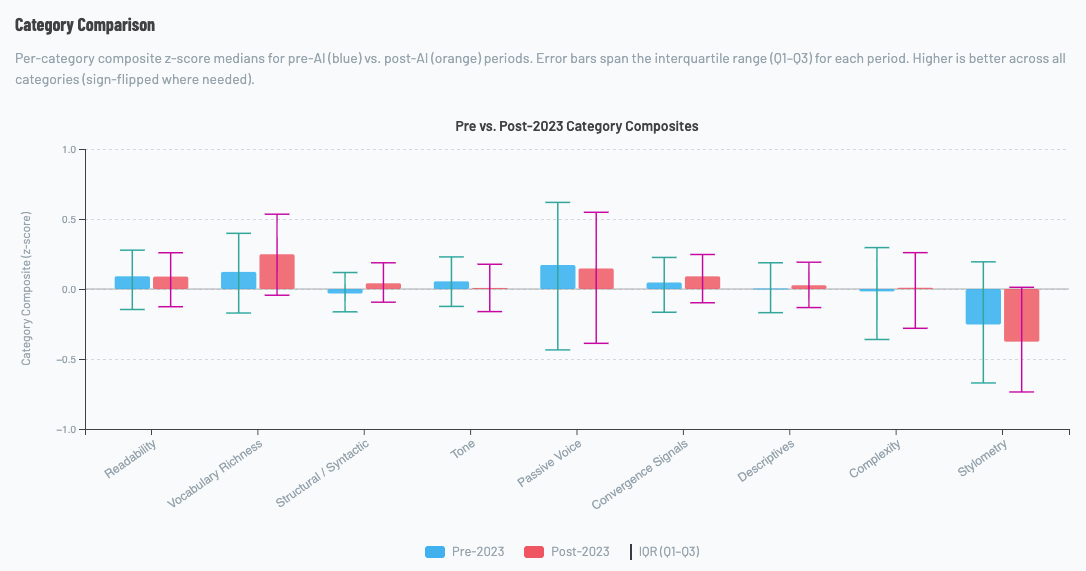
On the other hand, when we look at good ol’ digital transformation as a topic, we see marked increases in most metrics and something unusual: for the top 25% of content, uniqueness of authorship remains the same for pre and post AI. This means that while AI is in heavy use (as seen by the sheer volume increases last week), it’s not damaging the top 25% of content in the space even as the amount of content has gone up 10x.
What can we conclude from these metrics and measures? First, while writing style and writing quality are notoriously difficult to measure, there are decades of research on what constitutes better vs. worse writing, from uniqueness to richness of diction, complexity, etc. The 49 metrics we analyzed in this represent an ensemble of the different measures to mitigate the strengths and weaknesses of any one metric.
Second, the hypothesis that writing quality has declined in the post AI world is disproven. Writing quality in general has improved since the advent of generative AI, and that’s a good thing. Better quality writing improves the value of the craft of writing, whether you use AI or not – the more people become accustomed to improved writing quality, the more they’ll value it.
Third, these writing quality measures are something you can implement in your own work. When you work with AI to write, instead of just saying “help me improve my writing”, you can give AI the list of the 48 metrics we’ve compiled, ask your ideal customer profile (ICP) which metrics are most important to them in terms of writing quality, and then use the metrics to assess your own writing – and have AI help you improve it. If, for example, your ICP says that readability is vitally important to them, and you have a readability target of something like grade 8 in Flesch-Kincaid readability, AI can help you achieve that target by taking your original human-led writing and adjusting it.
Writing quality is important. If, as it seems, people are using AI to improve it across all categories but especially the highest quality quartile of writing, that benefits everyone.

- New!💡 Case Study: Predictive Analytics for Revenue Growth
- Case Study: Exploratory Data Analysis and Natural Language Processing
- Case Study: Google Analytics Audit and Attribution
- Case Study: Natural Language Processing
- Case Study: SEO Audit and Competitive Strategy

Almost every AI course is the same, conceptually. They show you how to prompt, how to set things up – the cooking equivalents of how to use a blender or how to cook a dish. These are foundation skills, and while they’re good and important, you know what’s missing from all of them? How to run a restaurant successfully. That’s the big miss. We’re so focused on the how that we completely lose sight of the why and the what.
This is why our capstone course, the AI-Ready Strategist, is different. It’s not a collection of prompting techniques or a set of recipes; it’s about why we do things with AI. AI strategy has nothing to do with prompting or the shiny object of the day — it has everything to do with extracting value from AI and avoiding preventable disasters. This course is for everyone in a decision-making capacity because it answers the questions almost every AI hype artist ignores: Why are you even considering AI in the first place? What will you do with it? If your AI strategy is the equivalent of obsessing over blenders while your steakhouse goes out of business, this is the course to get you back on course.
👉 Take this course now to become an AI leader

Here’s a roundup of who’s hiring, based on positions shared in the Analytics for Marketers Slack group and other communities.
- Digital Marketing Director at SBA Fintech LLP
- Director Of Agentic Marketing Systems at Huzzle.com
- Director Of Audience Growth And Conversion at Marriage Recovery Center
- Director Of Seo at adly
- Head Of Growth Marketing (Remote) at Roadpass Digital
- Head Of Growth at The Sage Group
- Head Of Marketing at Stealth Startup
- Head Of Seo at Wpromote
- Marketing Director at Momence
- Marketing Director at Strados Labs
- Senior Director, Marketing Strategy at Her Campus Media
- Strategy Director at 829 Studios

Are you a member of our free Slack group, Analytics for Marketers? Join 4000+ like-minded marketers who care about data and measuring their success. Membership is free – join today. Members also receive sneak peeks of upcoming data, credible third-party studies we find and like, and much more. Join today!

Where can you find Trust Insights face-to-face?
- SSI, Charlotte, April 2026
- SMPS AEC.AI, November 2026
Going to a conference we should know about? Reach out!
Want some private training at your company? Ask us!

First and most obvious – if you want to talk to us about something specific, especially something we can help with, hit up our contact form.
Where do you spend your time online? Chances are, we’re there too, and would enjoy sharing with you. Here’s where we are – see you there?
- Our blog
- Slack
- YouTube
- In-Ear Insights on Apple Podcasts
- In-Ear Insights on Google Podcasts
- In-Ear Insights on all other podcasting software
Read our disclosures statement for more details, but we’re also compensated by our partners if you buy something through us.
Imagine a world where your marketing strategies are supercharged by the most cutting-edge technology available – Generative AI. Generative AI has the potential to save you incredible amounts of time and money, and you have the opportunity to be at the forefront. Get up to speed on using generative AI in your business in a thoughtful way with our workshop offering, Generative AI for Marketers.
Workshops: Offer the Generative AI for Marketers half and full day workshops at your company. These hands-on sessions are packed with exercises, resources and practical tips that you can implement immediately.
👉 Click/tap here to book a workshop

Some events and partners have purchased sponsorships in this newsletter and as a result, Trust Insights receives financial compensation for promoting them. Read our full disclosures statement on our website.

Thanks for subscribing and supporting us. Let us know if you want to see something different or have any feedback for us!
|
Need help with your marketing AI and analytics? |
You might also enjoy:
|
|
Get unique data, analysis, and perspectives on analytics, insights, machine learning, marketing, and AI in the weekly Trust Insights newsletter, INBOX INSIGHTS. Subscribe now for free; new issues every Wednesday! |
Want to learn more about data, analytics, and insights? Subscribe to In-Ear Insights, the Trust Insights podcast, with new episodes every Wednesday. |
Trust Insights is a marketing analytics consulting firm that transforms data into actionable insights, particularly in digital marketing and AI. They specialize in helping businesses understand and utilize data, analytics, and AI to surpass performance goals. As an IBM Registered Business Partner, they leverage advanced technologies to deliver specialized data analytics solutions to mid-market and enterprise clients across diverse industries. Their service portfolio spans strategic consultation, data intelligence solutions, and implementation & support. Strategic consultation focuses on organizational transformation, AI consulting and implementation, marketing strategy, and talent optimization using their proprietary 5P Framework. Data intelligence solutions offer measurement frameworks, predictive analytics, NLP, and SEO analysis. Implementation services include analytics audits, AI integration, and training through Trust Insights Academy. Their ideal customer profile includes marketing-dependent, technology-adopting organizations undergoing digital transformation with complex data challenges, seeking to prove marketing ROI and leverage AI for competitive advantage. Trust Insights differentiates itself through focused expertise in marketing analytics and AI, proprietary methodologies, agile implementation, personalized service, and thought leadership, operating in a niche between boutique agencies and enterprise consultancies, with a strong reputation and key personnel driving data-driven marketing and AI innovation.
 Newsletter
 Podcast