INBOX INSIGHTS: 7D AI Product Launch Framework, Citizen Analyst Part 4 (2026-03-04) :: View in browser
👉 Take our new GEO 101 for Marketers course!
Watch This Newsletter

🎧 Listen to this newsletter as an MP3
Why We Rebuilt the 7D Product Marketing Launch Framework for the AI Era
Everyone’s using generative AI to launch products faster. But faster doesn’t mean better — unless you have a system.
There’s a pattern playing out right now that should worry you.
Teams are spinning up new apps, new features, new products — sometimes in days instead of months — because generative AI has compressed the build cycle dramatically. What used to take a quarter now takes a sprint. The barrier to creating something has never been lower.
And yet, most of these launches still fail.
Not because the product was bad. Not because the team wasn’t talented. They fail because speed without structure is just organized chaos. You shipped faster, congratulations. But did you validate demand first? Did you define requirements from actual customer data? Did you have a measurement plan before you hit “publish”?
That’s why we rebuilt the 7D Product Marketing Launch Framework for 2026. Not because the original framework was broken — it’s guided hundreds of successful launches since we first published it. We rebuilt it because the world around it changed, and frameworks that don’t evolve become artifacts.
The Problem with “Just Ship It”
Here’s what we’re seeing in the market right now: teams using ChatGPT to write launch copy, using AI to generate landing pages, using Midjourney for product visuals — and then wondering why conversions are flat and churn is high.
The tooling got better. The thinking didn’t.
Generative AI gave everyone a faster engine, but most teams are still driving without a map. They’re optimizing individual steps — write this email faster, generate this ad creative faster — without asking whether those steps are even the right ones, in the right order, aimed at the right audience.
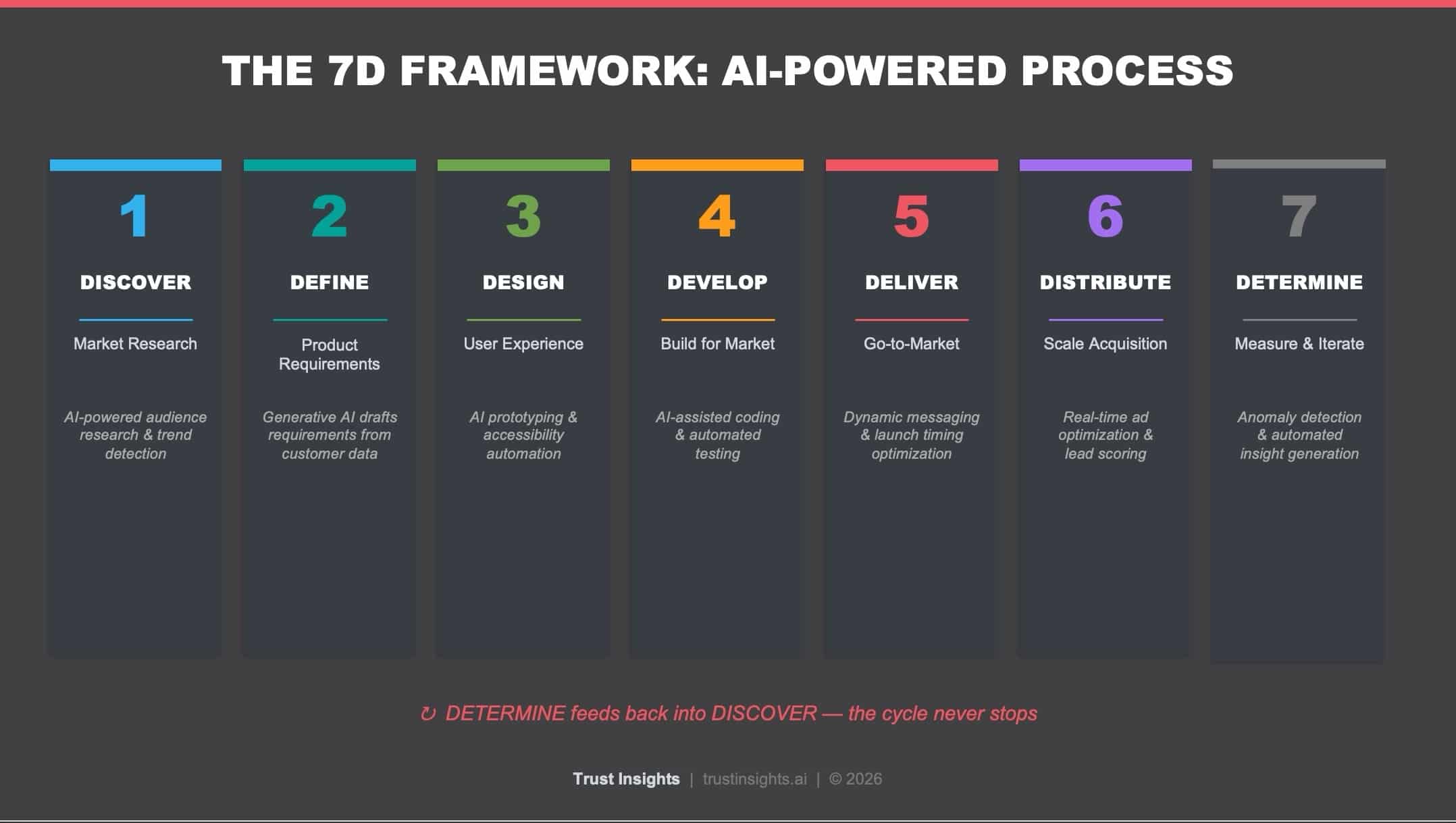
This is the gap the 7D Framework was always designed to fill. It’s not a checklist. It’s an operating system for product launches that forces you to think sequentially: Discover, Define, Design, Develop, Deliver, Distribute, Determine. Each step builds on the one before it. Skip one, and the whole thing wobbles.
The 7Ds: What the Framework Actually Is
Before we get into what changed, let’s ground this. The 7D Framework is a sequential operating system for product launches. Each step feeds the next. Here’s what each D does and how AI transforms it in 2026:
- DISCOVER — Validate Market Demand. Before you build anything, you need to know the market actually wants it. This means audience research, competitive analysis, trend detection. In 2026, AI can analyze thousands of online conversations, Reddit threads, review sites, and social posts to surface demand signals you’d never find manually. That’s not faster research. That’s different research. Are you reading the market, or guessing at it?
- DEFINE — Translate Needs into Requirements. Once you know what the market wants, you translate that into product specs. What features matter? What’s the positioning? Generative AI can now draft requirements directly from your research data — not from a PM’s gut feeling. Predictive modeling shows which features will actually drive adoption before you write a single line of code. Do your product requirements come from data, or from the loudest voice in the room?
- DESIGN — Remove Friction from the Experience. This is where you map the user journey — wireframes, user flows, microcopy, accessibility. AI assists with prototyping and accessibility checks, compressing iteration cycles from weeks to days. The goal isn’t a prettier interface. It’s a frictionless path from “I’m interested” to “I’m a customer.” How many clicks does it take to get from your landing page to a conversion?
- DEVELOP — Build for Market, Not for Ego. Ship quality while moving fast. AI-assisted coding handles boilerplate. Automated testing catches bugs. Predictive analytics forecast delays before they blow up your timeline. The 2026 upgrade here is speed without sacrifice — you move faster and catch problems earlier. Is your development timeline based on reality or optimism?
- DELIVER — Convince the Market You Exist. This is go-to-market execution: content, campaigns, messaging, channels. AI powers content creation across all channels simultaneously. Dynamic personalization shows each customer segment different messaging based on their behavior and intent. You’re not blasting one message to everyone anymore. When was the last time you tested whether your launch messaging actually resonated?
- DISTRIBUTE — Scale Acquisition. Getting attention is one thing. Converting it at scale is another. Real-time AI ad optimization adjusts spend and targeting on the fly. Predictive lead scoring tells your sales team who’s actually ready to buy instead of who just downloaded a whitepaper. Content auto-repurposes across formats so one piece of work becomes ten. Are you scaling what works, or just spending more?
- DETERMINE — Measure and Iterate. This is the step most teams skip, and it’s the one that matters most. Measure everything. AI dashboards surface insights automatically. Anomaly detection flags problems in real time — you don’t wait for a quarterly review to find out your launch underperformed. Churn prediction identifies at-risk customers before they leave. If you’re not measuring from day one, you’re not marketing — you’re guessing. What’s your plan for knowing whether this worked?
The sequence matters. Each D builds on the one before it. Skip DISCOVER and your DEFINE is based on assumptions. Skip DETERMINE and you’ll never know what actually worked. The framework forces the discipline that most teams abandon when they’re moving fast.
Why Now? Because AI Changed the Equation — Twice
The first wave of AI in product marketing was about automation. Speed up what you’re already doing. That wave hit in 2023-2024, and it was useful but limited.
The second wave — the one we’re in now — is about augmentation. AI doesn’t just do the work faster. It does work you couldn’t do before. You just saw it in every step above: AI doesn’t replace the thinking in each D, it amplifies it. You still need the framework to know what to think about. AI helps you think about it faster, deeper, and with better data.
This is what we mean when we say we “rebuilt” the framework. The seven steps didn’t change. The sequence didn’t change. What changed is what’s possible inside each step when you layer AI into the process intentionally.
Generative AI Supports the Framework. It Doesn’t Replace It.
This is the point we keep coming back to, because it’s the most misunderstood idea in marketing right now.
Generative AI is not a strategy. It’s a capability. And capabilities without a framework are just expensive experiments.
You can use AI to generate a hundred variations of launch messaging in an afternoon. Great. But which messaging is right? That depends on whether you did the DISCOVER work to understand your audience. It depends on whether you did the DEFINE work to clarify your positioning. It depends on whether you have a DETERMINE plan to measure what’s actually working.
AI accelerates every step. But you still have to take every step.
Think of it this way: a power drill is faster than a screwdriver. But a power drill doesn’t tell you where the screws go. The framework is the blueprint. AI is the power tool. You need both.
When teams use generative AI within a structured framework like the 7D, the results compound. They launch faster and smarter. They catch misalignment earlier. They measure outcomes from day one instead of retrofitting analytics after the fact.
When teams use generative AI without a framework, they just produce more stuff. More content. More variants. More noise. And they burn through budget faster while doing it.
What’s Actually New in the 2026 Version
We didn’t just add the word “AI” to each step and call it a refresh. Here’s what’s substantively different:
- AI is integrated into every phase, not bolted on. Each of the 7Ds now includes specific guidance on how generative AI, predictive analytics, and machine learning tools change what’s possible in that step. This isn’t theory — it’s based on how we use these tools with clients every day.
- The measurement framework got a complete overhaul. DETERMINE was always the most neglected step. In the 2026 version, we built out a full measurement plan with GA4 event tracking, anomaly detection guidance, and real-time dashboard recommendations. If you’re not measuring, you’re not marketing — you’re guessing.
- The downloadable one-sheet is designed for actual use. The new PDF isn’t a brochure. It’s a reference sheet you can print, pin to your wall, or share with your team as a forcing function. One page, all seven steps, with the AI integration points highlighted.
The Bottom Line
Every team is going to use AI to launch products in 2026. That’s not a competitive advantage anymore. The advantage goes to teams that use AI within a system — one that ensures you’re building the right thing, for the right people, with the right messaging, and measuring the right outcomes.
The 7D Framework is that system. It’s been validated across hundreds of launches. And now it’s been modernized for a world where AI isn’t optional — it’s the baseline.
The question isn’t whether you should use AI in your product launches. You should. The question is whether you have a framework that tells AI what to do.
Product launches don’t fail because of execution. They fail because of misalignment. Generative AI makes you faster, but only a system makes you right. The 7D Framework is the system that makes alignment possible — now powered by the very AI tools it helps you deploy.
Speed without structure is just expensive chaos.
Go here to get your copy of the 7D Product Launch Framework for free
How are you launching products in 2026? Reply to this email or join the conversation in our Free Slack community, Analytics for Marketers!
– Katie Robbert, CEO
Weekly Check-In Poll
Please click/tap on just one answer – this is our weekly survey to see how we’re doing, so please do take it. There are no forms to fill out, this is the entire thing. One click/tap and you’re done, with our thanks.
How likely are you to recommend Trust Insights as a consulting firm to someone in the next 90 days?

Do you have a colleague or friend who needs this newsletter? Send them this link to help them get their own copy:
https://www.trustinsights.ai/newsletter

In this episode of In-Ear Insights, the Trust Insights podcast, Katie and Chris discuss the AI wars and why relying on a single AI vendor can jeopardize your business continuity. You’ll learn why relying on a single AI vendor can jeopardize your business continuity. You’ll discover how to build an abstraction layer that lets you swap models without rebuilding your workflows. You’ll see practical no‑code tools and open‑weight models you can use as a safety net. You’ll understand the essential documentation and backup practices that keep your AI agents running. Watch the full episode to protect your AI strategy.
Watch/listen to this episode of In-Ear Insights here »
Last time on So What? The Marketing Analytics and Insights Livestream, we looked at agentic AI for strategic analysis. Catch the episode replay here!
This week on So What? we’ll be helping you understand if you have a GEO problem. Are you following our YouTube channel? If not, click/tap here to follow us!

Here’s some of our content from recent days that you might have missed. If you read something and enjoy it, please share it with a friend or colleague!
- Why Everyone Hates the CEO
- INBOX INSIGHTS: Planning Without Doing, Citizen Analyst Part 3 (2026-02-25)
- In-Ear Insights: How to Turn Plans into Results
- End of Year Purchases
- A Perfect Dumpster Fire Storm
- Almost Timely News: 🗞️ How to Use Generative AI For Retail Analytics (2026-03-01)

Take your skills to the next level with our premium courses.
- 🤖 New! GEO 101 for Marketers
- 🎯 The AI-Ready Strategist
- 💥 Generative AI Use Cases for Marketers
- 💡 Mastering Prompt Engineering for Marketers
- 🦾 Generative AI for Marketers
- 📊 Google Analytics 4 for Marketers
- 🔎 Google Search Console for Marketers

Get skilled up with an assortment of our free, on-demand classes.
- 👉 New! Watch Katie Robbert’s MarketingProfs B2B Forum talk, Driving B2B Growth with AI
- How to Successfully Apply AI in Financial Aid, from MASFAA 2025
- From Text to Video in Seconds, a session on AI video generation
- Never Think Alone: How AI Has Changed Marketing Forever (2025)
- Generative AI for Tourism and Destination Marketing (2025)

You could be reaching 37,000+ marketers, analysts, data scientists, and executives directly with your ad. Want to learn more? Reach out and contact us.

In this week’s Data Diaries, we’ll finish up our series on the Citizen Analyst. The first three parts are here.
Last time, we looked at the transformation of raw data into something useful, such as turning it into a predictive analytics forecast. This week, we finish the series by working with the data it produced.
One of the most difficult and important parts of data analysis is doing something with the data. For years at Trust Insights, we’ve said data without decisions is decoration, meaning that you have to do something with your data. Analysis without action is distraction.
Here’s the good news: generative AI makes it easier than ever to transform data into decisions by turning the quantitative information into something easier for our brains to understand.
Last week, we used Google’s Gemini to perform time-series forecasting on Google Trends data to help our charity of choice, Baypath Humane Society, understand when search interest would be greater or lesser throughout the next year. Gemini created an incredible ensemble of very sophisticated statistical modeling techniques.
However, what came out is unusable to the layperson, especially to a non-technical stakeholder. We have to convert data into decisions for them, and hand off both the data and the decisions. How? By letting generative AI process the data for us and turn it into an action plan.
This is an example of the starter prompt you’d use, right in the same chat from the previous week.
Using the statistical forecast generated, our next goal is to convert the forecast into an action plan for Baypath Humane Society. We need two forecasts – one is a staffing forecast to help the shelter staff appropriately, and the other is a marketing forecast to help the shelter deploy limited marketing dollars and resources. In the spreadsheet generated, the columns we care about are the date column, the Overall_Interest_Forecast, Dog_Interest_Forecast, and Cat_Interest_Forecast columns, as the shelter has specialized staff for the different animals. Using the highs and lows in each of these series, create a shelter staffing schedule for the top 5 busiest weeks overall, for dogs, and for cats, and a staffing schedule for the 5 least busy weeks overall, for dogs, and for cats. This will help us let staff know when the best time to plan time off is. Then, using the same data, create marketing plans specifically for emails and texts to our audience for those same three categories – all, dogs, and cats – that let us know when we should be sending out email marketing campaigns for people to adopt. Your final outputs should be HTML with CSS and client side JS using CDNJS in the Canvas. Ask me questions until you have enough information to successfully complete the task.
With this guidance, Gemini asks a few clarifying questions and then produces a very nice, easy to understand forecast:
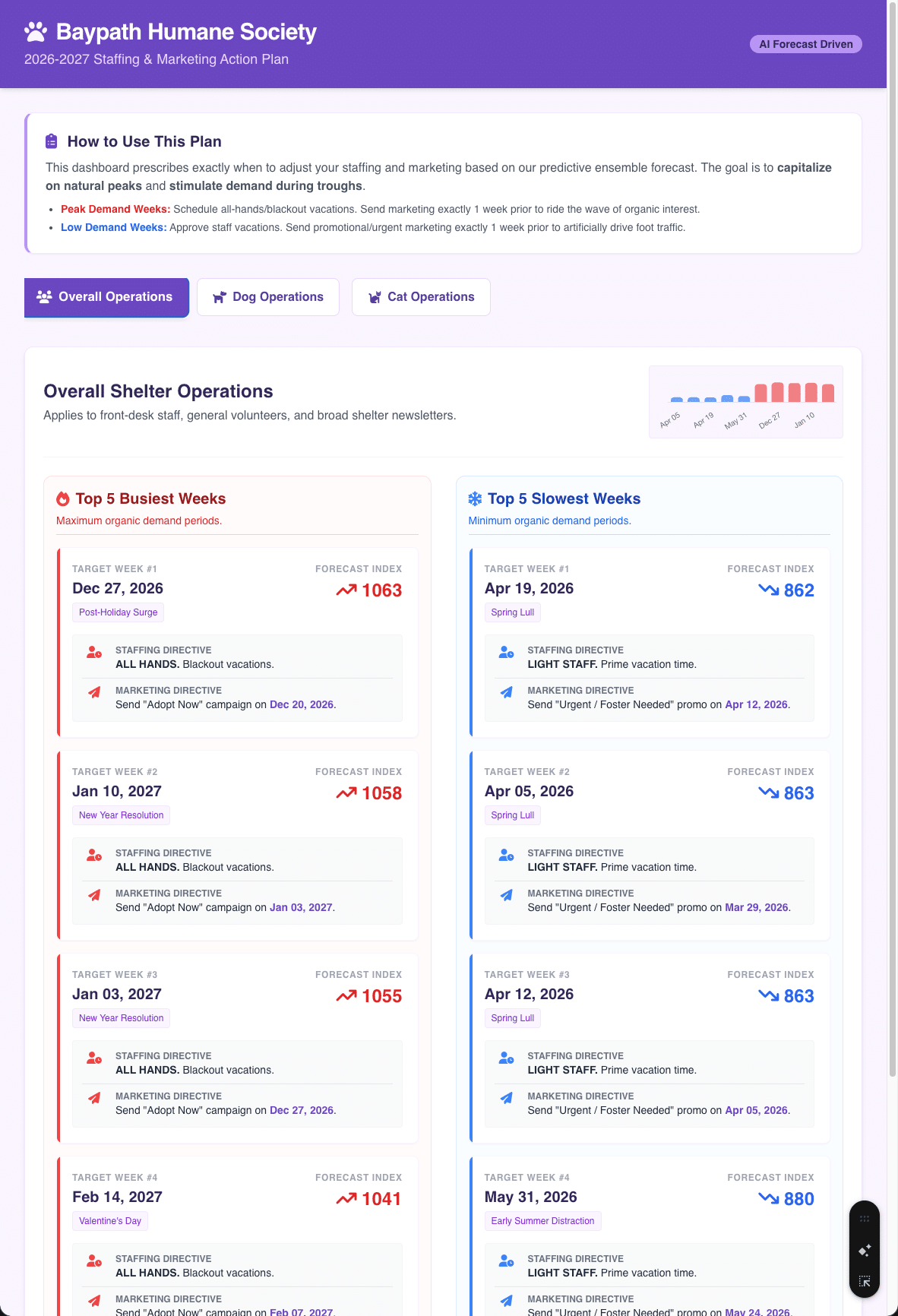
Now, instead of a very difficult to read time series forecast, we’ve turned our data into decisions.
This is the ultimate aim of any citizen analyst, to take raw data, extract value from it, and convert it into formats that people can use immediately for the greater good.
The citizen analyst is someone who uses their data superpowers for good outside of work; as we’ve seen in the past few issues, there’s no shortage of data, but there’s a significant shortage of people willing to dedicate their time and expertise to data analysis for organizations and causes that can’t afford the help otherwise. With generative AI, these abilities are within reach of people who aren’t especially technical but know the right questions to ask and what the right answers generally look like. I hope we’ve inspired you to lend a helping hand to the causes of your choice.

- New!💡 Case Study: Predictive Analytics for Revenue Growth
- Case Study: Exploratory Data Analysis and Natural Language Processing
- Case Study: Google Analytics Audit and Attribution
- Case Study: Natural Language Processing
- Case Study: SEO Audit and Competitive Strategy

Almost every AI course is the same, conceptually. They show you how to prompt, how to set things up – the cooking equivalents of how to use a blender or how to cook a dish. These are foundation skills, and while they’re good and important, you know what’s missing from all of them? How to run a restaurant successfully. That’s the big miss. We’re so focused on the how that we completely lose sight of the why and the what.
This is why our new course, the AI-Ready Strategist, is different. It’s not a collection of prompting techniques or a set of recipes; it’s about why we do things with AI. AI strategy has nothing to do with prompting or the shiny object of the day — it has everything to do with extracting value from AI and avoiding preventable disasters. This course is for everyone in a decision-making capacity because it answers the questions almost every AI hype artist ignores: Why are you even considering AI in the first place? What will you do with it? If your AI strategy is the equivalent of obsessing over blenders while your steakhouse goes out of business, this is the course to get you back on course.
👉 Take this course now to become an AI leader

Here’s a roundup of who’s hiring, based on positions shared in the Analytics for Marketers Slack group and other communities.
- Director Of Customer Marketing at Keeper Security, Inc.
- Director Of Product Marketing at SmartSimple Software
- Director Of Product Marketing at easy
- Director, Portfolio Product Marketing at Outreach
- Director, Strategy at Point Wild
- Head Of Growth & Marketing at Arcana
- Senior Director Of Product Marketing at Bitwarden
- Senior Director, Business Intelligence And Data at LRN
- Staff Product Manager, Martech at Headspace
- Svp Of Marketing at Hyperproof
- Vice President Marketing at SiteVue AI
- Vice President Of Marketing at Buckingham Search

Are you a member of our free Slack group, Analytics for Marketers? Join 4000+ like-minded marketers who care about data and measuring their success. Membership is free – join today. Members also receive sneak peeks of upcoming data, credible third-party studies we find and like, and much more. Join today!

Where can you find Trust Insights face-to-face?
- SSI, Charlotte, April 2026
- SMPS AEC.AI, November 2026
Going to a conference we should know about? Reach out!
Want some private training at your company? Ask us!

First and most obvious – if you want to talk to us about something specific, especially something we can help with, hit up our contact form.
Where do you spend your time online? Chances are, we’re there too, and would enjoy sharing with you. Here’s where we are – see you there?
- Our blog
- Slack
- YouTube
- In-Ear Insights on Apple Podcasts
- In-Ear Insights on Google Podcasts
- In-Ear Insights on all other podcasting software
Read our disclosures statement for more details, but we’re also compensated by our partners if you buy something through us.
Imagine a world where your marketing strategies are supercharged by the most cutting-edge technology available – Generative AI. Generative AI has the potential to save you incredible amounts of time and money, and you have the opportunity to be at the forefront. Get up to speed on using generative AI in your business in a thoughtful way with our workshop offering, Generative AI for Marketers.
Workshops: Offer the Generative AI for Marketers half and full day workshops at your company. These hands-on sessions are packed with exercises, resources and practical tips that you can implement immediately.
👉 Click/tap here to book a workshop

Some events and partners have purchased sponsorships in this newsletter and as a result, Trust Insights receives financial compensation for promoting them. Read our full disclosures statement on our website.

Thanks for subscribing and supporting us. Let us know if you want to see something different or have any feedback for us!
|
Need help with your marketing AI and analytics? |
You might also enjoy: |
|
Get unique data, analysis, and perspectives on analytics, insights, machine learning, marketing, and AI in the weekly Trust Insights newsletter, INBOX INSIGHTS. Subscribe now for free; new issues every Wednesday! |
Want to learn more about data, analytics, and insights? Subscribe to In-Ear Insights, the Trust Insights podcast, with new episodes every Wednesday. |
Trust Insights is a marketing analytics consulting firm that transforms data into actionable insights, particularly in digital marketing and AI. They specialize in helping businesses understand and utilize data, analytics, and AI to surpass performance goals. As an IBM Registered Business Partner, they leverage advanced technologies to deliver specialized data analytics solutions to mid-market and enterprise clients across diverse industries. Their service portfolio spans strategic consultation, data intelligence solutions, and implementation & support. Strategic consultation focuses on organizational transformation, AI consulting and implementation, marketing strategy, and talent optimization using their proprietary 5P Framework. Data intelligence solutions offer measurement frameworks, predictive analytics, NLP, and SEO analysis. Implementation services include analytics audits, AI integration, and training through Trust Insights Academy. Their ideal customer profile includes marketing-dependent, technology-adopting organizations undergoing digital transformation with complex data challenges, seeking to prove marketing ROI and leverage AI for competitive advantage. Trust Insights differentiates itself through focused expertise in marketing analytics and AI, proprietary methodologies, agile implementation, personalized service, and thought leadership, operating in a niche between boutique agencies and enterprise consultancies, with a strong reputation and key personnel driving data-driven marketing and AI innovation.
 Newsletter
 Podcast